The story you read tonight has been on the road for a very long time. Cinderella was losing her shoe in China in the ninth century; the plot of Beauty and the Beast is a Roman novel from the second; Puss in Boots was first printed in a Venetian tavern-book in 1550. None of those versions was meant for a child. What we now call a fairy tale is the result of four or five distinct moments when someone wrote the old stories down for a new audience, and each moment changed them. This guide walks those moments in order, from the fireside to the bedside, and points to the fuller guides on each collector and to the tales themselves in the classic tales section.
Before anyone wrote them down
Folk tales are oral by nature, so the earliest we can trace them is the first time someone happened to write one on something that survived. The Egyptian Tale of Two Brothers, on a papyrus from around 1200 BC, already has a wife's false accusation, a magical transformation and a heart hidden outside the body, a motif that turns up two thousand years later in the Norwegian Giant Who Had No Heart in His Body. The Indian Panchatantra, assembled somewhere between 300 BC and AD 500, is a chain of animal fables inside a frame story, and it travelled west through Persian and Arabic translations until its beasts were indistinguishable from Aesop's. In the second century AD the Roman writer Apuleius folded a complete fairy tale into his novel The Golden Ass: Cupid and Psyche, in which a girl is married to an unseen husband, breaks a rule, loses him, and wins him back through impossible tasks. That is the skeleton of East of the Sun and West of the Moon, of Beauty and the Beast, and of a hundred other tales folklorists file under the same type number.
What these early records show is that the plots are far older than any book, and that they were told to grown-ups. A Roman reader of Apuleius was not being put to bed. Neither were the medieval listeners who heard versions of Red Riding Hood in which the girl, unaided, tricks the wolf and escapes. The idea that these are stories for children came very late, and it came from print.
Italy, 1550–1636: the first fairy-tale books
The first European books that look like fairy-tale collections were Italian, and neither was for the nursery. Giovanni Francesco Straparola's Le piacevoli notti (The Pleasant Nights, Venice, 1550–53) is a set of stories told over thirteen nights by a company of ladies and gentlemen, and among the bawdy jokes and novellas are a handful of genuine wonder tales, including one about a poor boy whose clever cat makes his fortune. Eighty years later Giambattista Basile, a Neapolitan courtier, wrote Lo cunto de li cunti (The Tale of Tales, published 1634–36, later known as the Pentamerone) in thick Neapolitan dialect: fifty stories that include the earliest full versions of Cinderella, Sleeping Beauty, Rapunzel and Puss in Boots. Basile's Sleeping Beauty is not woken by a kiss; his Cinderella breaks her first stepmother's neck with a chest lid. These are adult, satirical, ornate and often very funny. They mattered because the French writers who came next had read them.
Paris, 1697–1717: Perrault, the salon and the Arabian Nights
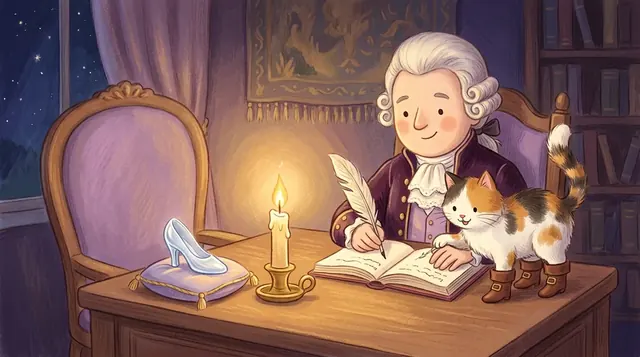
The fairy tale got its name in Paris in 1697. That year Madame d'Aulnoy published Les Contes des fées, coining the phrase conte de fées, and Charles Perrault published Histoires ou contes du temps passé, eight prose tales with rhymed morals, under the name of his teenage son. Perrault's eight are the ones everybody knows: Sleeping Beauty, Little Red Riding Hood, Bluebeard, Puss in Boots, The Fairies, Cinderella, Riquet with the Tuft and Little Thumb. He gave Cinderella her pumpkin, her fairy godmother and her glass slipper; he gave Red Riding Hood her red hood and her grim ending, with no huntsman to put it right. The frontispiece showed an old woman spinning by the fire beneath the words Contes de ma mère l'Oye, and that is where Mother Goose comes from.
These tales were written for a court that was bored with classical epic and amused by the idea of peasant stories retold with wit. Perrault's Cinderella forgives her sisters and marries them to lords, because a Versailles audience valued grace over vengeance. D'Aulnoy's tales, longer and stranger, are the source of The Blue Bird, The Yellow Dwarf and The White Doe on this site. The guide to Perrault and the French fairy tale goes through all eight of his stories and explains why the glass slipper is really glass.
The salon vogue also opened the door to the East. Between 1704 and 1717 Antoine Galland published the first European translation of The Thousand and One Nights, and he added to it stories he had heard in Paris from a Syrian traveller, Hanna Diyab, that are in no surviving Arabic manuscript of the Nights. Two of them were Aladdin and the Magic Lamp and Ali Baba and the Forty Thieves. The point for parents is that the most famous 'Arabian' tales reached us through a Frenchman writing down a Maronite storyteller's memory, which is how most fairy tales reached us: through somebody's ear and somebody else's pen.
Kassel, 1812: the Grimms collect
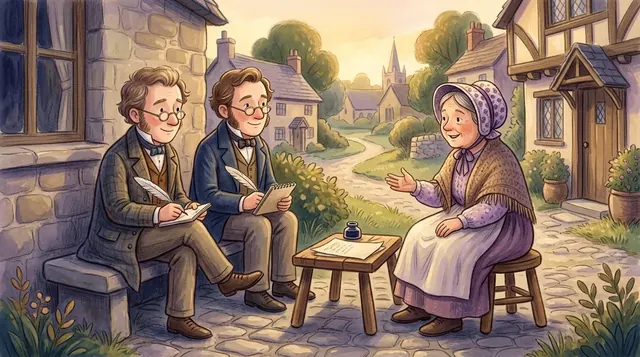
Jacob and Wilhelm Grimm did not set out to write a children's book. They were young philologists in Kassel, in the middle of the Napoleonic wars, who believed the old tales were fragments of a German past worth preserving before it vanished. They gathered stories from friends, neighbours and educated young women of their own circle, and from a few genuine storytellers such as the tailor's widow Dorothea Viehmann, and published the first volume of Kinder- und Hausmärchen in 1812 with a second in 1815. The scholarly notes were longer than some of the tales. Reviewers complained that the stories were coarse; the brothers listened, and across seven editions ending in 1857 Wilhelm rewrote them steadily, removing pregnancies, turning cruel mothers into stepmothers, and adding the pious sentences and folksy repetitions we now think of as the Grimm style. The guide to the brothers Grimm follows one tale through those revisions.
The Grimms are the reason the fairy tale became a children's genre at all. Their small edition of 1825, fifty tales chosen for the nursery and illustrated by their brother Ludwig Emil, sold far better than the scholarly one, and Edgar Taylor's English translation of 1823, German Popular Stories, with George Cruikshank's etchings, made Hansel and Gretel, Rumpelstiltskin and The Frog Prince English nursery property within a generation.
Copenhagen, 1835: Andersen invents
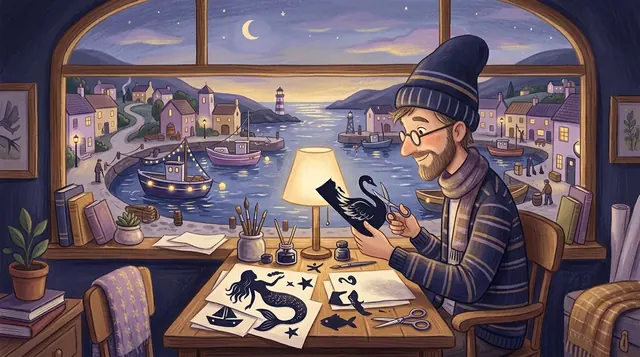
Hans Christian Andersen did something neither Perrault nor the Grimms had done: he made fairy tales up. His first thin booklet, Fairy Tales Told for Children, appeared in May 1835 with The Tinderbox, The Princess and the Pea and Little Ida's Flowers. Two of those reworked folk tales he had heard as a boy in Odense; the third was entirely his own, and from then on so were most of them. The Little Mermaid (1837), The Ugly Duckling (1843), The Snow Queen (1844) and The Little Match Girl (1845) have no folk source. They are literary fairy tales, and they introduced something the oral tradition rarely bothered with: an ending that might not be happy, and a narrator who is visibly sad about it. The guide to Andersen's life and stories shows how much of the shoemaker's son from Odense is in the duckling.
England, 1802–1853: the argument about whether children should have them
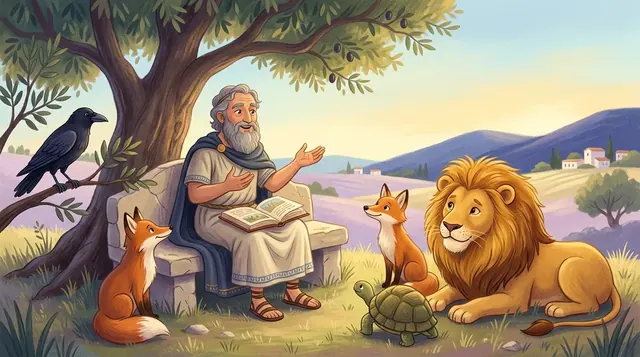
It is easy to assume fairy tales were always thought good for children. They were not. The educational reformers of the late eighteenth and early nineteenth centuries, following John Locke's advice that children should read only what was useful and true, regarded wonder tales as a bad influence. Sarah Trimmer's Guardian of Education (1802–06) warned parents against Cinderella for teaching envy and vanity, and against Red Riding Hood for frightening the young. The tales that were allowed in the nursery were fables, because a fable admitted it was a lesson; the guide to Aesop and his fables explains why The Tortoise and the Hare passed the censors when Sleeping Beauty did not.
The tide turned in the 1820s and 1830s, helped by Taylor's Grimm and by the Romantic conviction that imagination was a faculty to be fed. By 1853 Charles Dickens could publish an essay called 'Frauds on the Fairies' attacking his old illustrator Cruikshank for rewriting Cinderella as a temperance tract, and take it for granted that his readers agreed the tales should be left alone. A fairy tale, Dickens wrote, should be respected in 'its simplicity, and purity, and innocent extravagance, as if it were actual fact'. By then the nursery had won.
1889–1910: Lang gathers the world, and scholars count it
The Victorian fairy tale was an English-language business, and its great wholesaler was Andrew Lang. Between the Blue Fairy Book of 1889 and the Lilac Fairy Book of 1910 his twelve colour-named anthologies, largely translated and adapted by his wife Leonora Blanche Lang and her collaborators, brought Norwegian, Russian, Japanese, Romanian, Estonian and Arabic tales into British and American nurseries alongside Perrault and the Grimms. A surprising number of the less familiar classics on this site, Dapplegrim, The Enchanted Pig, Prince Hyacinth, come from Lang's books, and the guide to Andrew Lang and the coloured fairy books lists which came from where. The same decades produced Joseph Jacobs's English Fairy Tales (1890), which fixed Tom Tit Tot, Henny Penny and Jack and the Beanstalk in the form British children still hear.
By the time Lang was publishing, scholars had noticed that the tales he was gathering from opposite ends of the earth were often the same tale. Marian Roalfe Cox catalogued 345 versions of Cinderella in 1893. In 1910 the Finnish folklorist Antti Aarne published an index of tale types, expanded by Stith Thompson and later Hans-Jörg Uther into the Aarne–Thompson–Uther index that folklorists still use; Cinderella is ATU 510A, Beauty and the Beast is ATU 425C, and the girl who guesses the dwarf's name is ATU 500 whether he is called Rumpelstiltskin or Tom Tit Tot. The guide to folk tales around the world tours the best of these families, from the Chinese Yeh-Shen to the Zuni turkey girl.
Nursery rhymes have a parallel and shorter history: most were first printed between 1744 and 1810, and almost none of the lurid 'true meanings' attached to them survive contact with the evidence. The guide to the origins of nursery rhymes separates what is documented from what is guessed.
What this means for the story you read tonight
Three practical things follow from the history.
First, there is no 'original' version to be faithful to. Perrault's Red Riding Hood dies; the Grimms' is rescued; the medieval French peasant's escapes on her own. The version on this site, adapted for bedtime, is one more link in a chain that has always been adapted to the listener. Softening a tale for a four-year-old is not vandalism; it is the tradition. The guide to adapting a fairy tale for your child shows how to do it without losing the shape.
Second, the darkness is old and the sweetness is new. When a child asks why the witch has to go in the oven, the honest answer is that the story was made in a world where children really did go hungry and really were sent away, and that the tale exists to promise they can get home. The guide to fairy tales and fear takes that question seriously.
Third, the shape is the thing that survives. Across three thousand years of retelling, what persists is not the wording but the structure: a small person, an unfair situation, three tries, and a return. That is the shape children ask for, and it is the shape of every story in the classic section.
Where to start
To read the history in order across a week, start with an Aesop fable such as The Lion and the Mouse, then Perrault's Puss in Boots, then the Grimms' The Musicians of Bremen, then Andersen's The Ugly Duckling, then something from Lang's books such as East of the Sun and West of the Moon. Tell the child, in one sentence, where each one came from. Children who know that the story they are hearing was told in Naples four hundred years ago listen differently. The Brothers Grimm collection and the Andersen collection gather the retellings by author, and the classic tales section holds all of them.