A bedtime story looks like a small thing: ten minutes, one lamp, a child getting heavy against your arm. It is in fact the most efficient thing most families do all day. The same ten minutes feed a child's vocabulary, cue their sleep, rehearse other people's feelings, plant a set of values, exercise their imagination and prepare them for school, and each of those effects is stronger tomorrow because of what happened tonight. This guide walks through the six benefits in turn, says how confident you can be in the evidence for each, and points to the story on this site that shows it best.
People who write about bedtime stories tend to pick a favourite benefit and ignore the rest. Literacy charities talk about words, sleep clinics talk about routine, and the occasional philosopher talks about the moral education of the young. They are all right, and the remarkable thing is that the child gets all of it from the same sitting. Here is the list, roughly in order of how well each is evidenced:
- Language: vocabulary, grammar and listening comprehension.
- Sleep: a predictable, screen-free cue that the day is ending.
- Empathy: practice at imagining what someone else feels.
- Values: a sense of what is fair, brave, kind and foolish, learned from examples rather than instructions.
- Imagination: building a scene in the head from words alone.
- School readiness: attention, print awareness and the habit of sitting still for a story.
Underneath all six is a seventh that the research rarely measures because it is hard to put a number on: ten minutes of a parent's undivided attention, at the end of the day, every day. Children notice.
Language: the benefit with the strongest evidence
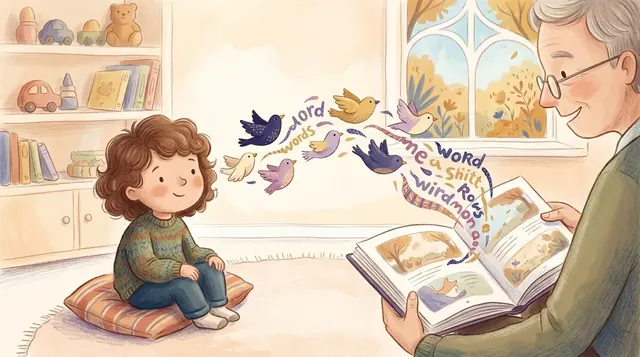
Written stories use words that spoken conversation does not. Nobody says glossy, flatter or cunning over breakfast, but all three turn up in The Fox and the Crow, a fable that takes under three minutes to read. Multiply that by a story a night and the arithmetic gets large quickly. Researchers at Ohio State University (Logan and colleagues, 2019) estimated, by counting the words in typical picture books, that a child read one book a day hears roughly 290,000 more words by the time they start school than a child who is never read to, and a child read five books a day hears over a million more. That finding is often confused with the older "30 million word gap" claim from Hart and Risley's 1995 study of spoken language in the home, which is real but has been strongly contested on sample size and method. The book-reading estimate rests on much simpler arithmetic and is the safer one to quote.
Words are only half of it. Story sentences are longer and more complex than anyone speaks aloud, and a child who hears "the wolf, who had been waiting behind the tree, stepped out onto the path" learns how a clause can be tucked inside a sentence long before a teacher explains what a clause is. Our guide to how bedtime stories build language goes through the mechanism in detail, including why the same story twenty nights running is doing more than a new story every night.
Sleep: the story is the cue, the routine is the engine
Parents often assume the story sends a child to sleep. It does help: a slow voice, a dim lamp and a familiar plot all lower arousal. But the research on children's sleep is clearer about something slightly different. What reliably shortens the time it takes a child to fall asleep, and reduces night wakings, is a consistent bedtime routine: the same few calm steps in the same order at roughly the same time. A story is the easiest final step to make consistent, because it has a natural ending built in, it involves no screen, and children will ask for it. Jodi Mindell's work on bedtime routines (a 2009 trial in the journal Sleep, and a 2018 review in Sleep Medicine Reviews) found that introducing a nightly routine improved sleep within a couple of weeks, and that the benefits held across cultures.
So the practical advice is not "find a sleepy story" but "put the story in the same slot every night". If the slot is settled, almost any story of the right length will do; if the slot moves around, even The Velveteen Rabbit read in a whisper will not fix it. We cover the mechanism, the screen problem and the evidence in why bedtime stories help children sleep.
Empathy: a safe rehearsal for someone else's feelings
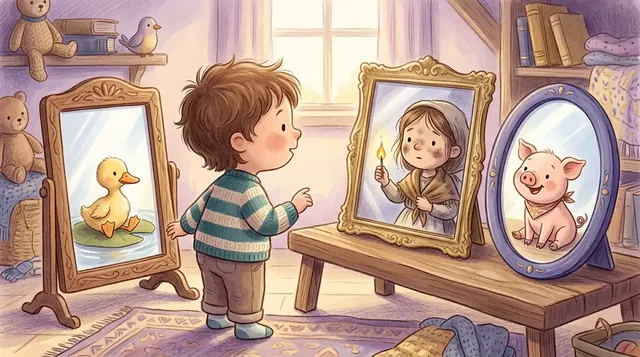
A child who listens to The Ugly Duckling spends ten minutes being pecked, laughed at and driven out of the yard, and then feels the relief of being recognised at the end. They have practised, from the inside, what it is like to be the one who does not fit. That is empathy in its most literal sense: feeling what another feels, and it is the thing most parents want most for their children and find hardest to teach directly.
Stories are good at it because they give the listener access to a character's inner life in a way real life never does. You cannot hear the thoughts of the child crying in the playground; you can hear the duckling's. Some psychology research (notably a 2013 study in Science by Kidd and Castano on adults reading literary fiction) suggested that fiction sharpens the ability to read other minds; that particular result proved hard to replicate, so treat the strong version of the claim with caution. What is not in doubt is that talking about characters' feelings during a story, using words like lonely, ashamed and relieved, gives children a vocabulary for feelings they cannot yet name, and that vocabulary is what they use to recognise those feelings in others. Every story page here has a "Talk about it" section with questions of that kind. The full argument, with more stories, is in how stories teach empathy.
Values: shown, not told
If you want a child to understand why lying is costly, you can explain it, or you can read The Boy Who Cried Wolf. The explanation takes a minute and is forgotten by morning. The fable takes three minutes and is remembered for life, because the child watches the lie, watches the villagers stop coming, and watches the sheep go. The moral is delivered by the plot, and then, because it is Aesop, stated in one line at the end. Fairy tales work the same way but skip the closing line: nobody in The Fisherman and His Wife says "greed is bad", but a child who has followed the wife from hovel to castle to papacy to hovel again does not need it said.
Children are not passive here. They argue with morals, and that is the point; a six-year-old who thinks the ant in The Ant and the Grasshopper should have shared is doing exactly the moral reasoning the story exists to provoke. Our guide to morals in children's stories goes through which stories state their lesson, which bury it, and how to talk about either without turning bedtime into a sermon.
Imagination: building the scene from words
A story told in words gives a child the outline of a scene and leaves them to fill it in. Where a cartoon shows a child exactly what a dragon looks like, a sentence such as "the dragon lay curled around the mountain like a scarf" makes the child build the dragon themselves, and every child builds a different one. A small brain-imaging study by John Hutton's group in Cincinnati (2018) compared preschoolers listening to a story as audio only, as illustrated pages and as animation, and found the illustrated version produced the most integrated activity across the brain's language, visual and imagination networks; the audio-only version seemed to be too little support for that age, and the animated version too much. The sample was small and the finding needs replicating, but it matches what parents see: a child watching a screen is absorbing, a child hearing a story is constructing.
The practical corollary is to leave room. Pause after a description and let the child tell you what the castle looks like. The space stories on this site, such as Moonlit Secrets of the Celestial Forest, are written with exactly that kind of gap in mind. More on this, and on what the research does and does not show, in bedtime stories and imagination.
School readiness: the easiest preparation there is
Reception teachers do not expect a child to arrive reading. They hope a child arrives able to sit and listen for ten minutes, follow a sequence of events, know that print runs left to right and that a book has a front, and have enough words to understand instructions and make friends. Every one of those is a by-product of bedtime stories. The American Academy of Pediatrics has recommended since 2014 that doctors advise all parents to read aloud from birth for exactly this reason. A long-running line of research by Monique Sénéchal and colleagues in Canada found that being read to at home in the preschool years predicted later vocabulary and reading comprehension, while parents teaching letters predicted early decoding; the two contributions were separate, and stories did the work nobody else was doing.
The school and first-day stories collection is the obvious place to look in the last weeks before September, but the preparation is really the habit itself. We set out what a reception teacher is actually looking for, and a twelve-week countdown, in reading aloud and school readiness.
Why the benefits compound
Each of the six benefits makes the others cheaper. A child with more words follows a longer story, so they can be read a richer one, so they get more words. A child who sleeps well is calmer at bedtime, so the story goes better, so the routine holds. A child who has felt the duckling's loneliness has a word for it when a classmate is left out, and a teacher who sees that child comfort a classmate sees a child who is ready for school. This is the reason the research on early reading keeps finding effects years later: not because one story does much, but because the habit runs for a decade and every night builds on the last.
It also explains the one rule that matters more than any other. Consistency beats quality. A dull story read every night beats a wonderful one read on Sundays. A parent who reads in a monotone with the wrong voices, every night, is doing more for their child than a gifted performer who manages it twice a week. If you can only fix one thing about bedtime, fix the regularity, and let everything else follow.
What the evidence is and is not
A short honesty section, because this topic attracts inflated claims. The strongest evidence is for language: the link between being read to and vocabulary is one of the most replicated findings in child development, and the mechanism (exposure to rare words and complex sentences) is well understood. The evidence for sleep is strong but is about routines, of which the story is one part. The evidence for empathy and values is more mixed and more dependent on how the story is read: a story with conversation about feelings does more than the same story read straight through. The brain-imaging work on imagination is early and small. School-readiness effects are real but are mostly the language and attention effects wearing a uniform.
What none of the good research finds is a particular book, method, voice or app that makes the difference. The variable that keeps mattering is whether a child is read to, by someone who talks with them about it, most nights, for years. That is available to every family on this site for free.
Tonight
Pick one story of the right length for the child and read it in the same slot as last night. If you want to see the benefits in action, try The Lion and the Mouse: three minutes long, four rare words, a feeling to name (the lion's surprise at being helped by something small) and a stated moral to argue about. Then ask one question from the "Talk about it" section and stop. Tomorrow, do it again. The whole library is sorted by age and length, and tonight's story is picked for you if choosing is one decision too many at 7.30pm.