A bedtime routine that works is short, dull and identical every night. It has four or five steps, it takes under half an hour, it always ends the same way, and after a fortnight the child's body starts getting ready for sleep at the first step without being told. That is the whole trick. The mistakes families make are almost never about choosing the wrong steps; they are about changing the steps, stretching the time, or letting the end of the routine turn into a negotiation. This guide sets out the template, shows how it changes from one to twelve, and explains how to mend it when it breaks.
Why the sequence matters more than the steps
Sleep is a habit before it is a decision. A young child cannot choose to feel sleepy, but their body can learn that a particular chain of events leads to the dark room, and it will begin the slide towards sleep as soon as the chain starts. That learning depends on repetition: the same steps, in the same order, at roughly the same time. Research on bedtime routines consistently finds that children who have one fall asleep faster and wake less, that the benefit shows up within a week or two, and that it is the regularity that predicts the improvement rather than any specific activity.
This is good news, because it means the routine can be built from whatever your household can actually repeat. A bath every night is a lovely step if you have the time and the hot water; a face wash with a warm flannel is an equally good step if you do not, and a routine that is kept every night beats a more elaborate one kept four nights out of seven. When you choose steps, choose the ones you can do at the end of your worst day.
The five-step template
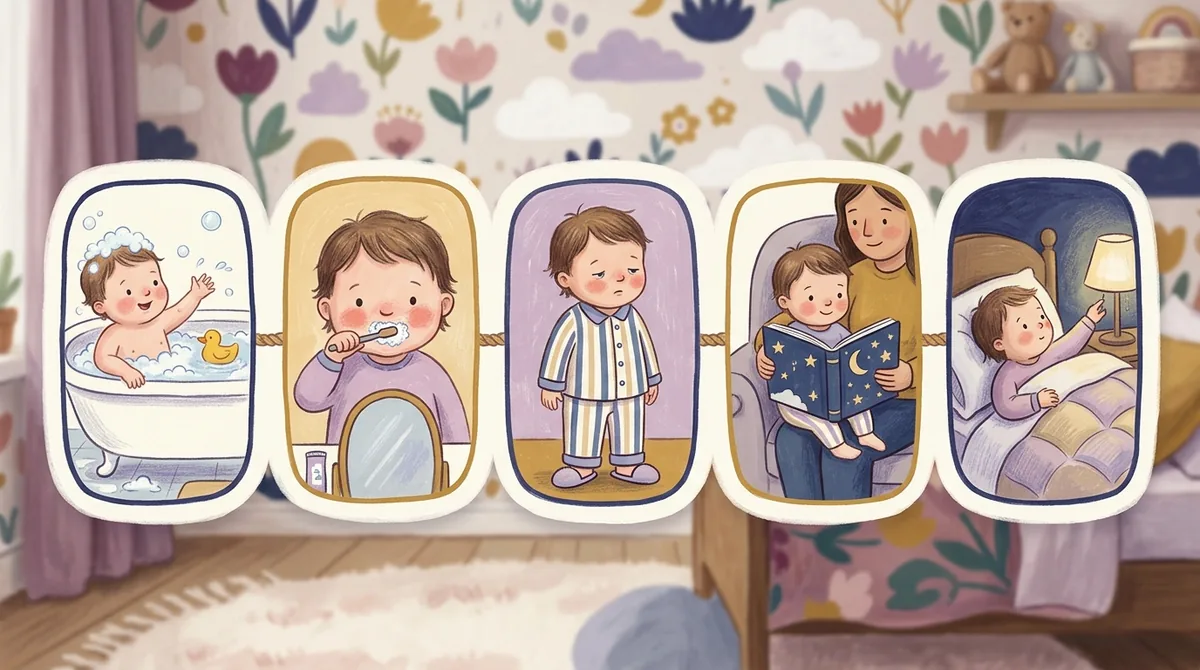
Almost every routine that works fits this shape. The names of the steps will vary; the order should not.
- Wind-down warning. Ten minutes before the routine starts, say so. "Story in ten minutes; last go on the trains." This is the step most families skip and the one that prevents the most tears, because a child pulled from play without warning arrives at bedtime already cross.
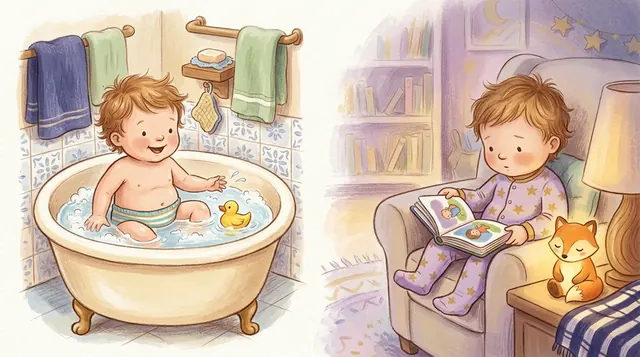
- Body care. Bath or wash, teeth, toilet, pyjamas. Keep it brisk and boring. This is not the time for bath toys that make the water the most exciting place in the house.
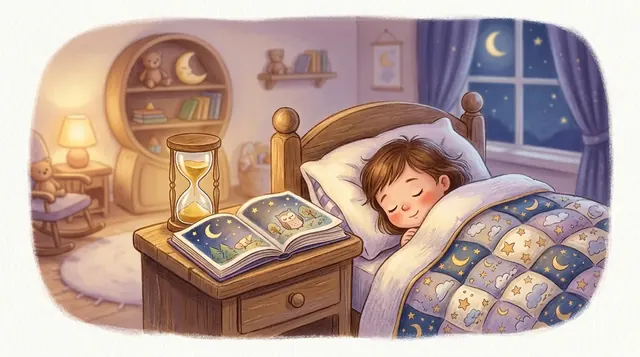
- Room ready. Main light off, lamp on, curtains closed, comfort object found, water within reach. Doing this before the story means the story ends in a room that is already dark and nobody has to get up.
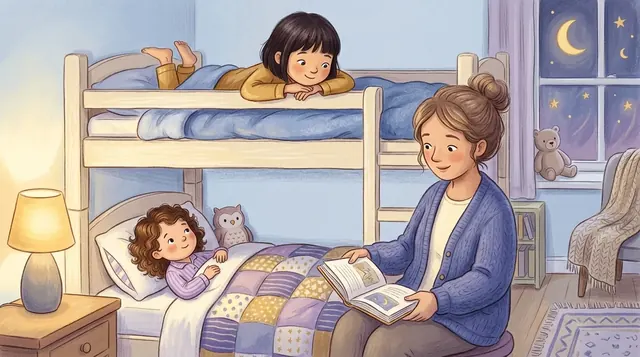
- The story. One story, chosen before the book opens, read slowly, in the bed or beside it. Five minutes for a toddler, ten for a preschooler or early reader, a chapter of a longer story for an older child. How to judge the length is covered in how long a bedtime story should be.
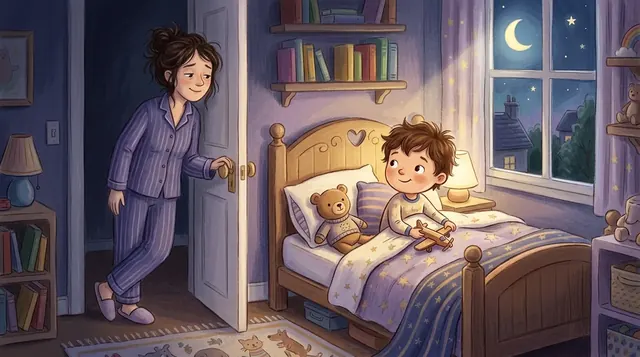
- Goodnight words. The same sentence every night, then leave. "Night night, sleep tight, see you in the morning" is fine. So is anything else, as long as it never changes. The fixed sentence is the child's signal that the routine is over, and it is what makes the ending non-negotiable without it needing to be stern.
From the warning to the door closing, aim for twenty to thirty minutes. Routines that run longer do not calm children more; they give more opportunities for delay and let the child's tiredness tip over into the wired, giddy state that makes sleep harder.
Setting the time: work backwards from the morning
The routine's start time should be set from the wake-up time, not from when the evening happens to be free. A child who must be up at seven for nursery and needs eleven and a half hours of sleep needs to be asleep, not in bed, by half past seven, which puts the wind-down warning at a quarter to seven and the bath at seven. Written down like that, it is clear why an evening that starts with tea at half past six goes wrong.
Rough sleep needs, as a guide to work from: toddlers need eleven to fourteen hours in a day including naps, preschoolers ten to thirteen, school-age children nine to twelve. Individual children vary, and the reliable signal is the morning: a child who has to be woken most days is not getting enough, and a child who wakes at half past five bright and ready may be getting too much, or going to bed too early. Adjust in fifteen-minute steps and give each change a week.
A worked example: a weekday for a four-year-old
Here is the template filled in for a preschooler who is up at seven and needs about eleven hours. Nothing about it is clever; that is the point.
- 6.45 Warning. "Story in ten minutes. Last thing you want to do before bed?" Toys away together, television off if it was on.
- 6.55 Body care. Bath or wash, teeth, toilet, pyjamas. Adult talks quietly and does not start a game. Ten minutes, twelve at the outside.
- 7.07 Room ready. Curtains closed, big light off, lamp on, rabbit found, water on the shelf. The child climbs in.
- 7.10 Story. One ten-minute story, chosen from two the adult offers, read slowly with a question or two in the middle and none at the end.
- 7.20 Goodnight words, kiss, lamp off, door to its usual position. Adult leaves and does not come back for a "quick check" unless the child is distressed.
Asleep by half past seven most nights, with the wobbly ones landing by a quarter to eight. If the same child is regularly still awake at eight, the answer is more likely to be a nap that ran late or a bedtime that is ten minutes too early than any flaw in the routine.
The hour before the routine
The routine starts at the warning, but the evening starts an hour earlier and it decides how the routine goes. Three things in that hour make the biggest difference. The first is food: a child who is hungry will not settle, and a child who has just eaten a large meal will not either, so tea should be finished at least an hour before lights out, with a small snack allowed at the warning if it helps. The second is light: bright overhead lights in the last hour keep the body in daytime, so dim the living room after tea and stop using screens at least half an hour before the warning. The third is pace. Rough play and running games are fine at five o'clock and disastrous at half past six; move the wild stuff earlier and let the last hour be drawing, building, a puzzle or a walk round the block. None of this is part of the routine, but a routine begun with a wound-up, hungry child under bright lights has to do far more work than one begun with a calm one.
What changes with age
One to three
Shorter, more repetitive, and more physical. Toddlers want the same two or three stories or rhymes every night for weeks, a song, and a routine that is over before their patience is. The whole thing, including the bath, can be twenty minutes. The toddler version is spelled out step by step in a bedtime routine for toddlers.
Three to five
The negotiating years. The routine can stretch to thirty minutes and the story to ten, but the fixed ending matters more than ever, because a four-year-old will test every soft edge. This is also the age when fears arrive, so the story should be chosen with the room's darkness in mind: The Three Billy Goats Gruff is a fine bedtime story for a four-year-old, because the troll is loud but the goats win; a story with a witch in it might not be, at least not on the first night.
Five to eight
The routine can become partly the child's job. Teeth and pyjamas without supervision, a choice between two stories, sometimes the first page read aloud to you. Keep the last two steps the same as always. Children this age are old enough to understand "one story, then lights out," and to be reminded of it before the book opens rather than argued with after.
Eight to twelve
The body-care steps shrink and the story grows. A chapter of a long tale, read by you, is often the last part of the day an older child will still share without prompting. Keep the story; drop the song. And keep the goodnight words, even if they roll their eyes.
Where routines break, and how to mend them
Routines rarely collapse. They drift, in steps small enough that nobody notices until bedtime is an hour late and everyone is crying. The usual pattern is that one step gets longer, the ending becomes negotiable, and a new step is added at the end to fix the trouble the first two caused. A second story, a drink, a check on the toys, a third goodnight. Each is reasonable on its own and together they push sleep back forty minutes.
The fix is always to rebuild from the beginning, never to add at the end.
- Restart the warning. The ten-minute warning is the first thing to go and the first thing to put back.
- Shorten the middle. If the bath has become a play session, make it a wash for a week.
- Restore the fixed ending. Say the goodnight words and leave, every night, for a week, even if the child protests. Most protests stop by night three.
- Move the whole thing earlier. A child who fights bedtime is more often overtired than under-tired. Bring the warning forward by twenty minutes before you try anything else.
If the story ends and the child still will not settle, that is its own problem with its own four causes, which are set out in what to do when your child won't settle. The one answer that is nearly always wrong is a second story.
Screens, siblings and the other complications
Screens belong before the routine starts, never inside it. A tablet in the last half hour before bed delays sleep through its light, its pace and the cliff at the end of every episode, and the easiest replacement is a story read aloud in the same slot. Making that switch without a fight takes about a fortnight and a plan, which is in screen-free bedtime.
Two children of different ages can share a routine up to the story, then split: the younger has a short rhyme and the goodnight words first, the older gets the chapter. Two adults should run the routine the same way, with the same words; children test the one who bends. Grandparents and babysitters get a written copy. And on holiday, keep the story and the goodnight words even if everything else goes, because they are the part of the routine the child carries with them.
The story's job inside the routine
The story is the step a child wants, which makes it the anchor. It is also the step most likely to be done wrong, because parents read it as entertainment when at bedtime it is a wind-down. Read slower than feels natural. Choose the calmest story the child will accept, and save the adventures for earlier in the evening or the weekend. The gentle sleepy stories collection exists for the last slot of the night: nothing frightening happens, the pace is slow, and most of them end with somebody asleep. The Pea Blossom is a good example, a quiet Andersen tale about a pea that grows on a windowsill and a girl who gets better watching it.
For length, let the evening decide. The five-minute stories are for the nights that have already run late, and they are whole stories, not extracts, so the child does not feel short-changed. Ten minutes is the natural bedtime length on an ordinary night. Long stories are for older children and for weekends, read a chapter at a time in the story-book mode.
Tonight
Write the five steps on a piece of paper and put it on the fridge. Say the ten-minute warning tonight, even if nothing else changes. Get the room dark before the story rather than after. Read The Pea Blossom or, if you have a toddler, the shortest rhyme they know from the five-minute stories. Say the goodnight words, and leave. Do the same tomorrow, and give it two weeks before you judge it.