Charles Perrault was sixty-nine, retired and out of favour when the little book that made him immortal appeared in January 1697. Histoires ou contes du temps passé, avec des moralités, Stories or Tales of Times Past, with Morals, contained eight prose tales that his contemporaries thought a charming trifle and that turned out to be the foundation of the Western fairy tale. This guide explains who he was, what the court he wrote for wanted, walks through the eight tales one by one with their retellings on this site, and shows what the Grimms did to them a century later. The site's Perrault tales live among the classic tales, with the cats in the cat stories collection and the royalty in kings and queens.
A civil servant with a quarrel
Perrault was born in Paris on 12 January 1628, the youngest son of a lawyer, and trained in law himself. He rose not as a writer but as an administrator: for twenty years he was the right hand of Jean-Baptiste Colbert, Louis XIV's finance minister, overseeing royal buildings, academies and the propaganda of the reign. He helped found the Academy of Sciences, was elected to the Académie française in 1671, and had a hand in the design of the Louvre colonnade. When Colbert died in 1683 Perrault lost his post and turned to writing full time.
He is remembered in French literary history for a fight. In 1687 he read a poem to the Académie, Le Siècle de Louis le Grand, arguing that the writers of the modern age were the equals of the Greeks and Romans. The great critic Boileau was outraged, and the Quarrel of the Ancients and the Moderns ran for a decade. The fairy tales were, in part, a move in that argument. A modern Frenchman, Perrault was saying, could take a peasant's tale, tell it with grace, and produce something worth as much as a Latin fable. He was right, though it took two hundred years to be sure.
What Versailles wanted
The 1690s were the decade of the fairy tale in Paris. In the salons of aristocratic women, telling and writing contes was a fashionable game, and Madame d'Aulnoy, whose Les Contes des fées also came out in 1697, gave the genre its name. Her tales, and those of her friends Madame de Murat and Mademoiselle de La Force, are long, ornate, full of enchanted princes and impossible gardens; the site's The Blue Bird, The Yellow Dwarf, The White Doe, Princess Belle-Etoile and The Fair with Golden Hair are all hers. Perrault's contribution was to do the opposite: to keep the tales short, plain and apparently naive, as if a nurse were telling them, and to let the sophistication sit in the rhymed morals at the end.
He published under the name of his nineteen-year-old son, Pierre Darmancour, with a dedication to the King's niece, and the frontispiece showed an old woman spinning by a fire, with a placard reading Contes de ma mère l'Oye. Whether the modest signature was a joke, a courtesy to his son, or a hedge against Boileau's ridicule, nobody knows. Pierre died a soldier in 1700; Perrault died on 16 May 1703, and for a while the tales were out of print. They came back, in English first (Robert Samber's translation, 1729), and never left.
The eight tales, one by one
1. The Sleeping Beauty in the Wood
The version children know is only Perrault's first half. His princess pricks her finger, sleeps a hundred years, and wakes when the prince kneels beside her: no kiss. They marry in secret and have two children, Dawn and Day, and the second half is about the prince's mother, an ogress, who tries to have the children and their mother cooked. It is the tale's least-read part, and the bedtime retelling of The Sleeping Beauty in the Wood on this site follows the Grimms in stopping at the wedding. The moral, dryly, observes that no girl nowadays would wait a hundred years for a husband.
2. Little Red Riding Hood
Perrault's is the first printed version and the darkest. The wolf eats the grandmother, gets into bed, has the famous conversation about eyes and teeth, and eats the girl. The end. There is no huntsman; the moral warns young ladies that the most dangerous wolves are the polite ones. The site's Little Red Riding Hood uses the Grimm rescue, as almost every telling since 1812 has, and The True History of Little Golden Hood, a nineteenth-century French answer to Perrault, gives the girl a magic hood and lets her win.
3. Bluebeard
A wealthy man with a blue beard, a forbidden room, and a wife who looks. It is a horror story with a rescue, and not on this site; it is the one Perrault tale that has never been a bedtime story and should not be.
4. The Master Cat, or Puss in Boots
The miller's youngest son inherits only a cat, and the cat, asking for nothing but a pair of boots and a bag, makes him the Marquis of Carabas by pure effrontery. Perrault took the plot from Basile and Straparola and gave it the boots. His two morals are about how far cleverness beats an inheritance and how far a good coat and a handsome face beat both. The site's Puss in Boots keeps the cat's swagger and the ogre-into-mouse trick, which is the best sleight in any fairy tale.
5. The Fairies
A kind sister gives water to an old woman at the well and is rewarded: flowers and jewels fall from her mouth whenever she speaks. Her rude sister goes to the well to get the same and comes back spitting toads. Andrew Lang called it Toads and Diamonds; on this site it is The Fairy, and it is the shortest and most toddler-friendly of Perrault's stories.
6. Cinderella, or The Little Glass Slipper
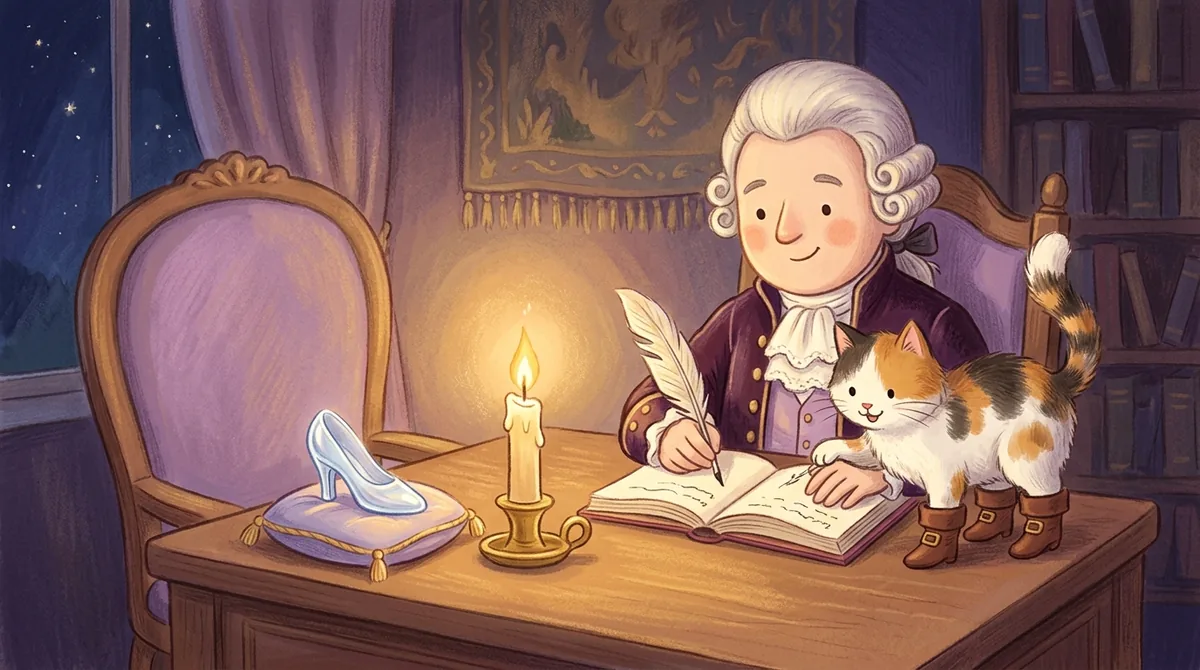
Perrault invented the fairy godmother, the pumpkin coach, the rat coachman and the midnight deadline; none of them is in Basile's version or the Grimms'. He also insisted on the glass slipper, pantoufle de verre. A nineteenth-century theory that he meant vair, squirrel fur, and that a copyist heard it wrong, has been repeated ever since; but Perrault wrote verre, glass is the point (a shoe that cannot stretch fits only one foot), and there is no manuscript with fur in it. His Cinderella forgives her sisters and finds them husbands at court. The site's Cinderella follows him there.
7. Riquet with the Tuft
An ugly, clever prince and a beautiful, stupid princess each have the gift of bestowing what they lack on the one they love. It is the most salon-like of the eight, more a conversation than an adventure, and it is on this site as Riquet with the Tuft. Its moral, that everything is beautiful in the one we love, is the kindest thing Perrault wrote.
8. Little Thumb
Seven brothers abandoned in a forest, a trail of pebbles then breadcrumbs, an ogre's house, and the ogre's seven-league boots. This is Hansel and Gretel's French cousin, and the source of the breadcrumbs. Not to be confused with the English Tom Thumb, who is a different, much smaller boy.
The morals: written for grown-ups
Every tale ends with one or two verse moralités, and they are where Perrault's voice is. They are worldly, teasing, and aimed over the child's head at the adult reading. The moral of Cinderella praises not virtue but bonne grâce, charm, and adds a second moral pointing out that charm is no use without a godmother to notice it. Puss in Boots is told twice over to mean that ingenuity beats inheritance. Red Riding Hood's moral is the famous warning about smooth-tongued wolves who follow young ladies home. The bedtime retellings on this site drop the verses, rightly, but a parent who knows they exist reads the tales differently: as a courtier's amused performance of simplicity, not as simplicity itself.
Perrault had already tried the form in verse, with The Ridiculous Wishes (1693), in which a woodcutter wastes three wishes on a sausage, and Donkey-Skin (1694). The Ridiculous Wishes is on this site and is the funniest thing he wrote.
What the Grimms did to Perrault
A century later, several of Perrault's tales were told to Jacob and Wilhelm Grimm by the Hassenpflug family of Kassel, whose grandparents were French Huguenots. The brothers recorded them as German folk tales, and the guide to the brothers Grimm describes how they later noticed and dropped some. Puss in Boots was removed from the Grimm collection after the first edition as too obviously French. Red Riding Hood and Sleeping Beauty stayed, with changes: the Grimms added the huntsman who cuts the girl from the wolf, gave Sleeping Beauty her kiss and cut the ogress. Their Cinderella is a different tale entirely, with a hazel tree and helpful birds instead of a godmother. So the two most-told fairy tales in the world each exist in a French version and a German one, and most modern retellings, including this site's, blend them. The history of fairy tales traces the whole chain from Naples to the nursery.
Tonight
Read Puss in Boots to a four-year-old and do the cat as the most confident creature in the world. Read The Fairy to a toddler and let them decide what should come out of the rude sister's mouth. Read Cinderella to anyone, and when the slipper comes out, tell them it was always glass. For a taste of the salon Perrault was writing in, follow with d'Aulnoy's The Blue Bird or Madame Leprince de Beaumont's Beauty and the Beast (1756), the last great French fairy tale and the one Perrault's successors got right. The kings and queens collection has the courts; the cat stories collection has the boots.