Aesop was, according to Herodotus, a slave on the Greek island of Samos in the sixth century BC, and according to almost everyone since, the author of any short story in which an animal learns something the hard way. Both things can be true. This guide sets out what is actually known about the man, how a few hundred Greek anecdotes became the world's first children's classic, why the fable's shape is so well suited to the last five minutes of the day, and how to read one so that the moral lands without a lecture. The Aesop's fables section holds the site's retellings, most of them under three minutes aloud.
What we know about Aesop, and what we don't
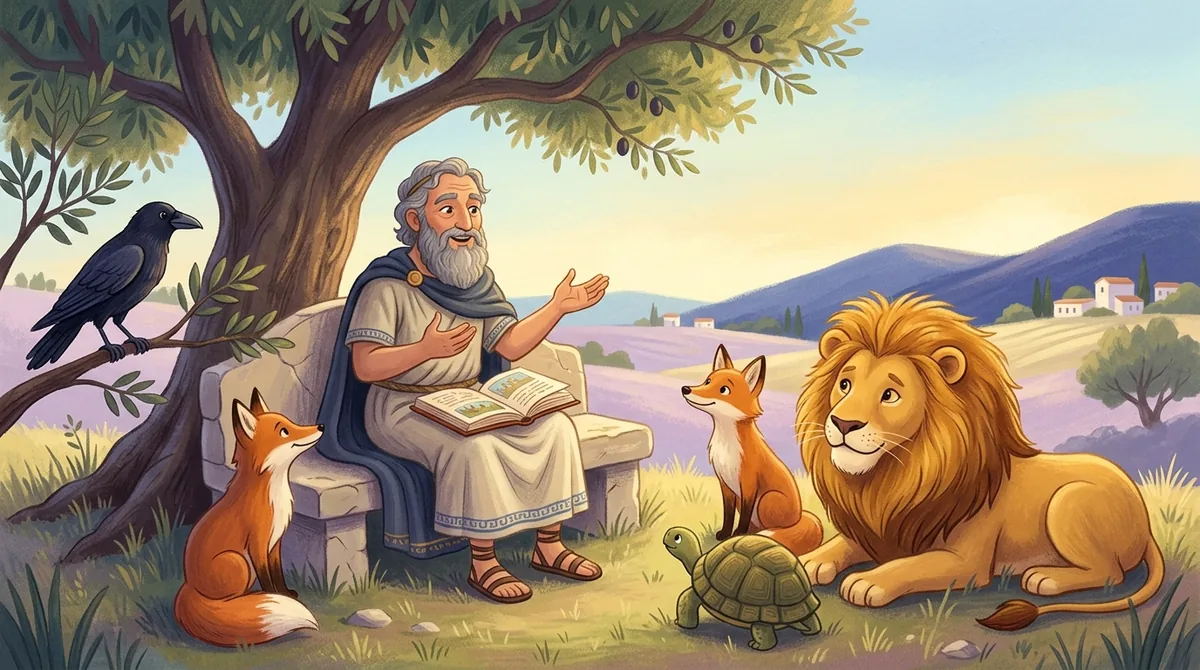
The hard evidence fits in a paragraph. Herodotus, writing around 430 BC, mentions Aesop the fable-teller as a slave belonging to a man named Iadmon of Samos, alive in the mid-sixth century, and says he was killed by the people of Delphi, who later paid compensation for it. Aristophanes has his characters quote Aesop as everyone's schoolroom reading. Plato records that Socrates, waiting in prison for the hemlock, passed the time turning fables of Aesop into verse. Aristotle tells one Aesop story and mentions that Aesop spoke in public defence of a politician. That is the lot: a slave, a storyteller, a death at Delphi, and a reputation already old by the time Athens was at its height.
Everything else is later legend. The Life of Aesop, an anonymous Greek romance from about the first century AD, makes him hideously ugly, mute until a goddess gives him speech, and cleverer than every master he serves; it is a very good story and no more historical than the fables themselves. The suggestion that he was Ethiopian rests on a pun on his name and nothing more. What is plausible is that a real Aesop existed, told fables well, and that within a century or two his name had become a label, so that 'Aesop's' meant 'the fables' the way 'Mother Goose's' later meant 'the rhymes'. Several fables attributed to him are older than he could be; the Indian Panchatantra and Sumerian proverb collections have relatives of the same stories.
How the fables survived
Nothing Aesop said was written down in his lifetime. The fables passed through five sets of hands before reaching the nursery.
- Demetrius of Phalerum, about 300 BC, an Athenian statesman, made the first collection of Aesopic fables in prose, as material for orators. It is lost, but later collections drew on it.
- Phaedrus, first century AD, a freedman at the court of Augustus, turned the fables into Latin verse in five books, adding sharp political ones of his own. The Latin schoolroom read Phaedrus for the next fifteen hundred years.
- Babrius, probably second century AD, did the same in Greek verse. Both poets' work is the reason we have the 'classic' wording of stories like the Fox and the Grapes.
- William Caxton, 1484, printed the first English Aesop, translated from a French version of a German one, with woodcuts. Every English child's Aesop since has been a descendant.
- Jean de La Fontaine, 1668, published the first of his Fables, retelling Aesop and Phaedrus in French verse for the court of Louis XIV. La Fontaine's wit made the fable fashionable for adults again, and the eighteenth-century nursery inherited the fashion.
The scholarly reference today is the Perry Index, compiled by Ben Edwin Perry in 1952, which numbers the Greek and Latin fables: the Tortoise and the Hare is Perry 226, the Lion and the Mouse is Perry 150, the Boy Who Cried Wolf is Perry 210. The point of the list is that 'Aesop' is a library, assembled over two thousand years, and that the fables most beloved by children (the North Wind and the Sun, the Ant and the Grasshopper, the Fox and the Stork) were all in it before the Middle Ages.
Why fables were the first stories allowed in the nursery
When the philosopher John Locke laid out a plan for educating children in 1693, he was suspicious of most stories but recommended Aesop by name, as a book that would 'entice' a child to read and 'afford him matter of reflection'. That endorsement matters. For the next hundred and fifty years, while fairy tales were suspected of filling children's heads with nonsense, fables were the respectable exception, because they admitted they were lessons. The history of fairy tales tells that story; the practical result is that the fable was the standard children's book in English from the 1690s to the 1830s, and every later children's author, from the Grimms' English translators to Beatrix Potter, grew up on it.
Fables are also the origin of the idea that a story can have a stated moral at all. Perrault borrowed the device for his 1697 fairy tales; the guide to morals in children's stories argues that the fable's explicit moral and the fairy tale's buried one are two different tools, and that both beat a parental lecture.
Why the two-minute shape works at bedtime
A fable has three parts and nothing else: a situation, a single turn, and the consequence. There is no backstory, no second act, no subplot. The Fox and the Grapes is a fox, a vine, a jump, and a sentence of sour comfort. That economy is a gift at nine o'clock at night, and it is a gift in three specific ways.
It gives a complete story to a child who cannot follow a long one. A two-year-old will not track Cinderella but will grasp that the lion let the mouse go and the mouse chewed the net. It gives a whole story to a parent with three minutes, so that 'one more' is genuinely one more. And it gives a child a lesson without a hero, which is subtler than it sounds: nobody in a fable is someone to be, and so a child can look at the crow flattered out of her cheese, or the dog who drops his bone snapping at his reflection, and recognise a bit of themselves without feeling accused. That distance is why animals carry the lessons. As the animal stories collection puts it, a child who would resist being told to share will happily learn it from a hedgehog.
How to read a fable aloud so the moral lands
- Read the fable and stop before the moral. Most printed versions, including the ones on this site, end with a line in italics. Cover it, or pause before it.
- Ask what the animal should have done. Not 'what is the lesson', which invites a shrug, but 'what should the hare have done?'. A four-year-old will say 'kept running'. That is the moral, in their words, and it will stick where the printed one will not.
- Then read the moral aloud and let them compare. Sometimes they will disagree with Aesop, and sometimes they will be right. Children often think the ant in The Ant and the Grasshopper is mean, and that is worth a two-sentence conversation about whether being right and being kind are the same.
- Do the voices sparingly. One low voice for the big animal and one quick one for the small is enough; the guide to character voices uses The Lion and the Mouse as its worked example for exactly this reason.
- Read a second one only if it is calmer than the first. Fables are short enough that a child will ask for three. Say yes to two, and make the second The North Wind and the Sun, which ends in warmth.
Fables by age
Toddlers and young preschoolers want animals they know and a single clear action: The Lion and the Mouse, The Tortoise and the Hare, The Crow and the Pitcher, whose pebble-by-pebble solution they will want to act out with a cup.
Four to six can manage a lesson that is slightly uncomfortable: The Boy Who Cried Wolf, The Fox and the Crow, The Dog in the Manger, The Town Mouse and the Country Mouse.
Seven and up enjoy the ones where the moral is debatable, and where the clever animal is not necessarily the good one: The Fox and the Stork, The Milkmaid and Her Pail, The Wolf in Sheep's Clothing, The Bundle of Sticks, which is the best fable ever written about siblings.
Tonight
Read The Tortoise and the Hare, stop before the moral, and ask what the hare should have done. Then read The North Wind and the Sun in your quietest voice. Five minutes, two complete stories, one conversation, lights out. The whole Aesop section works that way, and the animals in the animal stories collection carry on where Aesop stops.