Jacob and Wilhelm Grimm were two quiet, hard-up scholars from Hesse who spent their lives on dictionaries, grammars and law codes and are remembered, to their mild irritation, for a book of stories they gathered in their twenties. Kinder- und Hausmärchen, Children's and Household Tales, appeared in two volumes in 1812 and 1815 and reached its seventh and final edition in 1857. It contains the versions of Hansel and Gretel, Rapunzel, Rumpelstiltskin, Snow White and the Frog Prince that the world now treats as the originals. This guide covers who the brothers actually were, where the tales actually came from, and how one story changed under Wilhelm's pen across forty-five years, so that when you open the Brothers Grimm collection tonight you know what you are holding.
Two brothers, one desk
Jacob was born in Hanau on 4 January 1785 and Wilhelm on 24 February 1786. Their father, a lawyer and town clerk, died in 1796, and the family fell from comfortable to poor overnight; an aunt paid for the boys' schooling in Kassel. Both went to Marburg to study law, and both were diverted by their teacher Friedrich Carl von Savigny, who sent them into old manuscripts and gave Jacob his lifelong conviction that language, law and story were all evidence of a people's past. Jacob became a librarian in Kassel; Wilhelm, whose heart was weak, joined him. For most of their adult lives they shared a house, and when Wilhelm married Dorothea Wild in 1825 Jacob simply moved in with the couple.
They were not primarily folklorists. Jacob's Deutsche Grammatik (1819 onwards) contains the sound-shift rule still taught as Grimm's law; the brothers' Deutsches Wörterbuch, the great German dictionary begun in 1838, was only finished by other hands in 1961. In 1837 they were two of the Göttingen Seven, professors dismissed from the university for protesting when the King of Hanover tore up the constitution. It cost them their jobs and made them famous; Berlin eventually took them in. Wilhelm died on 16 December 1859 and Jacob on 20 September 1863, still working on the letter F.
Where the stories really came from
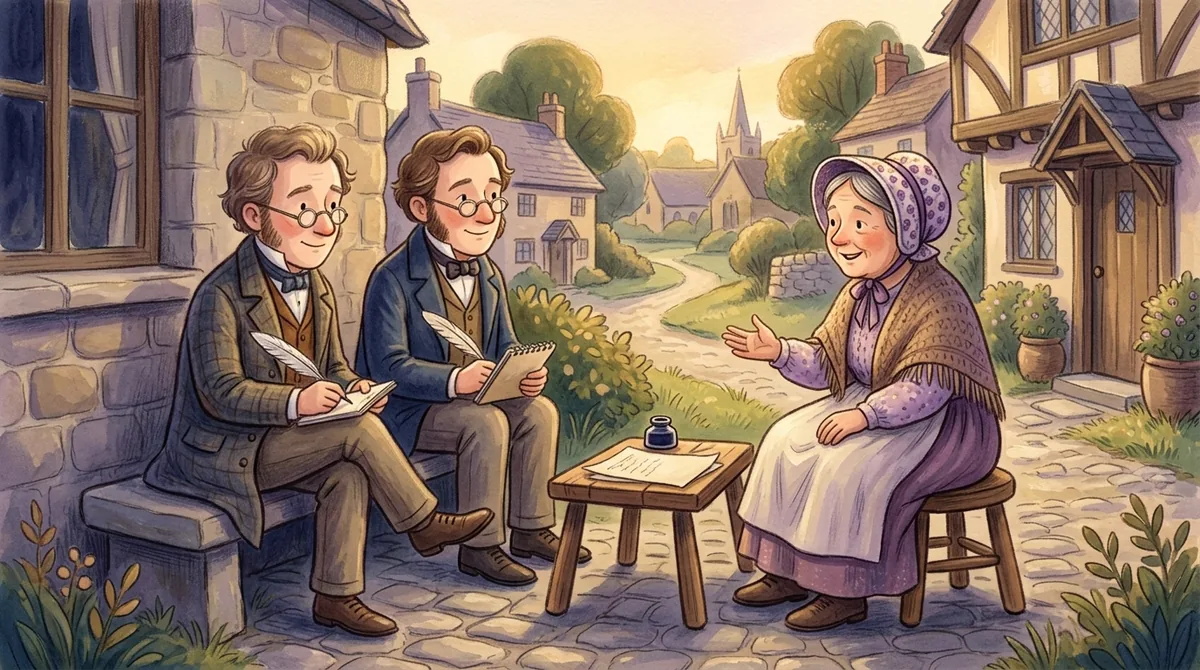
The brothers' preface talks about tales gathered from the mouths of the people, and the picture that stuck is of two young men walking from village to village with notebooks. The reality was more domestic. Most of the tales in the first volume came from the Grimms' own social circle in Kassel: the daughters of the Wild family, who lived across the road (Dortchen Wild, later Wilhelm's wife, gave them The Elves and the Shoemaker and much of Hansel and Gretel); the Hassenpflug sisters, from a family of French Huguenot descent who knew Perrault, which is why the Grimm Red Riding Hood, Puss in Boots and Sleeping Beauty look so French; the von Haxthausen family in Westphalia; and the painter Philipp Otto Runge, who sent them The Fisherman and His Wife in Low German dialect.
The one source who fits the legend was Dorothea Viehmann, a tailor's widow from Niederzwehren outside Kassel, who came to sell vegetables and stayed to tell stories, some forty of them, for the second volume. Wilhelm marvelled that she could tell a tale twice in exactly the same words. Ludwig Emil Grimm, the brothers' artist brother, drew her for the frontispiece of the 1819 edition, and she became the face of the collection: the old peasant woman by the fire who never was, exactly, but nearly was.
Five things people get wrong about the Grimms
- They did not write the tales. Andersen wrote his; the Grimms recorded and edited theirs. Their names on the cover are those of collectors.
- The first edition was not a children's book. It had scholarly notes, no pictures and a preface aimed at fellow antiquarians. It sold slowly and drew complaints that parents could not read it to the young.
- The stories were not uniformly dark. The 1812 volume has plenty of gentle tales; what shocked contemporaries was the frankness of a few, such as Rapunzel asking the witch why her dress no longer fits.
- The 'Grimm style' is Wilhelm's. The sing-song repetitions, the 'once upon a time' openings and the pious sentences were added in revision. The raw 1812 texts are terser and stranger.
- They never approved of the softest versions. Jacob in particular grumbled about the English tendency to prettify; Edgar Taylor's 1823 translation, which made the tales an English nursery staple, cut and sweetened freely.
One tale, seven editions: watching Snow White change
The clearest way to understand what the Grimms did is to follow a single story through the editions. Take Snow White, which is on this site as Snow White and the Seven Dwarfs.
- 1810, manuscript. The queen who wants Snow White dead is her mother. There is no huntsman: the queen drives the child into the forest herself and abandons her. The girl is woken not by a prince but by a servant who, exasperated at carrying the coffin, thumps her on the back and dislodges the apple.
- 1812, first edition. Still the mother. A huntsman is sent, and brings back lungs and liver, which the queen eats. The prince's servants jolt the coffin and the apple falls out. At the wedding the queen dances in red-hot iron shoes until she is dead.
- 1819, second edition. The mother becomes a stepmother, because Wilhelm could not bear, or thought parents could not bear, a mother who tries to kill her own child. The same edition turns Hansel and Gretel's mother into a stepmother in later printings, and removes Rapunzel's pregnancy.
- 1825, the Kleine Ausgabe. A small edition of fifty tales with pictures by Ludwig Emil Grimm, explicitly for children. This is the book that made the Grimms a nursery name.
- 1857, seventh edition. Two hundred tales and ten religious legends. Snow White now has the full apparatus of dwarfs who are named as miners, a mirror that speaks in rhyme, and a prince who begs for the coffin out of love. The iron shoes remain.
The bedtime retelling on this site sits at the end of that process. It keeps Wilhelm's rhymes and the three visits of the disguised queen, and lets the wedding end without the shoes. That is not a betrayal of the Grimms; it is the eighth edition, and they would have recognised the impulse.
What is unmistakably Grimm
Even after all the polishing, the Grimm tales have a character that Perrault's and Andersen's do not, and it is worth knowing so you can lean into it when reading aloud.
They are built on threes and on formulas. The fisherman's wife sends him back to the flounder with the same rhyme each time, and children will chant it with you by the third go. The Wolf and the Seven Little Kids gives the wolf three attempts at the door, each with a fix (chalk for the voice, flour for the paw). The Golden Goose adds one stuck person after another until the procession is absurd. These repetitions are not padding; they are the memory-hooks of oral telling, and they are the reason a tired parent can read a Grimm story half-asleep and still land it.
They are also fair in a hard way. Kindness to a strange old man or a trapped animal is always repaid, as in The Queen Bee, where the youngest brother's refusal to let his brothers disturb an anthill, a duck pond and a beehive wins him a kingdom. Unkindness is punished, sometimes savagely. The Goose Girl ends with the false bride naming her own punishment. The guide to fairy tales and fear discusses which of those endings to keep for which age; this guide's short answer is that the fairness matters more to children than the severity, and you can keep one without the other.
And they are comic more often than their reputation suggests. The Musicians of Bremen, Hans in Luck and Seven at One Blow are farces, and The Straw, the Coal and the Bean is a two-minute joke with a moral about why beans have seams.
How the Grimms travelled to your bookshelf
Edgar Taylor's German Popular Stories (1823, second volume 1826) was the first English selection, illustrated by George Cruikshank, and it arrived just as the English argument about whether children should have fairy tales at all was turning in the tales' favour; the history of fairy tales covers that fight. Taylor's choices and his softenings shaped which Grimm tales became famous in English. Margaret Hunt's complete translation of 1884 gave scholars all two hundred; Andrew Lang's coloured fairy books, from 1889, redistributed the best of them, often lightly retold, to a generation of Victorian children; Disney's 1937 Snow White fixed one version in the world's head for good. Every retelling in the classic tales section is downstream of all of these.
Reading a Grimm tale tonight
For a preschooler, start with the short, funny, repetitive ones: The Musicians of Bremen, The Elves and the Shoemaker, The Golden Goose. For five to eight, the great quest tales: Rapunzel, The Frog Prince, Rumpelstiltskin, Hansel and Gretel. For older children who can take a serious one, The Six Swans and The Goose Girl, both of which reward a conversation afterwards about keeping a promise when it costs you. Tell them, before you start, that these stories were collected two hundred years ago by two brothers who wrote them down exactly as an old woman told them, and then changed them a little every year. Children like knowing that the story has been fiddled with; it gives them permission to fiddle too.