Take a Chinese girl called Yeh-Shen, who is mistreated by her stepmother, is helped by the bones of a magic fish, goes to a festival in a gown and golden shoes, loses one, and is found by the king who will marry whoever it fits. That story was written down by Duan Chengshi in the 850s, in the Tang dynasty, about eight and a half centuries before Perrault gave Cinderella her pumpkin. It is not a coincidence, a borrowing, or a mystery; it is what folk tales do. This guide tours the great tale families that turn up everywhere, shows which versions are retold on this site's folk tales from around the world collection, and suggests the single most useful thing a parent can do with them: read the same story twice, from two places.
How folklorists sort the world's stories
By the end of the nineteenth century enough tales had been collected, by the Grimms in Germany, Asbjørnsen and Moe in Norway, Afanasyev in Russia, Jacobs in England and Lang's translators everywhere, that scholars could see the repeats. In 1893 Marian Roalfe Cox published a catalogue of 345 versions of Cinderella. In 1910 the Finnish scholar Antti Aarne published an index of tale types; the American Stith Thompson expanded it in 1928 and 1961, and the German Hans-Jörg Uther revised it again in 2004. The Aarne–Thompson–Uther index (ATU) assigns each recurring plot a number: Cinderella is ATU 510A, the search for the lost husband is ATU 425, the kind and unkind girls are ATU 480, the name of the supernatural helper is ATU 500. There are over two thousand types, but a few dozen account for most of what children hear.
Why the same plots recur is argued about. Some tales clearly travelled, along trade routes and with translators; some may have been invented more than once because they answer the same human situations; a few, on recent statistical evidence, seem to be thousands of years old and to have spread with the languages that carry them. For a parent the argument does not matter. What matters is that a child who knows the shape of a story will recognise it in a new coat, and enjoy the recognition.
The persecuted heroine: Cinderella, ATU 510A
Cinderella is the most-collected tale in the world, and the versions disagree about everything except the shape: a girl at the bottom of her household, a magical helper connected to her dead mother, a public event, a token that identifies her, a marriage. In Yeh-Shen the helper is a fish and the shoe is gold. In the Greek geographer Strabo, writing around the time of Christ, an eagle steals the sandal of a courtesan named Rhodopis and drops it in the Pharaoh's lap. In the Grimms' Aschenputtel a hazel tree on the mother's grave sends birds with the dresses, and the stepsisters trim their feet to fit the shoe. In the Zuni tale of the turkey girl, recorded by Frank Hamilton Cushing in 1901, the turkeys she tends dress her for the dance, she forgets her promise to return, and she loses everything: not every culture wanted a happy ending. Perrault's version, with the godmother and the glass slipper, is the one on this site as Cinderella, with a second retelling in The Magical Tale of Cinderella. The Grimm cousin One Eye, Two Eyes, Three Eyes, in which the ordinary sister is starved by her one-eyed and three-eyed siblings and fed by a magic goat, is the same family with the ball replaced by a tree of golden apples.
The lost husband: East of the Sun, ATU 425
A girl is married to a monster, a bear, a pig or an unseen stranger; she breaks a rule, usually by looking at him; he vanishes; she walks to the end of the earth to get him back. The oldest full version is Cupid and Psyche, in a Latin novel of the second century. The Norwegian East of the Sun and West of the Moon, collected by Asbjørnsen and Moe in the 1840s, is the most beautiful, with a white bear, a tallow-drip, and a ride on the backs of the four winds. The Romanian The Enchanted Pig gives the girl iron shoes to wear out on the journey; the French Beauty and the Beast (ATU 425C) softens the whole thing into a courtship. The Norwegian The Master Maid flips it: the girl is the clever one and the prince the one who forgets. Older children notice the flip, and it is worth pointing out.
The kind and unkind girls: ATU 480
Two girls, often stepsisters, are sent in turn to a strange household. The kind one does the chores she is asked, is polite to the odd creatures she meets, and is sent home rewarded; the unkind one does none of it and is sent home with the opposite. Perrault's version is The Fairy, with jewels and toads from the mouth. The Grimms' is Mother Holle, with a shower of gold and a shower of pitch. The Russian version puts the household in the hut of The Baba Yaga, where the kind girl's politeness to a cat, a dog and a gate is what lets her escape. The Grimm tale of The Three Dwarfs begins as one of these, with a girl sent into the snow for strawberries, before it grows into something longer. This is the tale type most parents want their children to absorb, because it is the plainest lesson in the whole tradition: be decent to the small and strange, and it will come back to you.
The name of the helper: Rumpelstiltskin, ATU 500
A girl is set an impossible task, a small supernatural creature does it for her at a price, and she escapes the price by learning his name. The Grimms' Rumpelstiltskin is the famous one; the Suffolk Tom Tit Tot, first printed in 1878 and fixed by Joseph Jacobs in 1890, is funnier and stranger, with a small black thing with a long tail and a girl who is lazy rather than wronged. Scotland has Whuppity Stoorie, Wales has Trwtyn-Tratyn, and the guessing scene is the same in all of them. Children who know one will shout the name at the other.
Tricksters, fools and why-stories
Not every world tale is a wonder tale. Three other kinds are everywhere.
Tricksters are small, clever animals who beat larger ones by wit: the fox in Europe, Anansi the spider in West Africa and the Caribbean, Coyote and Rabbit in North America, the monkey in India and Japan. The Japanese The Two Frogs and the Swahili-Indian The Monkey's Heart, in which a monkey talks a crocodile out of eating him by claiming he left his heart at home, sit alongside Aesop's foxes and Norway's Three Billy Goats Gruff.
Fools are the comic mirror of tricksters, and the noodle tale (ATU 1200–1349) is the oldest joke form there is. The Six Sillies, a French and English tale, is about a man who will only marry if he can find three people sillier than his bride's family, and cannot.
Why-stories, which folklorists call pourquoi tales, explain a feature of the world: why the sea is salt, why the bear has a stubby tail. The Norwegian Why the Sea is Salt (ATU 565, the magic mill) is the classic, and the Ojibwe Mudjee Monedo, recorded by Henry Rowe Schoolcraft in the 1830s, belongs with the great North American hero stories.
Further afield: Japan, China, Arabia
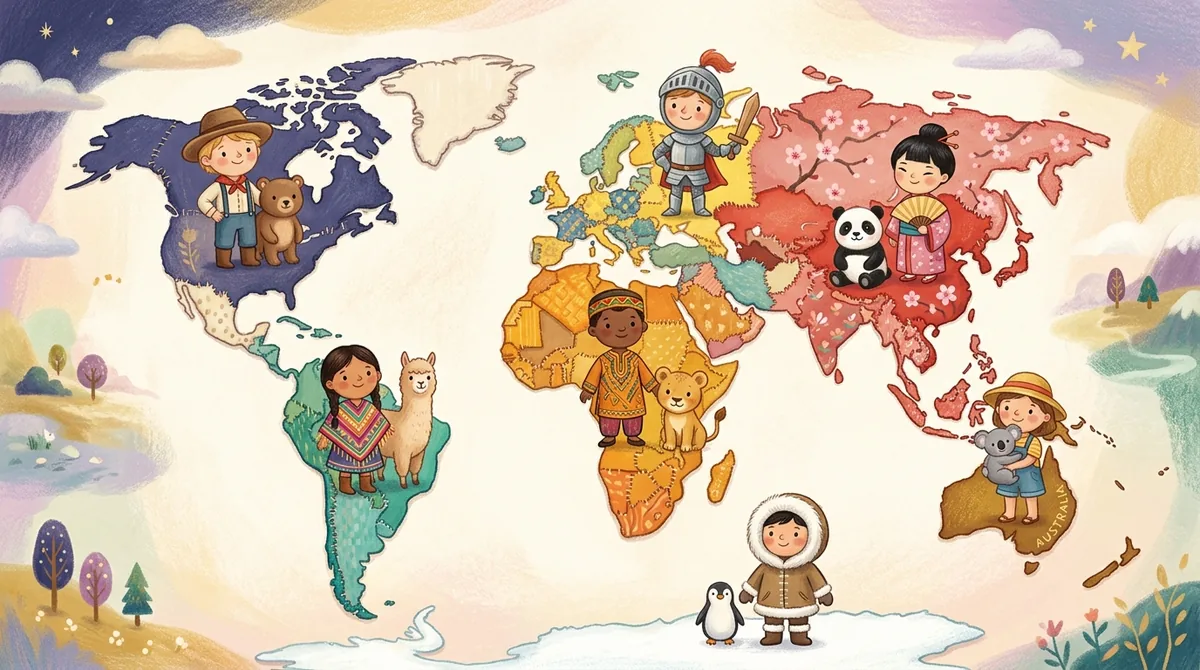
The site's collection reaches beyond Europe, and the tales from further away are among the best for older children precisely because the shape is familiar and the furniture is not. Prince Yamato Take and Princess Hase come from Yei Theodora Ozaki's Japanese Fairy Tales of 1903; The Man Who Made the Trees Blossom is one of Japan's most-told stories, with a kind old couple, a greedy neighbour and a dog whose ashes make dead trees flower. Giauna the Beautiful and The Kingdom of the Ogres are from Pu Songling's seventeenth-century Strange Tales from a Chinese Studio, and Princess Kwan-Yin is the folk version of the goddess of mercy's origin. Aladdin and Ali Baba reached Europe through Antoine Galland's French Arabian Nights (1704–17), told to him by a Syrian storyteller, Hanna Diyab. The Estonian The Dragon of the North and The Water Lily and the Gold-Spinners, the Bohemian Long, Broad and Sharpsight and the Russian The White Duck came to English through Andrew Lang's fairy books, which the guide to Andrew Lang covers.
What travels and what changes
Set two versions of a tale side by side and the differences are a lesson in what each culture wanted its children to know. Perrault's Cinderella forgives; the Grimms' does not. The Zuni turkey girl fails, because the tale is about keeping faith with the animals who help you, not about marrying up. In Norway the girl rescues the prince; in France the prince rescues the girl. The Japanese old man is rewarded because he is kind to a dog; the Norwegian lad is rewarded because he is stubborn with the North Wind, as in The Lad Who Went to the North Wind. What never changes is the underdog, the helper, the test, and the return, and that unchanging shape is why a child in Leeds hears a Japanese tale with no sense of strangeness at all. The journeys theme and the magic theme cut across the collection by shape rather than by country, which is how children sort stories anyway.
Where to start
Pick a tale type and read two of it in a week. For five and up: Cinderella on Monday and One Eye, Two Eyes, Three Eyes on Thursday, then ask what was the same. For seven and up: Beauty and the Beast and East of the Sun and West of the Moon, and ask which girl was braver. For any age: Rumpelstiltskin and Tom Tit Tot, and let them do the name-shouting. The folk tales collection is the map; the history of fairy tales explains how the collectors who drew it got their stories.