The version of a fairy tale that reaches a child's bed has always been edited by the person sitting on it. Softening a wolf, giving the heroine your daughter's name, moving the castle to the end of your road: these are not liberties with the classics, they are how the classics were made. What matters is knowing which parts are load-bearing and which are paint. This guide shows the difference, with the wolf, the pea and the three pigs as worked examples.
The classics were always adapted, starting with their authors
Charles Perrault's Red Riding Hood of 1697 ends with the wolf eating the girl, full stop, followed by a rhymed warning to young ladies about smooth-talking wolves. The Grimms' version of 1812 adds the huntsman, the scissors and the grandmother climbing out unharmed, and that is the ending most of us grew up with. The Grimms went on editing their own collection for forty years: the mother in Hansel and Gretel became a stepmother in a later edition, and Snow White's mother became a stepmother too, because the brothers judged that a birth mother plotting against her child was more than a nursery should carry. Who were the Brothers Grimm covers those revisions in more detail. The point for tonight is simple: if the collectors of the tales softened them for children, you have every right to.
The library shows the same thing in miniature. There are two Red Riding Hoods here, the fuller telling and a gentler one, and two Cinderellas, a feel-good version and a more traditional one. Each is a legitimate adaptation for a different child and a different hour, and the whole classic tales section is retellings shaped for bedtime rather than transcriptions.
What you must keep: the load-bearing parts
Every fairy tale has four or five beats that hold it up. Take one away and the tale does not become gentler; it stops working, and the child will tell you so.
- The rule. "Stay on the path." "Do not open the door." "Be home by midnight." A tale built on a rule needs the rule to be stated, broken, and paid for. You can shrink the payment; you cannot skip it.
- The three tries. Three pigs, three bears, three guesses in Rumpelstiltskin. Cut one and the rhythm breaks; add a fourth and the child stops listening.
- The villain is beaten. Not converted, not excused, beaten. The tension a child feels at the wolf is only worth having if it is released; are fairy tales too scary explains why a wolf that is defeated teaches more than a wolf that was never there.
- The calm ending. The bears go back to their porridge; the goats eat grass. The last paragraph is where the child comes down, and it must be there whatever you did to the middle.
Everything else, the names, the setting, the era, the gender of the rescuer, the exact fate of the wolf, is paint.
Softening: four techniques, with the wolf as the example
The scene most parents want to change is the wolf's. Here are four ways to change it, from mildest to most thorough, each keeping the beat.
1. Move it offstage
The wolf still swallows the grandmother, but you do not describe it. "And the wolf, who was very hungry, gobbled her up in one go, cloak and all, and she did not even have time to be frightened." The child hears the event and none of the detail. Perrault himself did most of his violence in a sentence.
2. Shrink the villain
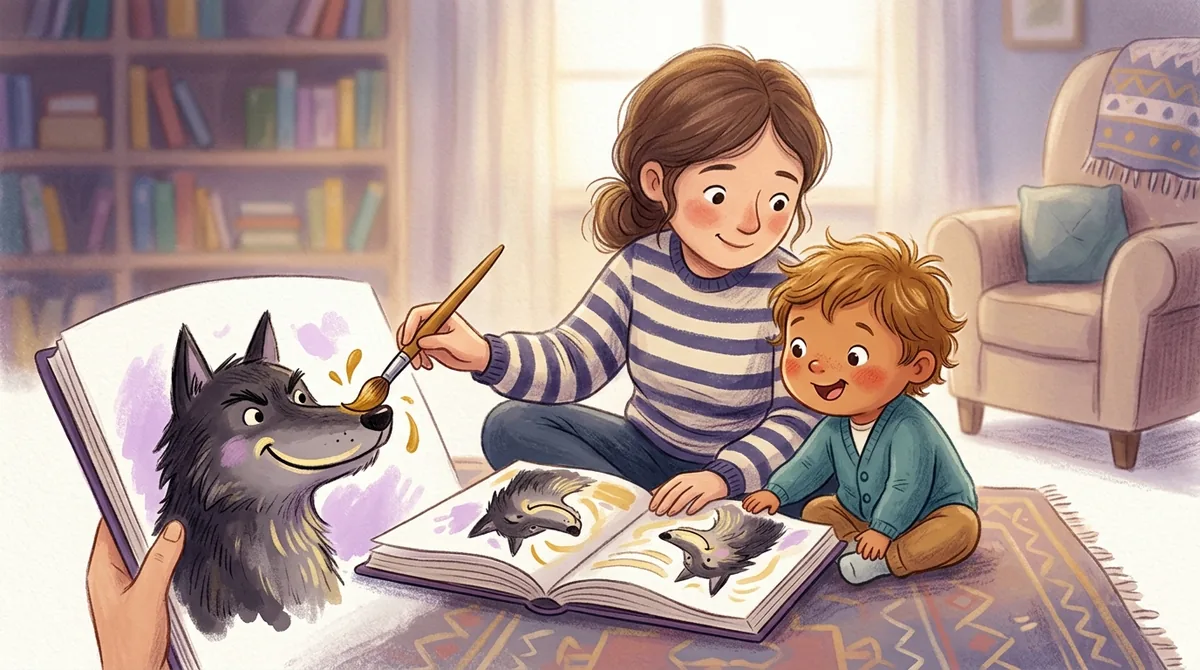
Make the wolf smaller, sillier or worse at his job. He gets the bonnet on backwards. He cannot do the grandmother's voice and has to keep trying. A villain who is slightly ridiculous is still a villain, and still beaten, but the fear has a laugh in it. The wolf in The Wolf and the Seven Little Kids already does this, dipping his paw in flour to look like a goat.
3. Add a warning
Let someone in the story see it coming. A bird calls "Not that way!" from the hedge. Grandmother hears the knock and hides in the cupboard first. The child who knows the wolf is coming and knows the grandmother is safe can enjoy the knock at the door. In your own words: "Now, Grandmother was a clever old lady, and when she saw those ears under the window, she slipped into the wardrobe and pulled the door to."
4. Change the consequence
The wolf is chased off, shut out, sent away with a sore head, rather than killed. This is the biggest change and the one to use for the under-fives; the library's gentler Red Riding Hood and the much-loved Little Blue Riding Hood both take some version of it. What you keep is that the wolf loses. Say it clearly: "And the wolf ran off into the forest and never, ever came back to that part of the wood again."
What none of these do is delete the wolf. A Red Riding Hood without a wolf is a walk.
Personalising: the child in the story
Under about six, the most powerful edit is the smallest: the child's name in the hero's place. Above six, children usually prefer a stand-in with one detail that is theirs. Either way, the exact phrasing at the start does the work:
- "Once upon a time there was a girl called Nell, and she lived in a house that was very like this one, on a road that was very like Oak Lane, only it had a forest at the end instead of the Co-op."
- "She had a red cloak, exactly like the one on your peg, and a dog, exactly like Biscuit, only in the story he could talk."
- "And her grandmother lived across the wood, in a cottage a bit like Nana's flat, with the same blue front door."
Then tell the tale straight. The child will supply the rest of the personalising themselves: "Would Biscuit have barked at the wolf?" Yes, he would, and now the dog is in the story, and the dog is the warning from technique 3. Some tales resist a name swap and some invite it. Anything with a numbered cast, three bears, seven dwarfs, six swans, takes a whole family or a whole class of nursery friends; Goldilocks and the Four Bears is the library's own demonstration that you can add a bear if the household has one. Anything with a single small hero, Tom Thumb, Thumbelina, the youngest goat, takes one child perfectly.
Updating: new settings, new jobs, same beats
Updating is changing the world of the tale while leaving its skeleton alone. The princess in The Princess and the Pea can arrive by bus; the test is still a small hard thing under a great many soft ones, and she still feels it. The library's The Picky Prince, the Princess and the Peanut does precisely this kind of update. Rules of thumb:
- Change the setting freely. Forest to park, castle to tower block, mill to garage. The beat is "far from home"; where does not matter.
- Change the jobs. The miller can be a baker, a mechanic, a bus driver. The beat is "a parent who boasts", not the flour.
- Change who does the rescuing. The library's princess stories collection is full of princesses who do their own rescuing, and no child has ever objected to the girl with the sword. The beat is "the trapped one is freed"; who holds the key is paint.
- Do not change what the beat is for. If the huntsman becomes a police officer, fine; if he becomes a friendly wolf-whisperer who talks the wolf into vegetarianism, the tension has nowhere to go and the child will not sleep any better for it.
A worked example: three little pigs, one small hedgehog
Here is the beginning of a three-pigs adaptation for a four-year-old called Rosa who has a hedgehog obsession and a wolf worry. The pigs have become hedgehogs, the wolf has been shrunk to a fox with a cold, and the setting is the child's garden. The three tries and the huffing are untouched.
At the bottom of a garden very like this one lived three hedgehogs, and the smallest was called Rosa. One autumn their mother said, "It is time you built your own houses for winter." The first hedgehog built hers of leaves, because leaves are quick. The second built his of twigs, because twigs are nearly as quick. Rosa built hers of stones from the rockery, which took all day, and her paws ached. That night a fox came down the garden. He had a cold, and a stuffy nose, but a fox with a cold can still huff. He huffed at the house of leaves, and, well. You know what happened.
The fox loses, of course: three huffs, a sneeze, and he goes home with his nose sorer than it was. Then all three hedgehogs sleep in the stone house, which is the calm ending, and it is the beat the original has always had. Rosa asked for it eleven nights running.
Two edits that do not work
Removing the villain. Covered above, but it bears repeating because it is the most common mistake: a parent, meaning well, tells Hansel and Gretel without the witch, and the child, who knows the shape of stories better than they know the alphabet, asks "but where is the bad bit?" Hansel and Gretel can be told with a witch who is simply pushed out of her own door and locked out, and that is a fine edit. A gingerbread house with nobody in it is not a story.
Adding a lecture. The second most common: "and so Red Riding Hood learned never to talk to strangers." The tale already taught it, the way every fairy tale teaches, by showing what happened. Saying it aloud converts a story into a warning and wakes the child up. If you want the moral discussed, use the "Talk about it" questions on the story page in the morning, not the last line at night.
An age guide to how much to change
- Under 3: Cast and setting from the child's own life, villain shrunk to a nuisance, consequence changed. The tale is really a rhythm at this age.
- 3 to 5: Villain kept, fright moved offstage or given a warning, child's name in. Consequence softened for the wolf, kept for the witch, because a witch outwitted is the whole point.
- 5 to 8: Tell it nearly straight. Update the setting if it helps, let the child pick who rescues whom, and stop softening the ending: they can take it, and they will notice if you flinch.
- 8 to 12: Tell it straight and then tell them how Perrault ended it, and why the Grimms changed it. At this age the history of the adaptation is the best story of all.
Tonight
Pick one tale the child already knows so the shape is not in doubt, and make one change only: their name, or the wolf's cold, or the castle at the end of the road. Read the site's version first if you need the beats fresh: the gentler Little Red Riding Hood for a preschooler, The Princess and the Pea if you want to try updating, Snow White and the Seven Dwarves if there are seven friends at nursery who need casting. Once you are comfortable changing paint, how to write a bedtime story shows how to build the load-bearing parts yourself.