
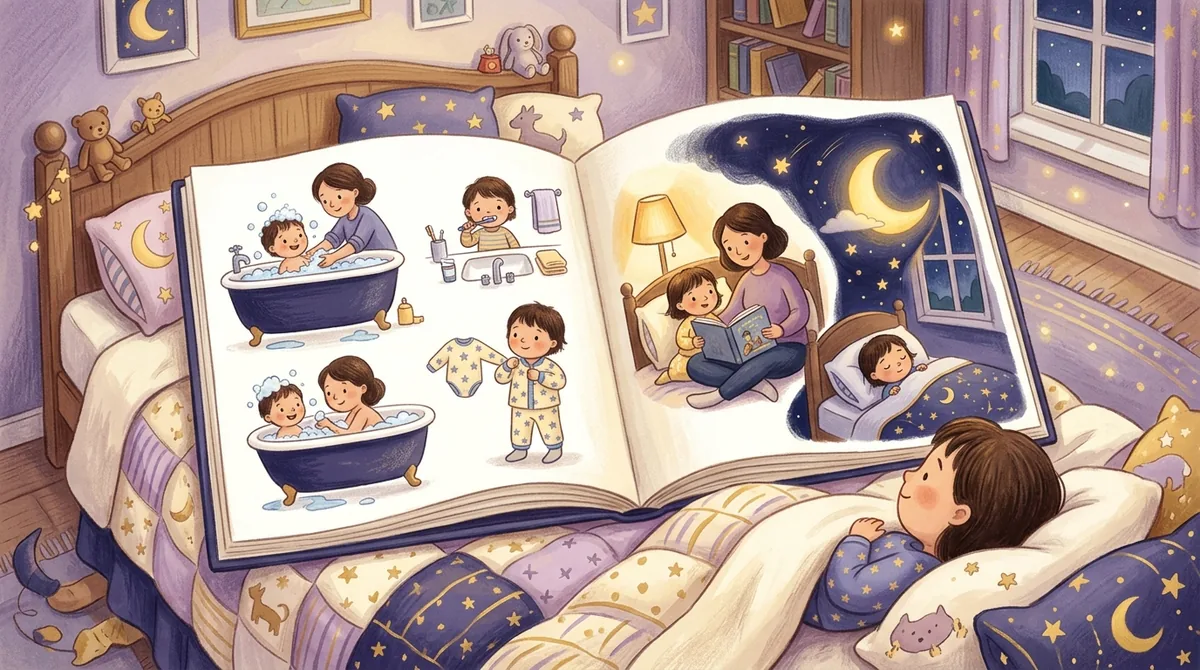
A bedtime story is the last thing that happens before the light goes off, and that position is the whole point. It is a signal, a wind-down and a conversation folded into one ten-minute ritual, and it is the most reliable sleep cue a family can build. This guide is the long version: what a story does for a child, when to begin, what to read at each stage from the first months to the last years of being read to, how to read so that they ask for another, and what to do on the nights it all falls apart. Each section points to a fuller guide where one exists, and to stories in the library you can read tonight.
What a bedtime story actually does
Three things happen at once when you read to a child at bedtime, and it helps to separate them, because they need different care.
The first is sleep. A story is predictable, quiet, screen-free and slow. It lowers the pace of the evening, gives the body a fixed cue that sleep is next, and ends on a note you control. Research on bedtime routines consistently finds that children with a fixed routine fall asleep sooner and wake less in the night, and that the effect grows the longer the routine is kept up. The story is the easiest anchor for that routine because it is the one step a child actively wants.
The second is language. Story language is denser and stranger than talk. Nobody says at breakfast that the goats went trip-trap, trip-trap over the bridge, or that the emperor's new clothes were light as cobwebs; a child hears words like these only in books. Ten minutes a night, for years, adds up to a vocabulary and a feel for sentence shape that a child cannot get any other way before they can read for themselves. The mechanism and the evidence are set out in the benefits of bedtime stories.
The third is the two of you. It is ten minutes of undivided attention with no task attached, in a dim room, sitting close. Children process the day through it; parents find out what is bothering them because the story gives the worry a name and a face. When the ugly duckling is chased away from the farmyard, a five-year-old who had a bad day in the playground will tell you about it, unprompted, in a way that "how was school?" never produces.
What to read at each age
When to start, and when to stop
Start before it looks like it makes sense. A baby of a few months cannot follow a plot, but they can hear your voice slow down, feel your chest rise and fall, and learn that this rhythm means the day is ending. Nursery rhymes are the first stories for exactly this reason: they are short, sung, and built entirely of rhythm. There is no age at which it is too early.
Stop later than you think. Most children who drift away from bedtime stories do so between eight and eleven, and the usual cause is that the stories stopped growing while the child kept going. A ten-year-old who is bored by the three bears is not bored by being read to; they are bored by the three bears. Move them on to the long literary tales, the myths, and stories whose endings are not entirely tidy, and most come back. The whole run from birth to twelve, with the right stories for each stage, is mapped in bedtime stories by age.
Babies (0–12 months)
Rhythm over plot. Rhymes, songs, any short text with a strong beat, read in the same soft voice every night. They are listening to you, not to the words.
Toddlers (1–3)
Short, repetitive and safe. Toddlers want the same two or three stories for weeks, with animals they recognise, a small surprise and no real peril. The Enormous Turnip is close to perfect: a line of characters pulling in turn, a refrain to join in with, and a happy ending in under five minutes. Expect to be corrected if you skip a line. That is not a problem; it is the learning showing.
Preschoolers (3–5)
The first real stories. A hero to root for, a problem that feels big but is never frightening, and an ending that puts the world right. This is the age for the kindest versions of the classic fairy tales and the first Aesop's fables. The Lion and the Mouse lands well at four: the smallest creature in the story turns out to matter most, which is exactly what a four-year-old wants to hear.
Early readers (5–8)
Longer tales, cleverer heroes, and a villain who is properly villainous. Children this age can follow a story across chapters and hold two characters in their heads at once. The fuller fairy tales come into their own here, with their giants, wolves and witches, and so do fables with morals worth arguing about. Some will want to read the first page to you. Let them, and take over before it becomes a chore.
Big kids (8–12)
Rich language and endings that reward thinking. The Snow Queen, The Happy Prince and the longer folk tales suit this age, read over several nights. The story-book mode on each page splits long stories into chapters, so you can stop at a natural place and pick up tomorrow.
Building the routine around the story
The story works best as the last fixed step in a short sequence that never changes order. The sequence matters more than its contents; a routine of bath, teeth, story and lights out works no better than wash, pyjamas, story and lights out, but either works much better than a different order every night. Keep it to twenty or thirty minutes from the first step to the dark room. Longer routines drift, and a drifting routine loses its power as a cue.
A few rules that hold at every age:
- The story is not a reward. Never withhold it for bad behaviour. A child who loses the story loses the wind-down, and everyone pays for that at midnight.
- One story, agreed in advance. "One story" said before the book opens is a boundary. "One more" negotiated after the ending is a bid for time, and it never stops at one.
- Same place, same light. Read where the child sleeps, with the main light already off and a lamp on. The night-light dim mode on every story page exists for this reason.
- The reader stays calm. A parent who is visibly counting the minutes reads faster and the child notices. If tonight is a five-minute night, pick a five-minute story rather than rushing a ten-minute one.
How to build the sequence, how long each step should take, what changes for toddlers, and how to handle the nights it drifts are all covered in the bedtime routine guide.
How to read aloud so they ask for another
Most parents read too fast. Read at about two-thirds of the speed that feels natural, and slower still in the last two paragraphs. Pause at every page turn, or every chapter in story-book mode, long enough for a question. Give the big character a low, slow voice and the small character a quick, high one, and read the narration as yourself; three voices are plenty, and accents are unnecessary. Let the ending land in near-silence. Then close the book, say the same goodnight words you always say, and leave.
Questions during the story double what a child gets from it, but only if they are the right questions in the right places. Two or three per story, open rather than testing, asked at a natural pause: "What do you think the fox wants?" rather than "What colour was the fox?" Every story page has a Talk about it section with three to five questions written for that story, and a Words to know list for the vocabulary. Use them before the ending, not after, because after the ending the job is sleep.
Pacing, voices, questions, and what to do when a child interrupts, wriggles or wanders off are covered in how to read a bedtime story aloud.
Choosing the story for tonight
The library holds more than three hundred stories, which is too many to choose from at nine o'clock, so use the filters that matter at bedtime.
- Start with length. If the evening has run late, go straight to the five-minute stories: complete tales, not extracts, that end before the yawns win. Ten minutes is the classic bedtime length, and the long stories are for weekends and older children.
- Then mood. An overexcited child needs the gentle sleepy stories, where nothing frightening happens and the pace is slow. A child who has had a hard day needs a story about the feeling; a child who wants to giggle can have a funny one, a little earlier in the evening.
- Then age. Every story page shows suggested ages and read-aloud minutes at the top, so you can check both in a glance.
- Or let the site choose. Tonight's story picks one story a day for the whole site, which removes the decision entirely on the nights you have no decisions left.
Browse the whole collection at the story library, by theme, age, length or collection. The Next-story button on each page stays within the same theme, so a good choice tonight leads to a good one tomorrow.
Using the story page at bedtime
Every story page is built for a dim room and a tired reader, and a few of its features change how the ten minutes go. The read-aloud minutes and suggested ages sit at the top, so you can check the length before you commit. Story-book mode turns the chapters into swipeable pages with large text, which is easier to read by lamplight and gives a natural place to pause; a page turn is a better spot for a question than the middle of a paragraph. The night-light mode dims the screen to a warm glow, and the font-size controls mean you can read from arm's length without glasses.
The Listen button reads the story in the device's own voice and highlights each paragraph as it goes. It is not a substitute for you, but it is a good second-best on the nights your voice has gone, on long car journeys, and for a child who wants to follow the words with a finger. Stay in the room, keep the screen dimmed, and it does no harm at all. Below the story sit the Talk about it questions, the Words to know list and the moral in a single line, which is there for you rather than for the child; if you want to point the lesson, a question does it better than the sentence. The Next-story and Previous-story buttons stay within the same theme, so a child who wants "another one like that" tomorrow can have it.
Where the stories come from
Almost everything called a fairy tale was once a story for adults. Charles Perrault polished French folk tales for the court of Louis XIV and published eight of them in 1697, giving the world the glass slipper, Puss in Boots and the first printed Red Riding Hood. Jacob and Wilhelm Grimm collected German household tales for scholarship, publishing their first edition in 1812 and softening the darkest corners edition by edition. Hans Christian Andersen, born in Odense in 1805, invented his own: the ugly duckling, the little match girl, the snow queen, the emperor's new clothes. Andrew Lang's twelve coloured fairy books, from the Blue in 1889 to the Lilac in 1910, brought tales from every continent into English nurseries. Aesop's fables are older than all of them.
Knowing this changes how you read. The site's classic tales are retellings adapted for bedtime, as every version told to a child has always been; softening a scene for the child in front of you is not cheating, it is the tradition. It also helps to know which wolves are meant to be frightening and which are meant to be funny. The story of the storytellers, from fireside to nursery, is told in a short history of fairy tales.
When bedtime goes wrong
Every family has nights when the story ends and the child does not settle. There are four usual causes, and they need different fixes.
- Overtiredness. The child is wired, silly, tearful, and bedtime was too late. Tomorrow, start the routine twenty minutes earlier. Tonight, keep the lights low and stay boring.
- A routine that drifted. A week of late nights, a holiday, a new baby. Rebuild the sequence from the first step tonight and hold it for a week.
- A fear that has not been named. The story was too much, or something at school is. Name it plainly, sit a little longer, and choose a gentler story tomorrow.
- A bid for more time. The most common one after four. Warm, brief, firm: "Story's finished. I love you. See you in the morning."
In none of these cases is a second story the answer. It rewards the resistance, it pushes sleep later, and it turns "one story" into a negotiation every night after. The one exception is the child who is genuinely frightened, and even then a two-minute rhyme said from memory with the lights off does the job better than reopening a book.
Telling your own stories
Some of the best bedtime stories are never written down. A story about the child, their street, and the small problem they had at nursery today is the oldest bedtime trick there is, and it needs no talent, only a shape: a hero the child likes, one problem, three tries, and a calm ending. Retelling a fairy tale with your child's name in it works the same way, and children of four and five will happily co-author, given an "and then what?" at the right moment. On the nights you have nothing left, a rhyme from memory or the site's read-aloud voice with you lying beside them keeps the ritual alive; skipping it entirely is the only real mistake. The step-by-step, with a template you can fill in tonight, is in how to write a bedtime story.
Where to start
If your child is under three, open The Enormous Turnip and read it slowly, and again tomorrow. If they are three to five, try The Lion and the Mouse and ask the first question from the Talk about it section when the lion laughs. If they are five to eight, The Elves and the Shoemaker is a ten-minute story with a kind ending and a good pause in the middle. If they are older, start The Snow Queen in story-book mode and read one chapter a night. And if you cannot decide, tonight's story has decided for you.