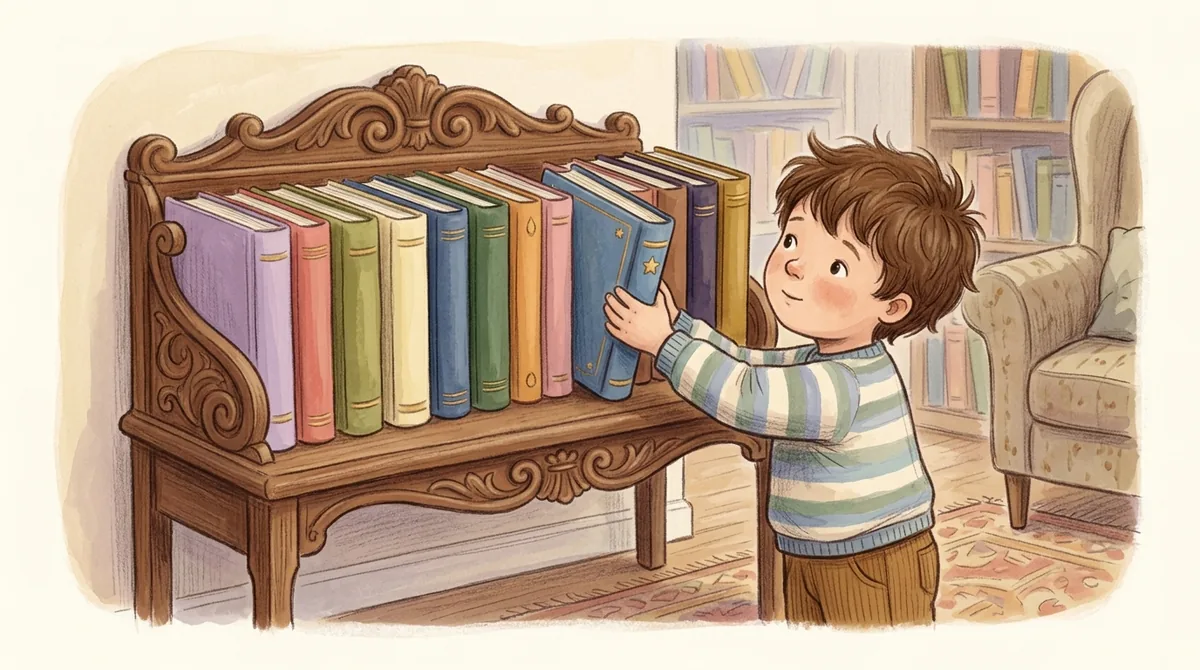
Andrew Lang wrote or edited something like a book a month for forty years, and the only ones anybody still reads are the twelve with colours on the cover. The Blue Fairy Book of 1889 and its eleven successors, ending with the Lilac Fairy Book in 1910, are the reason an English-speaking child of the twentieth century knew Norwegian trolls, Russian firebirds and Romanian enchanted pigs as well as Cinderella. This guide explains who Lang was, who actually did the work, what is in each of the twelve books, and which of the less familiar classics on this site came from them, so that when you open the classic tales section you can tell the Lang tales from the rest.
The man on the cover
Lang was born in Selkirk, in the Scottish Borders, on 31 March 1844, the eldest of eight children of the town clerk. He was educated at Edinburgh Academy, St Andrews, Glasgow and Balliol College, Oxford, and held a fellowship at Merton until his marriage in 1875 to Leonora Blanche Alleyne, after which he moved to London and lived by his pen. He was, in no particular order, a poet, a translator of Homer (the Butcher and Lang Odyssey of 1879 was the standard prose version for decades), a journalist who could write a leader on anything, a historian of Scotland, a psychical researcher, a golfer, a cricketer, a fisherman, and an anthropologist who argued in Custom and Myth (1884) and Myth, Ritual and Religion (1887) that myths and fairy tales were the survivals of very old human thinking rather than, as the Oxford professor Max Müller held, a 'disease of language'. He was funny and prolific and rather sad, and he died at Banchory on 20 July 1912.
His interest in fairy tales was scholarly before it was commercial. He wrote the long introduction to Margaret Hunt's complete Grimm in 1884, edited Perrault in French in 1888, and was a founding member of the Folklore Society. When his publisher Longmans, Green proposed a children's anthology, Lang had both the learning to choose the tales and the name to sell them.
Who actually did the work
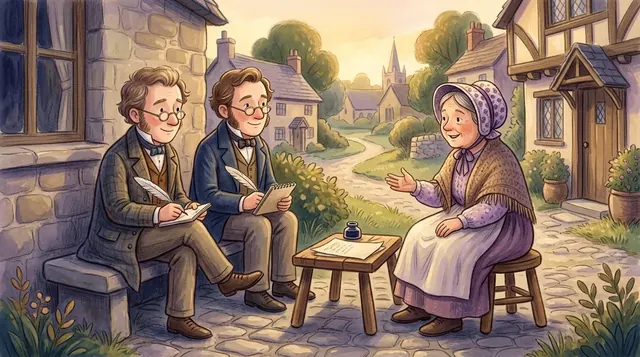
Lang was honest about this, and posterity was not. In the preface to the Lilac Fairy Book he wrote that the fairy books 'have been almost wholly the work of Mrs. Lang, who has translated and adapted them from French, German, Portuguese, Italian, Spanish, Catalan, and other languages', and added that his own part had been that of Adam in the Garden of Eden as described by Mark Twain: 'Eve worked, Adam superintended.' Leonora Lang (1851–1933) led a shifting team of translators and adapters, many of them women, credited in the prefaces by initial or surname: May Kendall, Violet Hunt, Mrs Sellar, Miss Blackley, Miss Alma Alleyne, and others. Lang chose the tales, wrote the prefaces and, for the early books, translated some of the French himself. The books were, in other words, a workshop, and the name on the spine is a brand as much as an author. This matters for the history and it matters at bedtime, because the plain, quick, slightly formal English that children hear in a Lang retelling is chiefly Leonora's.
The pictures were Henry Justice Ford's, more than a thousand of them across the twelve volumes (G. P. Jacomb-Hood helped on the Blue and Lancelot Speed on the Red). Ford's princesses with long necks and heavy hair and his sad-eyed dragons are how two generations of children saw fairyland, and a good deal of later fantasy illustration descends from them.
The twelve books, and what came from each
- The Blue Fairy Book (1889). The classics: Perrault's eight, the best-known Grimms, Aladdin and the Forty Thieves, and a leavening of Norway. On this site from the Blue: East of the Sun and West of the Moon, The Yellow Dwarf, Prince Hyacinth and the Dear Little Princess, The Master Maid, Why the Sea is Salt, The Wonderful Sheep, Prince Darling, The Water Lily and the Gold-Spinners, The Goose Girl and Snow White and Rose Red.
- The Red Fairy Book (1890). More Norse, more d'Aulnoy, and the Grimms not used in the Blue. From the Red: The Twelve Dancing Princesses, The Princess Mayblossom, The Enchanted Pig, Dapplegrim, The Three Dwarfs, The Six Sillies, The Ratcatcher, The True History of Little Golden Hood, The Seven Foals, The Little Good Mouse and Princess Rosetta.
- The Green Fairy Book (1892). Lang wrote in its preface that it would probably be the last; it was not. From the Green: The Blue Bird, One Eye, Two Eyes, Three Eyes and The Fisherman and His Wife.
- The Yellow Fairy Book (1894). Heavy on Andersen, Russia and the Baltic. From the Yellow: The Six Swans, The Dragon of the North, The White Duck, and Andersen's The Emperor's New Clothes and The Tinderbox.
- The Pink Fairy Book (1897). Japanese, Sicilian, Danish and African tales. From the Pink: The Two Frogs and Andersen's The Fir Tree.
- The Grey Fairy Book (1900). Lithuanian, Greek, Bohemian and African tales; from the Grey, Long, Broad and Sharpsight.
- The Violet Fairy Book (1901). Romanian, Swahili, Serbian and Japanese tales.
- The Crimson Fairy Book (1903). Hungarian, Finnish, Icelandic and Sicilian tales.
- The Brown Fairy Book (1904). Australian Aboriginal, American Indian, Persian and Lapp tales, with the prefaces now warning that some heroes are 'not always quite so well-behaved as they should be'.
- The Orange Fairy Book (1906). Tales from Rhodesia, Uganda, Jutland and Punjab, among others.
- The Olive Fairy Book (1907). Turkish, Indian, Danish, Armenian and Sudanese tales.
- The Lilac Fairy Book (1910). Portuguese, Irish, Welsh and Indian tales, with the preface in which Lang set the record straight about who had written the series.
The pattern is visible in the list. The early books are European and canonical; the later ones go further and further afield, as Leonora Lang and her team exhausted the French and German collections and started on the ethnographers. That is why the folk tales from around the world collection on this site has so much Lang in it, and why a child raised on the Blue Fairy Book and a child raised on the Olive would have had rather different ideas of what a fairy tale was.
The Lang treatment
The Langs' retellings have a house style, and it is worth knowing because it is the style most of the site's classic retellings inherit through them. Three things were done to every tale.
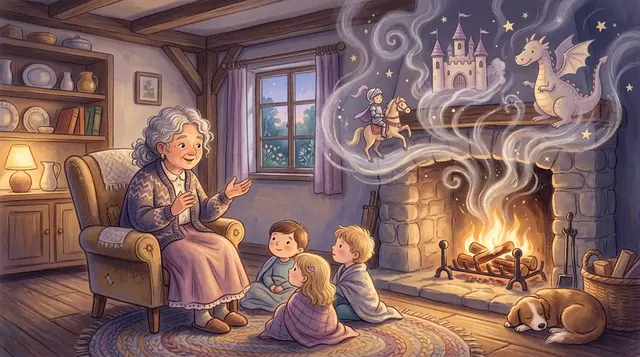
It was shortened. D'Aulnoy's tales run to fifty pages in French; the Blue and Red versions are a fifth of that, with the courtly speeches cut and the plot kept. It was cleaned: Lang told his readers that the stories were 'not to be told to children who are too young', but in practice the team removed the sexual and the very cruel, softened deaths, and left the tales' basic justice intact. And it was Anglicised in rhythm, not in setting. The princes stay Norwegian or Romanian, but they speak in the short declarative sentences of a Victorian nursery, and the narrator never winks. A Lang tale sounds like this: Once upon a time there was a poor man who had so many children that he had not food enough to give them. That plainness reads aloud beautifully, which is one reason it lasted.
What Lang was arguing for
The fairy books were not only entertainment; they were a position in an argument. Lang's prefaces return again and again to the educators who thought children should read only what was true and improving. In the Lilac preface he wrote that 'nobody can write a new fairy tale; you can only mix up and dress up the old, old stories', and in others he defended the tales' appeal on the anthropologist's ground that they were the oldest and most universal of all human amusements, enjoyed by 'the naked ancestors of civilised mankind' as much as by modern children. He also wrote fairy tales of his own, Prince Prigio (1889) and Prince Ricardo (1893), which are affectionate parodies, and he had a hand in the vogue for fantasy that produced Nesbit, Barrie and, eventually, Tolkien, who read the Red Fairy Book as a boy and singled out its Story of Sigurd as the tale that made him want dragons. The history of fairy tales places Lang at the end of the long English quarrel about whether children should have wonder tales at all; the short version is that after the Blue Fairy Book the question was closed.
Reading a Lang tale tonight
Lang's collections are where to go when a child has heard the famous tales too often and wants something with the same shape and a new coat. The princess tales are the easiest entry: The Princess Mayblossom, Princess Rosetta, The Twelve Dancing Princesses and Prince Hyacinth are all in the princess stories collection, and the first two are d'Aulnoy at her most inventive. For a boy or girl who wants a quest with a horse, Dapplegrim is the best fairy tale most people have never heard of. For an older child who likes a story with a rule in it, East of the Sun and West of the Moon, in a chapter a night. Tell them the book it came from had a blue cover and was published when Queen Victoria was on the throne, and that the woman who wrote the words down was called Leonora. It is the least she is owed.