The short version: sit where the child can see the page and your face, read more slowly than you think you need to, give the big character a low voice and the small one a high voice, stop at the page turns, and slow right down as the story lands. That is nearly all of it. The rest of this guide is the detail: why each of those things works, the exact words to use, and what to do on the nights when the child talks over you, kicks the duvet off, or demands The Three Billy Goats Gruff for the fourteenth time.
One thing to say first. A bedtime story is not a performance. You are not auditioning; the child is not an audience. The goal is a calm child who feels close to you and who has heard some good sentences. A parent who reads flatly but warmly, every night, is doing far more good than one who does all the voices twice a month. If you take one thing from this page, take the slow ending. Everything else is a bonus.
Set up the room before you open the page
Half the battle is over before you read a word. The lights should already be low, the child should already be in bed or on it, and whatever comes after the story (a song, a kiss, lights out) should already be agreed. If the story is the last calm thing before sleep, it needs to be read in a room that is already calm. Reading a lovely story and then starting a negotiation about teeth undoes the story. Teeth first; the bedtime routine guide covers the order.
Then position. For children under about six, sit so they can see the illustrations and your mouth; both help them follow. On a phone, that means the phone held between you, not in front of your face. The story-book mode on every story page turns the chapters into swipeable pages with big text, which is designed for exactly this: you can hold the phone low, at duvet height, and the child can see the words. Switch on the night-light dim mode so the screen is not the brightest thing in the room. For older children who are lying down with their eyes closed, none of this matters, and you can sit wherever your back prefers.
Look ahead so you are never surprised by your own page
Before you begin, glance down the story. Thirty seconds is enough. You are looking for three things: how long it is (so you can choose whether tonight is a whole-story night or a stop-at-a-chapter night), whether there is a scary bit (so you can decide in advance how to read it, rather than deciding mid-sentence), and whether there is a refrain you can hand to the child. The site shows the length in minutes and the suggested ages at the top of every story, and the classic tales are marked as retellings adapted for bedtime, so the worst edges are already softened. But a child who is going through a frightened-of-wolves phase does not need The Wolf and the Seven Little Kids tonight, however gentle the version. Look first.
Looking ahead also stops the two commonest stumbles: reading a line in the wrong voice because you did not see who was speaking until the "said the fox" at the end, and getting halfway through a long story and realising it is not going to finish. Both are recoverable. Neither is ideal.
Read slower than feels natural, then slower again
This is the single biggest change most parents can make. Adults talk at around 150 words a minute and, when tired, read aloud faster than that, because the eyes run ahead of the voice. A five-year-old following a story is building every picture in their head from scratch: the bridge, the water, the troll underneath. That takes time. A story read at talking speed is a story half of which the child never sees.
Aim for two-thirds of your natural speed. It will feel ponderous to you. It will not to the child. A practical way to find the pace: read a sentence, and before you start the next one, breathe in through your nose. That one breath is roughly the gap a child needs to finish the picture. On the site, each story shows its read-aloud minutes; if you are finishing a ten-minute story in six, you are reading too fast.
The speed should not be constant. A story has four speeds:
- Opening: unhurried and even. "Once upon a time there were three billy goats, and the name of all three was Gruff." Let the world arrive.
- Action: a little quicker, a little brighter. The gingerbread man running, the wolf huffing. This is where children sit up. Do not be afraid of it; a story that is all hush is boring, and a bored child fidgets.
- The turn: the moment the problem is solved. Slow down again here, because this is what the child has been waiting for and they want to savour it. The biggest goat lowering his horns; Red Riding Hood realising what big teeth grandmother has.
- The landing: the last two or three paragraphs. Slowest of all, and quieter. More on this below, because it is the part that decides whether the child sleeps.
Pause at the page turns and the full stops
A pause is not dead air; it is where the child does their thinking. The most useful pauses are at the page turn (in story-book mode, before you swipe), at the end of a paragraph that ends a scene, and just before a line the child knows is coming. That last one is gold. In The Gingerbread Man, stop before "Run, run, as fast as you can" and look at the child. By the third reading they will say it for you. A child who says the refrain is a child who is fully inside the story, and a child fully inside a story is not thinking about the dark or the monster under the bed.
Pause also after anything surprising. "And the wolf swallowed grandmother whole." Then wait. Three seconds feels like an age; hold it anyway. The child needs a moment to register the shock and a moment to look at your face and confirm it is still safe. It is. You are right there, and the wolf is on a page.
Give characters a hint of a voice, not a full one
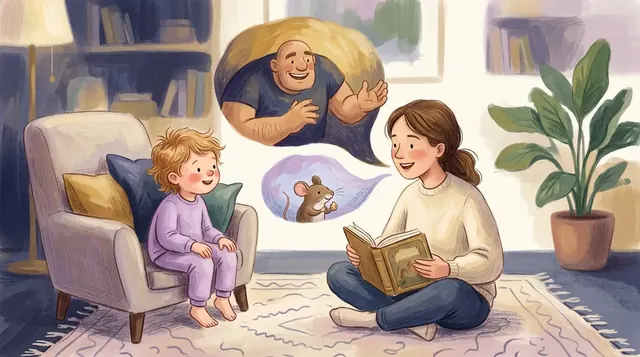
You do not need to be good at voices. You need two: a low, slow one for whoever is big, and a high, quick one for whoever is small. The narrator is your own voice. That is the whole system, and it works for almost every story in the library. The troll under the bridge is low and slow; the smallest billy goat is high and quick; you are you. The lion is low; the mouse is high. The wolf is low and, crucially, smooth, because the wolf in Little Red Riding Hood is not frightening because he growls but because he is polite.
Keep the voices small at bedtime. A voice that is funny at four in the afternoon can be too much at eight at night. The rule is that the voice should never be louder or faster than your narrator voice. If you find yourself performing, drop it back to your own voice for a page and let the words do the work. The full method, with a cast list for the site's wolves, giants, mice and fables, is in Character Voices for Bedtime Stories.
The ending is the part that matters
Every story on the site was chosen or adapted to land calmly, but landing is still up to you. Here is the technique, and it is the one piece of this guide that is genuinely about sleep rather than about reading.
- When you can see the last two paragraphs, take a breath and halve your speed.
- Lower your volume, sentence by sentence, so the final line is nearly a whisper. Children lean in to a quiet voice; they cannot lean in and thrash about at the same time.
- Lengthen the gaps between sentences. By the last one, the gap should be long enough that you could count to three.
- Read the final line, close the book or dim the screen, and say the same closing words you say every night. Ours is "and that is the end of the story"; yours can be anything, but it must be the same every night, because the repetition is the signal.
- Do not start another story. If the child asks for one, the answer is "Tomorrow. Which one shall we have tomorrow?" That gives them a choice and keeps tonight's ending as the ending.
Andersen's The Ugly Duckling is the model of a landing: the last page is nothing but the duckling seeing his reflection and feeling glad. Read that page at half speed and you will watch a child's shoulders drop. Aesop's fables are the opposite; they end on a moral, which is a sharp, wakeful sort of line, so if you finish with a fable, read the moral and then add one soft sentence of your own: "And the tortoise went home to bed."
Ask a question or two, in the right place
A story read straight through is good. A story with two or three open questions at natural pauses is better, because the child talks, and talking about a story is how the words in it become theirs. But there is a right amount and a right moment. The right amount is two or three per story, never one per page. The right moment is a pause you were going to take anyway: a page turn, a scene end, or the moment before a character decides something. "What do you think the little goat will say to the troll?" at the page turn is perfect. The same question in the middle of the troll's speech is not.
Every story page has a "Talk about it" section with three to five questions written for that story, so you need not invent them. Ask one during, one after, and let the child's answer go wherever it goes. If they say something you disagree with, the reply is "Hmm, maybe," not a correction. There is a whole guide on this, Questions to Ask During a Bedtime Story, including which questions kill a story stone dead.
What to do when it is not going well
Three things go wrong most often, and each has a different fix.
The child keeps interrupting
With a question, a comment about the picture, an unrelated fact about their friend's dog. This is engagement. Answer briefly and go back: "Yes, that is a big dog. And the goat went trip-trap over the bridge..." If there are more than a handful of interruptions, the story is too long for tonight or the child is too tired; either way, shorten. Do not fight it. The long version of this is in Reading Aloud to a Child Who Interrupts, Wriggles or Wanders Off.
The child wants the same story again
Read it. Repetition is not a failure of your library; it is how children under six learn language and how children of any age feel safe. A story heard twenty times is doing more, not less. The trick is to keep yourself interested: hand the child the refrains, change one small voice, or ask a question you have never asked before. See Why Children Want the Same Story Every Night.
The child is frightened
Stop, rather than push through. Put your hand on them and say "Shall I tell you what happens?" and summarise the rest in one calm sentence: "The woodcutter comes and grandmother is fine and the wolf runs away." A frightened child does not need the scene; they need the ending. Tomorrow, choose from the gentle sleepy stories instead.
Choosing the story, and using the page
Which stories are easiest to read aloud well
Some stories are built for the voice. The old classic tales were told aloud for centuries before anyone wrote them down, and it shows: they have refrains, threes, and a shape you can feel coming. If you are new to reading aloud, or nervous about it, start there. The Three Billy Goats Gruff is the perfect first read: three goats, one troll, a refrain, two voices, five minutes. The Enormous Turnip gives the child a job (the pulling). The Lion and the Mouse is a two-voice fable with a kind ending. The Elves and the Shoemaker is the gentlest of the Grimm tales and lands beautifully. Longer, literary stories such as The Snow Queen reward a more confident reader and an older child, and are best read a chapter a night.
Use the page, not just the words
The site's story pages have features that are meant to help the reading, and most of them are worth knowing about. The font-size controls let you make the text big enough to read at arm's length in dim light. The Listen button uses your device's own voice and highlights the paragraph being read, which is useful for the night your voice has gone, though a parent's voice remains the first choice; there is a guide to using the read-aloud voice well. The "Words to know" list is worth a glance before you start: if the story turns on a word the child will not know (a "sty", a "spindle", a "tinderbox"), you can drop the meaning in as you read ("a spindle, that is the pointy bit of a spinning wheel") rather than stopping for a lesson. And the Next-story and Previous-story buttons stay within the same theme, so a child who loved tonight's fable is one tap from tomorrow's.
Tonight
Pick something short and familiar from the story library, or let tonight's story choose for you. Before you begin, glance to the end. Read the first page at two-thirds speed, stop at the first page turn, and look at the child. Give the big character a low voice. Ask one question at the halfway point. Then, when the last two paragraphs are in sight, halve your speed, drop your voice, and land it. Say your closing words. Do not read another. That is the whole technique, and it is enough.