
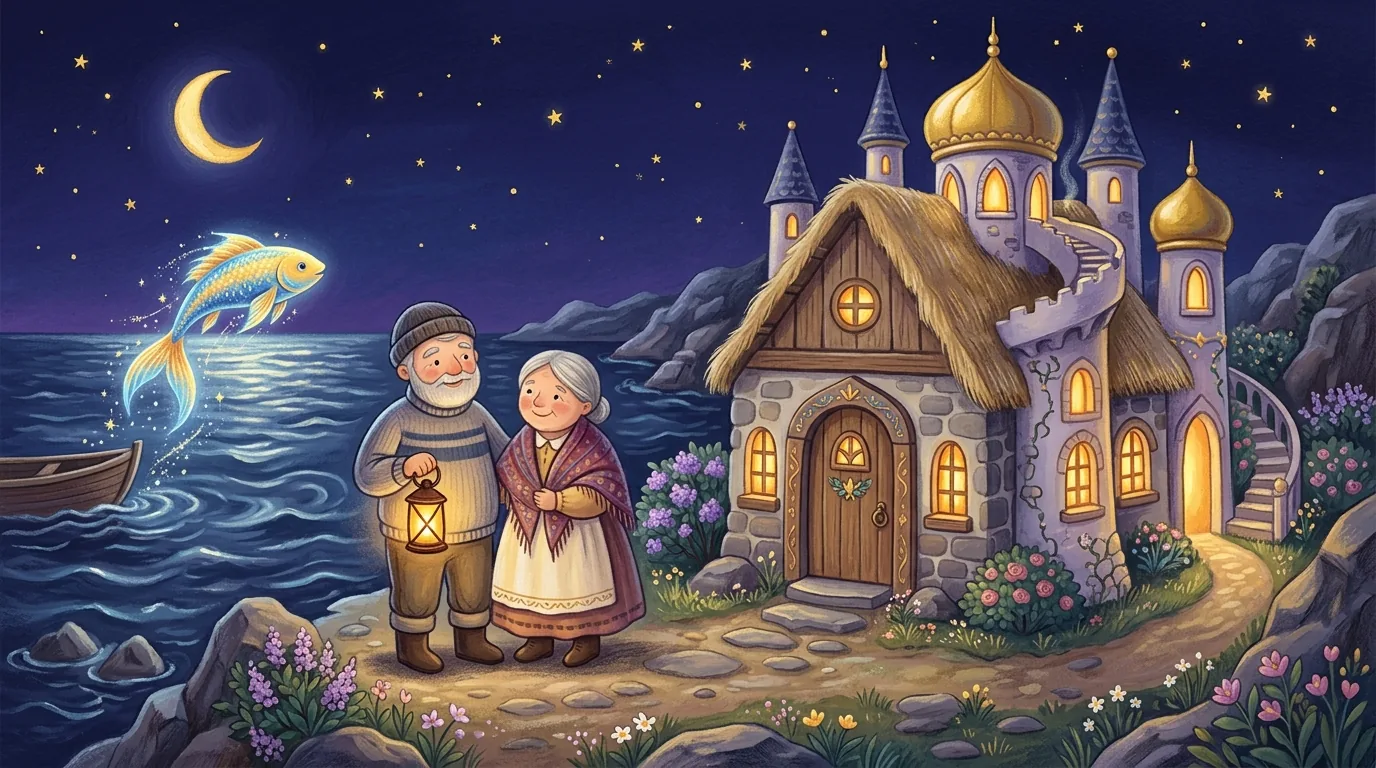
Forty stories about wanting more than your share and finding out what it costs. Most are Aesop’s fables of four to eight minutes; King Midas and The Fisherman and His Wife are the two that carry the idea furthest.
Greed is the fairy tale's favourite flaw because it punishes itself: the wife who wants the palace loses the cottage, the man who wants more gold is buried in it. Children find these outcomes deeply fair, and the stories give a parent a gentle way to talk about wanting everything in the shop.
Most of these tales are old ones, from Aesop and the Grimms to Norwegian and Indian folk stories, because greed is a lesson every culture has wanted to teach early. They are best for children from about four, who have begun to feel the pull of "more", and they end with the greedy character worse off but rarely harmed, which keeps the lesson clear and the bedtime calm.
Where to start in greed
12 of the 40 stories in this theme, picked as good first choices: the shortest, the gentlest and the best loved.
 4 min
Ages 4–8 · Classic Tales
The Thief and the House-Dog
4 min
Ages 4–8 · Classic Tales
The Thief and the House-Dog
Rex, a fluffy house dog, lives happily with the kind Johnson family. One night, a cunning thief named Jack targets…
 4 min
Ages 4–8 · Classic Tales
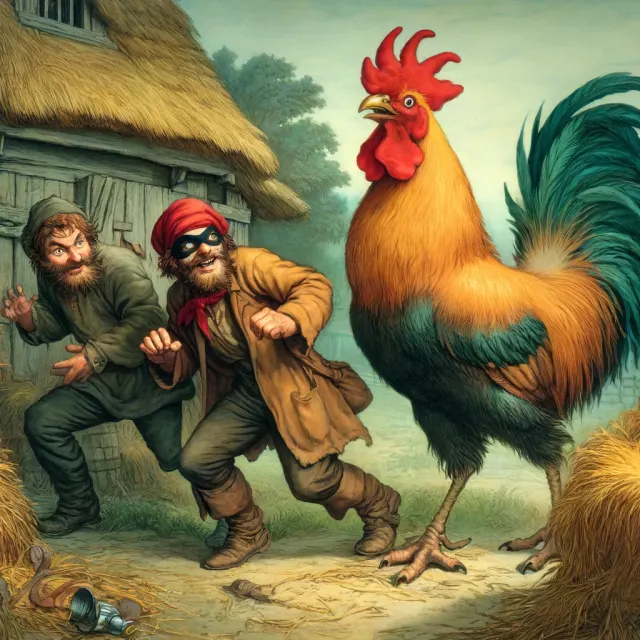
The Thieves and the Cock
4 min
Ages 4–8 · Classic Tales
The Thieves and the Cock
Two cunning thieves plan to steal a hidden treasure from a bustling farmyard. But the wise old cock, known for his keen…
 5 min
Ages 3–7 · Classic Tales
The Dog and the Cook
5 min
Ages 3–7 · Classic Tales
The Dog and the Cook
Max the curious dog loves Maria's delicious cooking. One day, the smell of her stew is too tempting, and he devises a…
 5 min
Ages 3–5 · Classic Tales
The Dog and the Shadow
5 min
Ages 3–5 · Classic Tales
The Dog and the Shadow
Max, a friendly dog, loves playing in his sunny town. One day, a mysterious shadow follows him everywhere, making his…
 5 min
Ages 4–8 · Classic Tales
The Fox and the Crow
5 min
Ages 4–8 · Classic Tales
The Fox and the Crow
A proud crow loves to show off his brilliant red feathers and melodious voice. A cunning fox, always looking for an…
 5 min
Ages 4–8 · Classic Tales
The Fox and the Pheasants
5 min
Ages 4–8 · Classic Tales
The Fox and the Pheasants
In a lush forest, a sly fox devises a cunning plan to gather all the generous pheasants' berries for himself. But the…
 5 min
Ages 3–7 · Classic Tales
The Peasant and the Apple Tree
5 min
Ages 3–7 · Classic Tales
The Peasant and the Apple Tree
A hardworking peasant dreams of a garden brimming with apples. He plants a seed and patiently tends it through seasons…
 6 min
Ages 4–8 · Classic Tales
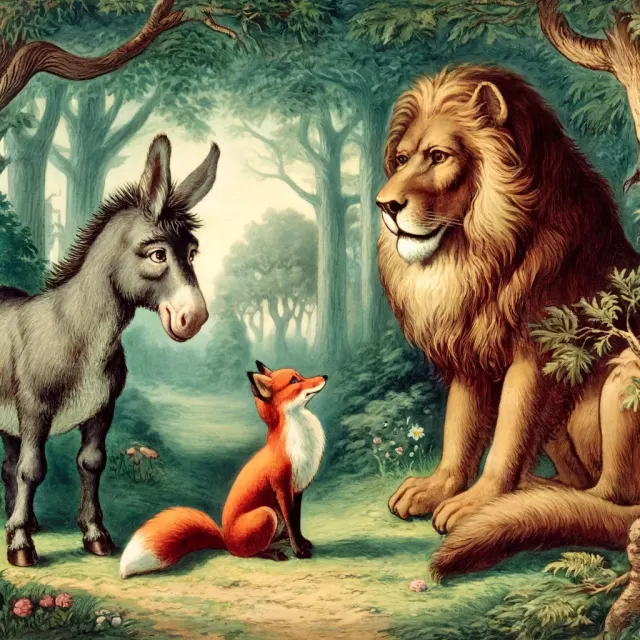
The Ass, the Fox, and the Lion
6 min
Ages 4–8 · Classic Tales
The Ass, the Fox, and the Lion
The hardworking Ass befriends the mighty Lion in the forest. But when a cunning Fox appears, he tries to trick the…
 6 min
Ages 4–8 · Classic Tales
The Boy Who Cried Wolf
6 min
Ages 4–8 · Classic Tales
The Boy Who Cried Wolf
A mischievous boy guarding his flock enjoys tricking villagers with false cries of "Wolf!". They rush to help, only to…
 6 min
Ages 3–7 · Rhyming Stories & Poems
The Cat Who Could Eat So Much
6 min
Ages 3–7 · Rhyming Stories & Poems
The Cat Who Could Eat So Much
Whiskers, a friendly cat, has an insatiable appetite that worries his village. Advised by a wise owl, he embarks on a…
 6 min
Ages 4–8 · Classic Tales
The Fox and the Grapes
6 min
Ages 4–8 · Classic Tales
The Fox and the Grapes
A clever fox spots a bunch of juicy grapes, but they are just out of reach. Frustrated, he declares them sour and walks…
 6 min
Ages 4–8 · Classic Tales
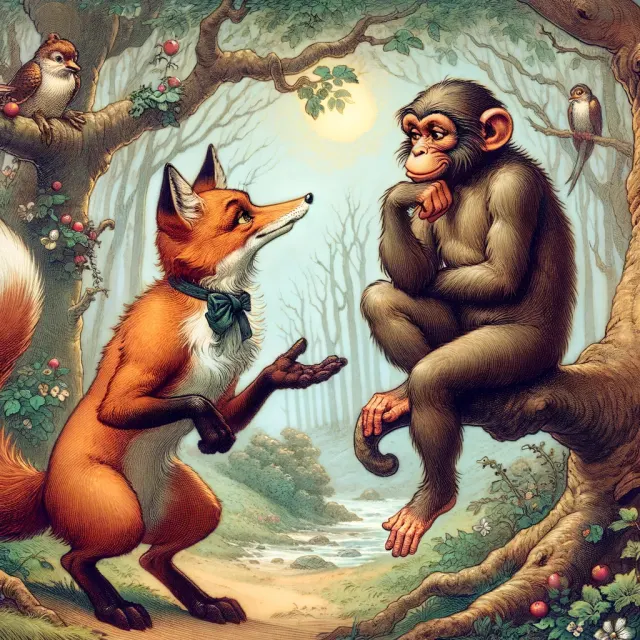
The Fox and the Monkey
6 min
Ages 4–8 · Classic Tales
The Fox and the Monkey
A clever fox envies the joyful monkey's delicious fruits. He devises a cunning plan to trick the trusting monkey…
The three shapes a greed story takes
Read half a dozen of these and the pattern is unmistakable. Knowing the pattern helps you pick the one that fits the week you have had.
Grabbing at a reflection
The character already has enough and loses it reaching for more. The Dog and the Shadow is five minutes and the purest example. The Milkmaid and Her Pail spends the money before it exists, and The Fox and the Grapes shows the sulk that follows.
Killing the goose
The character destroys the thing that was feeding them. The Goose that Laid the Golden Eggs takes six minutes and is the one every adult can still quote. The Golden Touch of King Midas is the grand version for ages six to ten.
Keeping what you cannot use
The meanest kind, and often the most useful at home. The Dog in the Manger is ten minutes about refusing to share something you do not even want, and The Selfish Giant, retold from Oscar Wilde, turns the same idea into a garden and a wall.
Wishes that go wrong
A whole cluster here is about wishes, which is the cleanest way to show a child what wanting badly does to somebody. The Ridiculous Wishes is six minutes and very funny, which makes it the safest starting point. The Fisherman and His Wife is nine minutes of the same story told without jokes, from the Brothers Grimm.
Reading the funny one first and the Grimm one a week later is a genuinely good sequence, because the second lands harder once a child recognises the shape.
The treasure that turns out not to be
The Golden Nugget is seven minutes for ages six to ten and ends by deciding that the gold was the least interesting thing in the story. The Rich Man and the Tanner makes the same case in five minutes with no magic in it at all, which some children find more convincing.
When to reach for one of these
The week before a birthday, after a row over a shared toy, or in the run-up to Christmas when the list is getting long. Pick a four or five minute fable rather than a long tale; the point is made faster and nobody feels lectured.
What not to do is name the culprit. If you read The Dog in the Manger and then say that is exactly what you did with the scooter, you have spent the story for nothing. Say nothing at all and read it again in a fortnight. Children are perfectly able to apply a fable to themselves, and they do it more honestly when nobody is watching them do it.
Two of these tales, The Fisherman and His Wife and Rumpelstiltskin, come from the Grimm collection first published in 1812; our guide to who the Brothers Grimm were gives the background if your child starts asking where stories come from.
The neighbouring themes
Greed is a branch of hardship, and its twin is pride — the same forty-odd fables reshuffled around a different fault. Where greed wants to own things, pride wants to be admired for them.
Because so many of these are Aesop, Aesop’s fables is the fastest place to find more of the same length and tone. Traditionally placed in the sixth century BC, they are the shortest moral stories anyone has bettered, and this theme is where the sourest of them ended up.
If you would rather end the evening somewhere warmer, kindness is the obvious counterweight, and reading one fable from each is a better pairing than two from here. The last story of the night sets the tone a child falls asleep in, and forty minutes of people losing things is not the tone anybody wants.
| Story | What is wanted | What it costs |
|---|---|---|
| The Dog and the Shadow | A second bone | The first one |
| The Goose that Laid the Golden Eggs | All the gold at once | The goose |
| The Golden Touch of King Midas | Everything turned to gold | Dinner, and worse |
| The Fisherman and His Wife | One wish more | The whole bargain |
| The Dog in the Manger | To keep the hay unused | Nothing gained at all |
Every greed story, A to Z
- Ali Baba and the Forty Thieves
- How Molo Stole the Lovely Rose-Red
- Rumpelstiltskin
- The Ass, the Fox, and the Lion
- The Bear and the Two Travelers
- The Birds, the Beasts, and the Bat
- The Boy Who Cried Wolf
- The Cat and the Old Rat
- The Cat Who Could Eat So Much
- The Cock and the Jewel
- The Dog and the Cook
- The Dog and the Shadow
- The Dog in the Manger
- The Fisherman and His Wife
- The Fox and the Crow
- The Fox and the Grapes
- The Fox and the Monkey
- The Fox and the Pheasants
- The Golden Nugget
- The Golden Touch of King Midas
- The Goose that Laid the Golden Eggs
- The Lion and the Fox
- The Lion and the Three Bulls
- The Lion, the Bear, and the Fox
- The Lion, the Fox, and the Beasts
- The Milkmaid and Her Pail
- The Monkey and the Camel
- The Monkey as King
- The Monkey’s Heart
- The Ox and the Frog
- The Peacock and the Fox
- The Peasant and the Apple Tree
- The Pot and the Kettle
- The Rich Man and the Tanner
- The Ridiculous Wishes
- The Selfish Giant
- The Thief and the House-Dog
- The Thieves and the Cock
- The Tinderbox
- The Wolf in Sheep's Clothing
Questions parents ask about greed stories
What is a good story to teach a child about sharing?
The Dog in the Manger is the most direct: a dog refuses to let others eat hay it cannot eat itself. It takes ten minutes, or The Fox and the Pheasants covers similar ground in five.
Is King Midas too frightening?
The retelling here is written for ages six to ten. Younger children tend to find the moment his food turns to gold genuinely alarming, which is rather the point, so judge it by your own child.
Should I tell my child the story is about them?
No. Read it, say nothing, and let it sit. A story used as a telling-off stops being a story and children notice immediately.
How many greed stories are there here?
Forty, most of them four to eight minutes long, and a good number of them retellings of Aesop's fables.