The reason a bedtime story builds language is not that it is a story; it is that it is written. Written English, even the simple written English of a fable, is packed with words and sentence shapes that spoken English at home rarely uses, and a child who hears it nightly is quietly stockpiling both. This guide explains the three ingredients that do the work, what the research does and does not support, and the small changes in how you read that make the difference between a child who hears words and a child who keeps them.
Ingredient one: rare words, in a place a child can catch them
Linguists who have counted find that children's books contain more uncommon words per thousand than adult conversation, and considerably more than the language a parent uses with a small child, which is naturally simplified. Sit with The Fox and the Crow and count: glossy, flatter, cunning, morsel, beak, compliment, perhaps vanity or foolish in the moral. Half a dozen words a four-year-old would otherwise not hear for years, delivered in three minutes, inside a plot that makes each one obvious. The crow drops the cheese because the fox flatters her; the child does not need a definition of flatter, they have just watched it happen.
That last part matters. Words in stories arrive with context: a picture, a plot, a tone of voice and a consequence. A word met that way is far more likely to stick than a word met in a list, which is why vocabulary programmes at school lean so heavily on reading aloud. Researchers at Ohio State University (Logan and colleagues, 2019) put a number on the accumulated exposure by counting the words in popular picture books: a child read one book a day hears around 290,000 more words by age five than a child who is never read to, and five books a day takes the difference past a million. Do not confuse this with the older and now contested "30 million word gap" from Hart and Risley's 1995 home-conversation study; the book estimate is simpler arithmetic and stands on its own.
Ingredient two: sentences nobody says out loud
Vocabulary gets the attention, but grammar may be the bigger gift. Listen to how a fairy tale opens a scene: "When the wolf, who had run ahead by the shorter path, reached the cottage, he knocked softly at the door." Nobody speaks like that. Speech at home is short, present-tense and full of gestures; stories are long, past-tense and have to do everything with words. A child who hears that sentence hears a subordinate clause, a relative clause, a past perfect and an adverb, and hears them in an order that makes sense of the plot. They will not name any of it, but by the time they meet these structures in their own reading at seven they have heard them thousands of times.
Three grammatical things stories teach that conversation does not:
- Connectives that carry logic: because, although, until, meanwhile, so that. Fables live on these: the grasshopper sang while the ant worked, and so in winter he starved.
- Dialogue tags and reported speech: "'Not I,' said the cat" in Little Red Hen is a tiny lesson in who is speaking and how.
- Comparatives and degree: Goldilocks and the Three Bears is essentially a grammar exercise about too hot, too cold and just right, too hard, too soft, biggest, smallest, disguised as a story about porridge.
Ingredient three: repetition, the part parents want to skip
The first time a child hears a word they may notice it. The fifth time, in the same story, they can predict it. The tenth time they use it. Language researchers call this the difference between receptive and productive vocabulary, and the bridge between the two is repetition in a familiar context. This is why toddlers demand the same story every night and why you should let them, up to a point; the guide to why children want the same story every night covers the sanity side of that.
Stories built on refrains do this work inside a single reading. The Gingerbread Man repeats "Run, run, as fast as you can" at every encounter, and by the third one a two-year-old is saying it with you. The Enormous Turnip adds a character each round and repeats the whole chain, which is a memory exercise as much as a language one. Cumulative tales are the oldest teaching technology we have, and they are almost all under five minutes.
What the research supports, and what it does not
The link between being read to in the early years and later vocabulary is one of the most consistent findings in child development, replicated across countries and decades. A well-known Canadian series of studies by Monique Sénéchal and Jo-Anne LeFevre followed children from nursery into primary school and found that shared storybook reading at home predicted vocabulary and listening comprehension, while parents teaching letters and sounds predicted early word-reading; the two were separate routes, and the story route was the one that predicted reading comprehension by the third year of school. The American Academy of Pediatrics' 2014 policy statement on literacy promotion summarised the evidence and recommended reading aloud from birth.
What the research does not say is that any particular method, app or programme matters. It also does not say that more is always better: one or two short stories a night, every night, is the pattern in most of the studies. The one addition that clearly increases the gain is conversation, which is the next section.
How to read for language: five changes that cost nothing
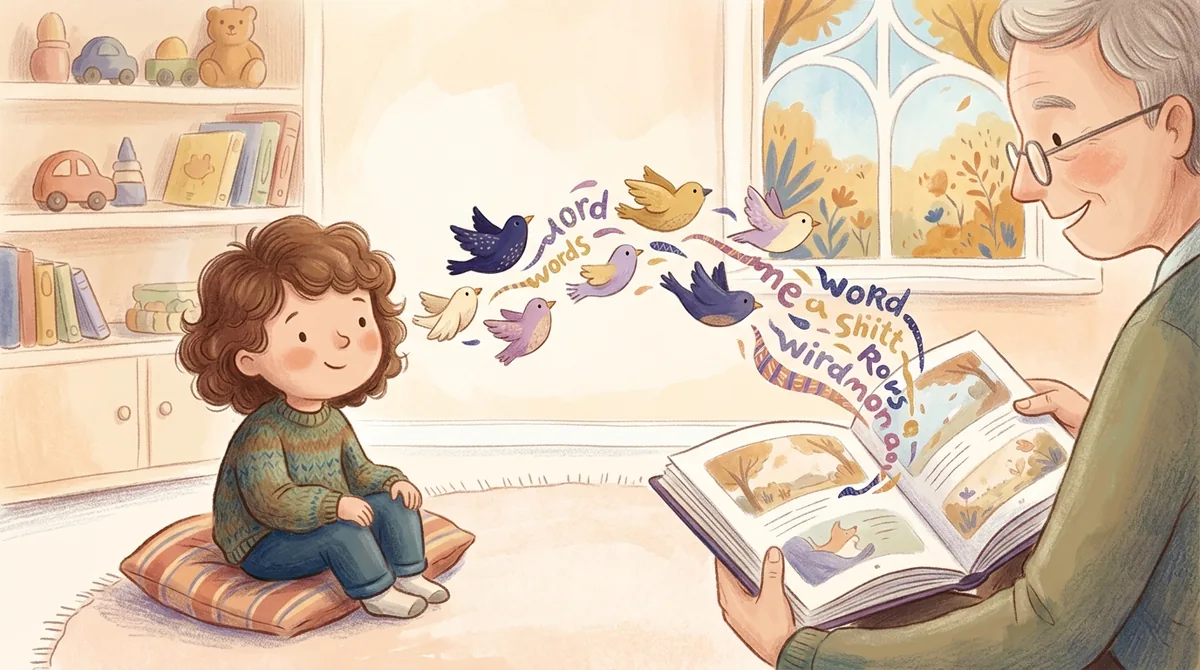
The technique researchers call dialogic reading, developed by Grover Whitehurst's group in the late 1980s, is simply reading with the child talking back, and it has been shown to increase vocabulary gains over straight reading. You do not need the programme; you need the habit.
- Do not explain every word. Let the plot do it. If a word is important and the context is thin, give a three-word gloss and keep going: "cunning, that means sneaky-clever".
- Ask "what do you think happens next?" once. Prediction forces the child to use the words they have just heard. Once per story is plenty; more and the story stalls.
- Repeat the child's words back, upgraded. Child: "the fox tricked her." You: "yes, he flattered her until she sang." That is called expansion, and it is the single most effective thing in the dialogic-reading research.
- Read the moral and ask if it is true. Aesop's closing lines are abstract vocabulary in its purest form: slow and steady wins the race. A six-year-old who argues that the hare would have won if he had not slept is using steady correctly for the first time.
- Use the "Words to know" list afterwards, not before. Every story page here lists four or five vocabulary words. Look at it after the story and ask the child which one they remember; do not pre-teach, it drains the story of its surprises.
Our guide to questions to ask during a bedtime story has more on timing, and on how to stop asking when the child is nearly asleep.
Which stories do which job
Not every story builds language the same way, and it helps to mix them across a week.
Rhymes and rhyming stories: sound before meaning
Nursery rhymes and rhyming stories and poems train phonological awareness, the ability to hear that cat and hat share a sound. That skill is one of the best early predictors of how easily a child learns to read, and it is built entirely by ear, years before letters. Hey Diddle Diddle is short enough for a one-year-old; The Anxious Leaf adds a longer plot for an older listener.
Fables: abstract words in tiny stories
Aesop delivers words like greed, pride, patience and gratitude attached to an animal and a consequence. These are the hardest words for a child to learn from speech, because you cannot point at greed; you can point at the dog dropping his bone for its reflection in The Dog and the Shadow.
Classic fairy tales: long sentences and long plots
The classic tales are where the complex grammar lives. They also hold a listener across ten minutes, which is a comprehension skill in itself: to follow Rumpelstiltskin a child must remember a bargain made on page one until it is called in on page four.
Age by age: what the language benefit looks like
- Under two: rhythm, rhyme and your voice; the words are almost incidental, but the ear is being tuned.
- Two to three: refrains and repetition; expect them to complete sentences for you and to demand the same book.
- Three to five: the vocabulary explosion; this is where the rare-word effect is largest, and where questions start doing real work.
- Five to eight: grammar and comprehension; longer plots, characters who lie or change their minds, and words the child will meet in their own reading a year later.
- Eight and up: literary language; Andersen and Wilde, stories with irony, sentences worth reading twice. Keep going.
Where to start
Tonight, read The Fox and the Crow and do nothing but notice the words. Tomorrow, read it again and ask what flatter means; the child will explain it to you using the story. On the third night let them pick anything from the classic tales and read it straight through with a single "what happens next?" in the middle. That is the whole method. The wider case for the habit, covering sleep, empathy and school as well as words, is in the benefits of bedtime stories.