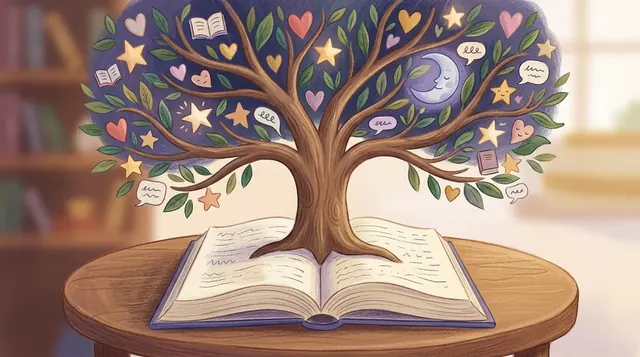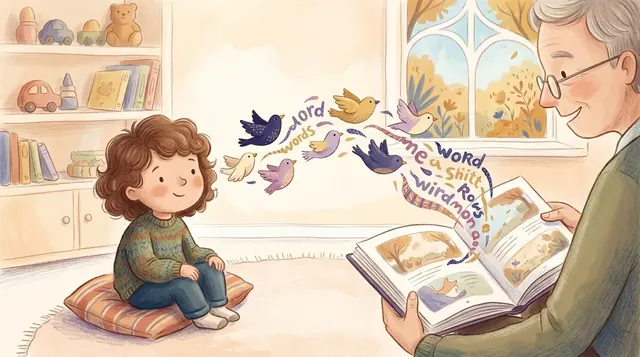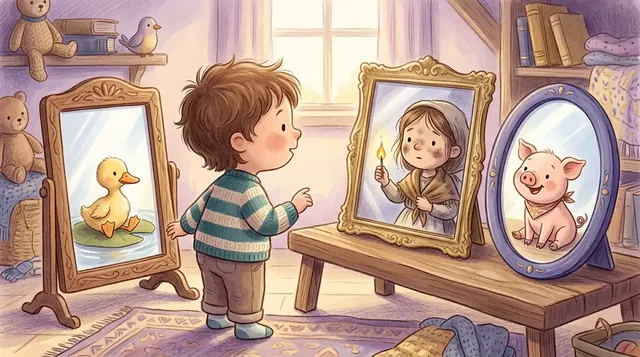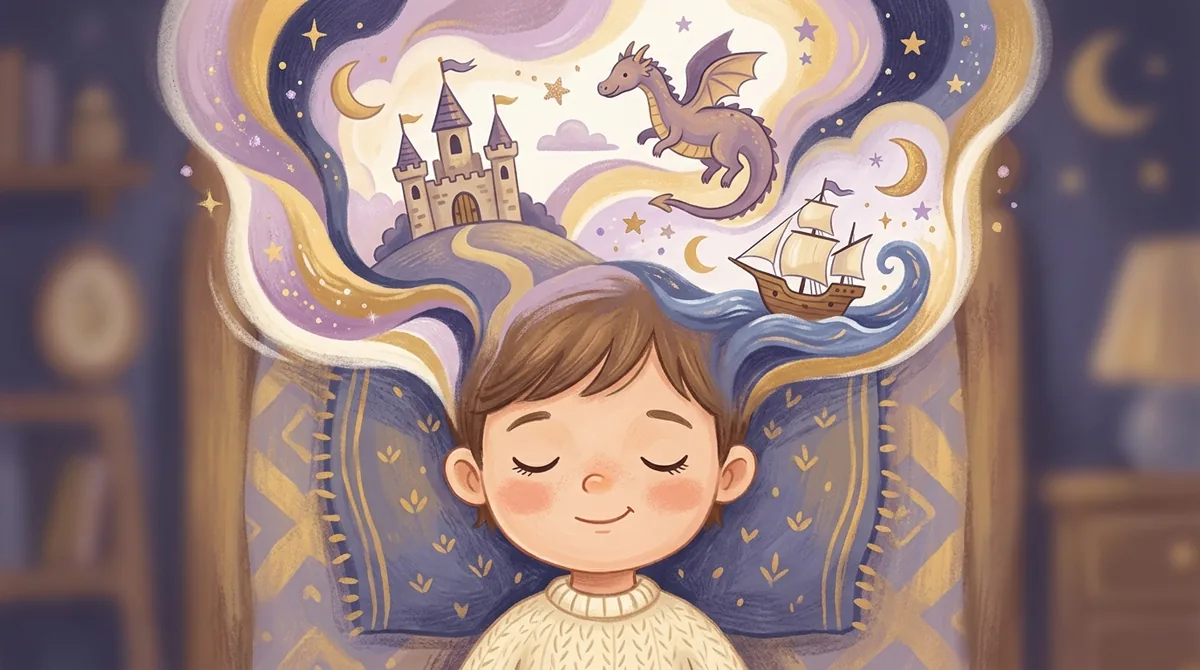
When a child hears "the castle stood on a rock so high that clouds went past its windows", they build a castle. When they watch one, it has been built for them. That difference is the entire case for the bedtime story as an exercise in imagination, and it holds even against the best animation ever made, because the work of constructing a scene from words is the work that grows the faculty. This guide explains the mechanism, sets out what the research shows and how much weight it can bear, and gives you a handful of reading habits that leave room for the child's own pictures.
The scene has to be built by someone
Every story has a scene, and someone has to make it. In a film the director, designer and animators make it, and the viewer receives it. In a story read aloud the words give a sketch, "a little house with a roof of gingerbread", and the listener does the rest: the colour of the roof, the size of the windows, whether there is smoke. No two children build the same house. That construction is not a by-product of listening; it is listening, and it is why a child who has heard a story can draw it, act it out and continue it in a way that a child who has watched it usually cannot.
The faculty being exercised has a name in psychology, mental imagery, and it is closely tied to comprehension. Children who form images as they listen understand and remember stories better, and teaching children to visualise is a standard reading-comprehension technique in primary schools for exactly that reason. The bedtime story gets there first and free.
What the research shows, and how much to trust it
The most-cited work here is by John Hutton's group at Cincinnati Children's Hospital. A 2015 study in Pediatrics found that preschoolers from homes with more reading showed more activity, while listening to stories in a scanner, in brain regions associated with mental imagery and narrative comprehension. A 2018 follow-up compared the same kind of children hearing a story three ways: audio only, illustrated pages, and animation. The audio-only condition seemed to strain the language network with too little support; the animated condition showed the visual network doing the work and the language and imagery networks doing less; the illustrated version showed the most connection between them. The authors called it a "Goldilocks effect", and it is a neat finding.
It is also a small one. These were studies of a few dozen four-year-olds, imaging is an indirect measure, and nobody has yet shown that the pattern in the scanner turns into a difference in the playground. Treat it as suggestive support for something parents already observe, not proof. The broader research is firmer: the American Academy of Pediatrics reviewed the evidence on screens and young children in 2016 and concluded that under two the benefit of screen media is minimal and that for older preschoolers, co-viewed, well-designed content can help, but that it does not replace reading and play. Our guide to screen-free bedtime covers the sleep side of that.
Why an illustrated story is not a screen
Parents sometimes conclude from this that pictures are the enemy, and then worry about the illustrations on this site. They are not the same thing. A still picture gives a child one image of one moment and leaves everything else, including motion, sound and the next moment, to be imagined. An animation supplies all of it, thirty times a second, and the child's job becomes tracking rather than building. The Cincinnati finding was precisely that the illustrated story sat in the middle: enough support to keep a four-year-old anchored, not so much that there is nothing left to do.
The story-book mode on every story page here is built on that principle. It turns the chapters into swipeable pages with big text and a single illustration, then stops; the dragon on the page is one dragon, and the one the child sees when they close their eyes is theirs. For older children who no longer need the anchor, switching the illustrations off in your head is as simple as reading from the plain text and letting them lie back.
Stories that leave the most room
Some stories are set in the child's own world and the imagination has less to do; a story about a farm draws on farms the child has seen. Others are set somewhere no child has been, and every detail has to be invented. Three themes on this site are especially generous.
Magic
The magic stories are full of things that cannot be pictured from life: a bear who is a prince by night, a palace that lies "east of the sun and west of the moon". East of the Sun and West of the Moon is the great imagination story of the Norwegian tradition, and a child of six or seven will furnish the whole journey, wind by wind, without noticing they are doing it.
Discovery
The discovery stories are about finding something new, and the reader finds it alongside the hero. The Bird with Nine Heads hands the child a creature no illustrator has ever quite agreed on and lets them decide.
Space
The space stories were written for this site with exactly this purpose: settings that are described enough to be vivid and not enough to be finished. Moonlit Secrets of the Celestial Forest and The Crystal Caverns of the Asteroid Belt both pause on a landscape and let the child walk into it. Ask what colour the crystals are and you will get a different answer every night.
How to read for imagination: leave the gaps open
The imagination benefit is fragile in one way: it is easy for a well-meaning reader to fill the gaps themselves. Five habits that keep them open.
- Pause after descriptions. Read "the cave was full of crystals that hummed", stop, and count three. The child is building. If you go straight on, you have moved them along before the picture was finished.
- Ask "what does it look like?" not "do you see the picture?" The first invites construction; the second points them back at the illustration.
- Do not over-perform. A voice for every creature and a sound effect for every door hands the child your version. Two voices and a narrator is plenty; the guide to reading a bedtime story aloud explains why less is more.
- Let the child correct you. "No, the dragon is green." Fine; it is their dragon. Never argue with a child's mental image; it is the thing you are trying to grow.
- Stop at the end. Resist explaining what happened next or what the story means. The gap after the last line is where children continue the story on their own, usually while falling asleep, and it is the most valuable gap of all.
Where the imagination goes in the day
The point of building a castle at 7.30pm is what happens at 10am. Children who are read to have richer pretend play, and pretend play is where children practise planning, negotiating, taking roles and solving problems that have no right answer. A child who has spent a week walking the winds of East of the Sun has material for a month of games. Research on pretend play and its links to later creativity and self-regulation is, like the imaging work, suggestive rather than settled, and the effects are modest; but the direction is consistent and the cost is nothing.
It also shows up in problem-solving. A child who can hold an imagined scene in their head can hold an imagined solution there too, and try it out before acting. That is the skill every hero in the discovery stories uses, and the child who has built their worlds has practised it.
Tonight
Choose a story set somewhere neither of you has been. Moonlit Secrets of the Celestial Forest for a child under seven, East of the Sun and West of the Moon for an older one. Read slowly, stop after the first big description, and ask what it looks like. Then go on without commenting on their answer. If you want the wider case for the habit, including the parts of it that are far better evidenced than this one, it is in the benefits of bedtime stories.