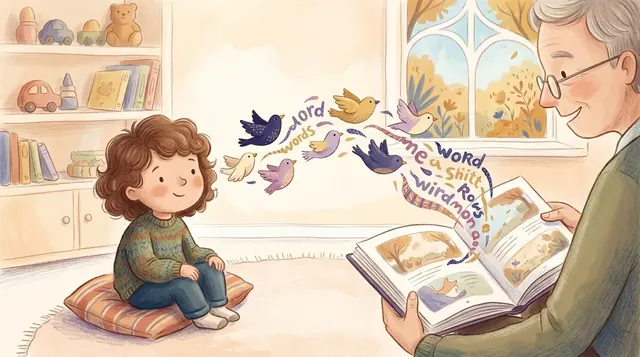
A child does not need to read before they start school; they need to be ready to be taught, and the single activity that prepares them for that is being read to. Ask a reception teacher what they hope a child arrives with and you will get a list that has nothing to do with letters: the ability to sit and listen for ten minutes, enough words to follow an instruction, a sense of how a book works, and the habit of paying attention to something that is not a screen. Every item on that list is built at bedtime. This guide goes through what teachers actually look for, shows how a story delivers each, and gives a twelve-week countdown to the first day.
What "school readiness" actually means
The phrase gets used to sell flashcards, so it is worth being precise. In England the early years curriculum measures a child at the end of reception, not the start, and the areas it cares about are communication and language, personal and social development, physical development and, only then, literacy and maths. The Department for Education's own reading framework is explicit that talk and stories in the early years are the foundation on which phonics is later built. A child who arrives at four with a rich spoken vocabulary and the ability to attend to a story is ready; a child who can name the letters but cannot listen to the end of one is not.
Five things, then, that a nightly story builds and a teacher notices in the first week.
One: listening for ten minutes
The first thing a reception teacher does each day is gather the class on the carpet and talk to them. A child who has spent three years listening to a story each night has practised carpet time a thousand times: sitting, attending to a voice, following it without pictures of their own to look at, and waiting for the end. A child who has not finds the carpet baffling. This is the least glamorous benefit of bedtime reading and probably the most important for the first term.
The way to build it is by length. Toddlers listen to two-minute rhymes; by four a child should be able to follow a whole ten-minute tale like The Musicians of Bremen, with its four animals, one robbers' house and one night-time trick. If your four-year-old cannot yet sit through a ten-minute story, that is the thing to work on in the last months before school, and the way to work on it is not to insist but to build up from five minutes, story by story. The early readers age page lists the stories pitched at exactly the reception year.
Two: enough words to understand the day
"Line up by the door, put your book bag on your peg, and then find a space on the carpet" is a sentence with a sequence, three nouns and a preposition, and a child who does not follow it looks disobedient when they are merely lost. Vocabulary at school entry is one of the strongest predictors of how a child does in the years that follow, and stories are the richest source of it. Researchers at Ohio State estimated in 2019 that a child read a book a day has heard roughly 290,000 more words by age five than a child never read to; a longer Canadian series by Monique Sénéchal's group found that home storybook reading in the preschool years predicted vocabulary and, three years later, reading comprehension, independently of whether parents had taught letters. The mechanism is set out in our guide to how bedtime stories build language. For school specifically, the words that matter are the ordinary ones a story uses and a home conversation skips: beside, before, enormous, whisper, disappointed.
Three: knowing how print works
Teachers call these "concepts of print", and they are the things nobody remembers learning: a book has a front and a back; you read the left page before the right; the words, not the pictures, carry the story; you go left to right and top to bottom; the gaps mean the words are separate. A child who has watched a parent's finger travel along a line a few hundred times arrives knowing all of it. A child who has not spends the first weeks of phonics working out which way to look.
You can build this deliberately in the last months, and it takes seconds: run a finger under the words as you read, let the child turn the page, and occasionally point at a word and say it. The story-book mode on this site, with its big text and one page at a time, suits this well on a phone, and the "Words to know" list on each story page gives you a few words to point at after.
Four: following a sequence
School days are sequences, and so are stories. Cumulative tales are the purest training: The Enormous Turnip adds a puller every round and repeats the chain, and a child who can tell you who came after the granddaughter has done the ordering that "first we wash hands, then we sit down, then we eat" requires. Henny Penny and Chicken Licken do the same with a chain of animals and a chain of names, and children love reciting them. Ask "what happened first, then, then?" after a story once a week and you have covered the sequencing part of the reception curriculum before it starts.
Five: the social script
The fifth thing a teacher looks for is a child who can cope with the social weather of a classroom: sharing, waiting, asking for help, being the one left out for a minute and recovering. Stories give children scripts for all of that. Together We Are Good is a story about a town saved by small helpers working together, and it is essentially a rehearsal for group work. The Hare and the Tortoise is a story about persistence that a child will hear again from a teacher in different words. And the school and first-day stories collection does the most direct job: it puts the nerves into a character the child can root for and ends the way most first days end, better than expected. Read one in the last week and one on the evening after the first day, and let the child notice that the character managed.
What the research supports
The link between shared reading in the preschool years and later school outcomes is well established, and it holds across income levels, though it is one factor among many. The American Academy of Pediatrics has recommended since 2014 that paediatricians advise all parents to read aloud from birth, on the strength of that evidence. Two cautions. First, the effect is on language and comprehension, not on decoding; a child who is read to still has to be taught to read, and being read to does not make phonics unnecessary. Second, the studies measure a habit sustained over years, so a burst of reading in August is not what they are describing; it is still worth doing, but the child who benefits most is the one whose story habit continues through reception and beyond, which is where most families let it slip. Our guide to bedtime stories for five-to-eight-year-olds is about keeping it going once school has started.
A twelve-week countdown
If school starts in September and it is now June, this is what to add to a bedtime story that is already happening. If it is not already happening, step one is the whole list.
- Weeks 12 to 9: fix the slot. Same time, same order, story last, every night, including weekends. Schools start early and the story habit is the easiest way to move bedtime earlier without a fight.
- Weeks 8 to 6: stretch the length. Move from five-minute stories to ten. Read The Musicians of Bremen one night and The Enormous Turnip the next, and ask what happened first.
- Weeks 5 to 4: add the print habits. Finger under the words, child turns the page, one word pointed at per story.
- Weeks 3 to 2: add one question a night. Use the "Talk about it" section on the story page. One question, answered or not, then sleep.
- Week 1: read a school story. Something from the school and first-day collection. Do not make a speech about it.
- The first night after school: read the favourite. Not a new story, not a school story; the one they have asked for fifty times. It tells the child that the thing that has always been there is still there.
Where to start
Tonight, read The Enormous Turnip with a finger under the words and ask who came to pull after the dog. That single story covers listening, vocabulary, print, sequence and cooperation in six minutes. Then look at the early readers page for the next few weeks. The wider argument for why ten minutes a night does so much, at school and beyond, is in the benefits of bedtime stories.