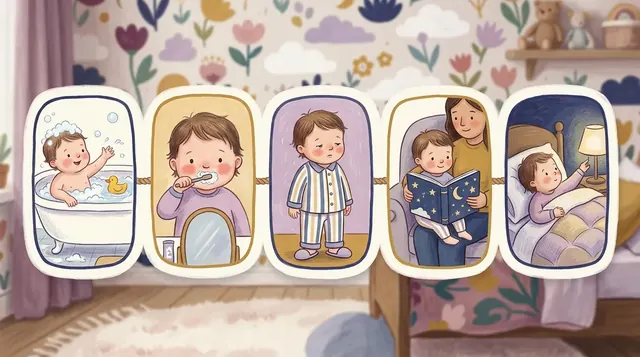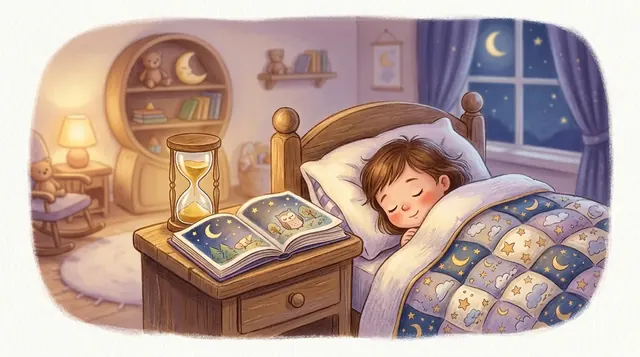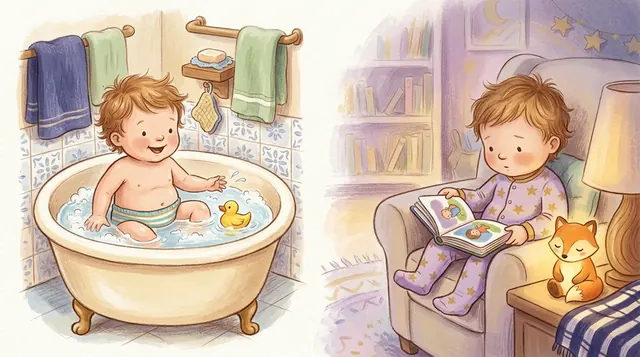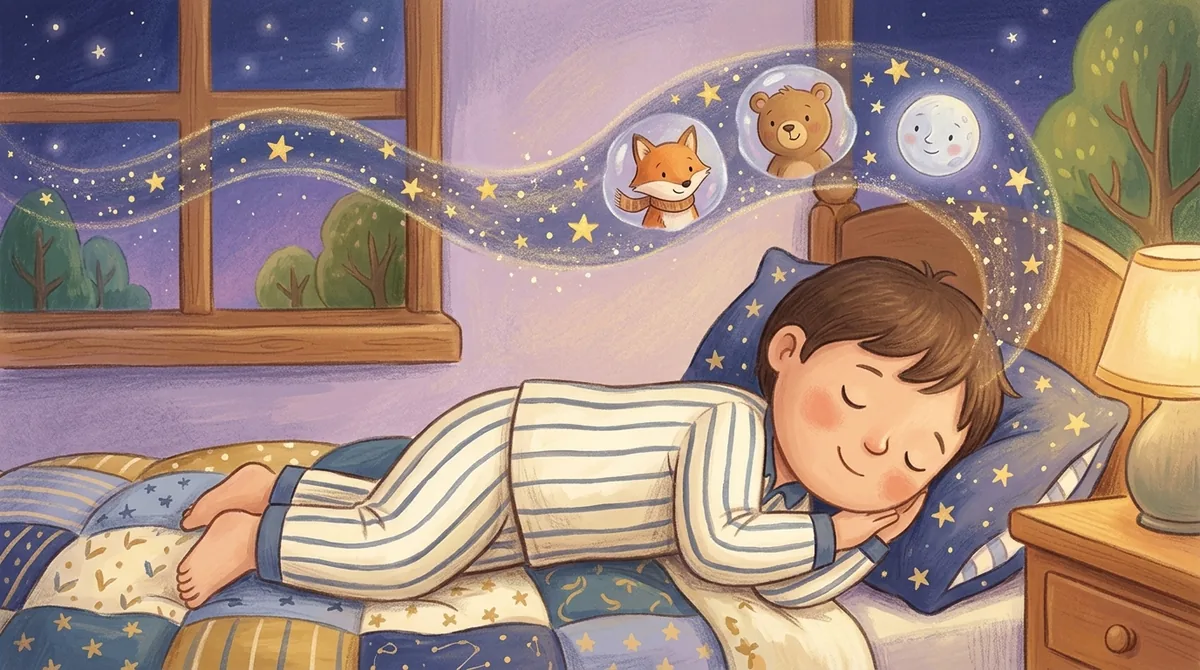
A story helps a child sleep because of what it is at bedtime, not what it says: it is the same calm, dim, screen-free, slow thing every night, and a child's body learns that it comes just before the dark. The research behind that sentence is substantial and consistent, and it is worth knowing what it actually shows, because most of what parents are told about sleep is either stricter or vaguer than the evidence. This guide sets out the findings, the four mechanisms that explain them, and the claims the evidence does not support.
What the research on bedtime routines shows
The single strongest finding in children's sleep research is about routine rather than stories as such. Studies across many countries, and a large international survey of bedtime routines published in the journal Sleep in 2015, find the same pattern: children who have a consistent bedtime routine fall asleep sooner after being put down, wake less often in the night, and sleep longer in total. The relationship is dose-dependent, which is the researchers' way of saying that the more nights a week the routine is kept, the better the sleep, with children who have it every night doing best. That pattern holds from infancy through the preschool years and in families of every kind.
The same body of work connects routine to daytime outcomes. Children with consistent bedtimes show fewer behaviour problems and better attention during the day, which fits what every parent knows about a child after a bad night. And intervention studies, where families without a routine are helped to start one, see improvement within a week or two, which tells us the routine causes the better sleep rather than merely accompanying it.
Reading aloud appears in this research as one of the most common elements of a good routine, and separately as one of the best-evidenced things a parent can do for language development, which is covered in the benefits of bedtime stories. What the research does not do is isolate the story from the rest of the routine. The story helps because it is the routine's anchor, and that is a stronger claim than it sounds, because it means the story will keep working as long as the routine does.
Mechanism one: the story is a learned cue
Sleep is triggered by cues, and a child learns them fast. The bath, the pyjamas, the lamp and the story are each a small signal, and together they are a chain; by the end of the second week the first link starts the body's slide towards sleep. A story is an unusually good link because it is the step a child actively wants, so it is never skipped, and because it is done in the bed, in the dim, with the child lying down, which are all cues of their own.
This is why the same story every night, which a toddler will demand anyway, is doing more than it looks. A story with no surprises is a purer cue than a new one. It is also why swapping the story for a different calm activity is fine, but swapping it for nothing is not; the chain has lost its strongest link. The routine the story sits inside, and how to build it, is set out in the bedtime routine guide.
Mechanism two: it is dim and screen-free
Light in the evening tells the brain it is still day, and it delays the release of melatonin, the hormone that opens the door to sleep. Screens are a particular problem: they are bright, they are held close to the face, and what is on them is designed to hold attention. Research on children's screen use consistently associates screens in the hour before bed with later sleep onset and shorter sleep. A story read from a book or a dimmed phone by lamplight is the opposite on every count: low light, a voice rather than a video, and a pace set by the reader. The practical switch from tablet to story, and how to make it without a fight, is in screen-free bedtime.
Mechanism three: it slows breathing and attention
Listening to a slow voice does something physical. A child lying still and following a story breathes more slowly and evenly, and their attention narrows from the whole busy room to one thread of words. This is the same mechanism a lullaby uses and a guided relaxation uses; the story simply does it with a plot attached. The effect depends on how it is read. A story read fast, with big voices and dramatic pauses, is entertainment and it raises arousal rather than lowering it. Read at bedtime pace, slower than feels natural, and slower still in the last page, the story becomes a relaxation exercise the child does not notice they are doing.
It also depends on what happens in the story. A tale whose most exciting moment is on the last page leaves a child buzzing; a tale whose danger is in the middle and whose ending is a walk home or a sleep lands softly. The gentle sleepy stories collection is built on that principle. The Fir Tree is a good example for an older child: an Andersen story that is quiet throughout, faintly sad, and ends with everything still. For a younger child, The Stars in the Sky is a rhyming tale of a small girl who wants to touch the stars, and it ends, as the best bedtime stories do, with her in bed.
Mechanism four: it gives the day somewhere to go
Children do not settle while something is unresolved, and they often cannot say what it is. A story gives the feeling a character to live in. A child who was left out at nursery hears the duckling being chased from the farmyard and, without being asked, says "that happened to me." The worry is named, and named worries are smaller. Sleep researchers describe this as the routine's role in emotional regulation; parents describe it as the ten minutes when they find out what actually happened today. Either way, a story that touches a feeling and then resolves it is doing a job that a screen, or silence, cannot.
What the evidence does not say
- It does not say a story works on the first night. The routine effect is built over one to two weeks. A new story tonight will not fix a bad sleeper by itself.
- It does not say any particular story is better. There is no research showing that fairy tales beat fables or that rhymes beat prose for sleep. Choose for calm and for the child's age.
- It does not say longer is better. The evidence favours short, consistent routines. Thirty minutes of reading is not three times as good as ten, and it is often worse.
- It does not say audio is as good as a parent. Studies of routines are studies of parent-led activities. Audio is a reasonable stand-in on the nights you have nothing left; it is not the thing being measured.
- It does not replace the basics. A story cannot overcome a bedtime that is too early, a nap that ran late, a hungry stomach or a bright room. It is one part of a routine, and the routine sits inside a day.
Putting the science to work
- Fix a bedtime and keep it within half an hour, weekends included.
- Screens off at least half an hour before the routine starts; main lights dimmed after tea.
- Run the same four or five steps in the same order, ending with the story in bed.
- Read slowly, and slower at the end. Choose stories whose ending is calm.
- Keep it every night for two weeks before judging it, and expect nights one to three to be the hardest.
Tonight
Dim the room before the story rather than after. Read The Stars in the Sky to a child under six or The Fir Tree to an older one, at about two-thirds of your normal pace, and let the last line sit in silence before the goodnight words. Then do exactly the same tomorrow. The science is in the repetition, not the story.