Empathy cannot be taught by instruction, because it is not a fact; it is a habit of imagination. A child learns it by repeatedly imagining their way into someone else's situation until the imagining becomes automatic, and a bedtime story is the safest, cheapest and most enjoyable way to practise. This guide takes three stories from this site apart to show what each one rehearses, sets out what the research does and does not show, and gives you the handful of sentences that turn a story from entertainment into practice.
Two kinds of empathy, and why stories reach both
Psychologists usually split empathy in two. Affective empathy is feeling what another person feels: your stomach drops when the child next to you falls off the wall. Cognitive empathy, sometimes called perspective-taking or theory of mind, is understanding what another person thinks and wants even when you do not share it: knowing that your friend wants the red cup because she thinks it is hers. Toddlers have a fair amount of the first and very little of the second; the second develops mainly between three and six, and it is the one that stories are unusually good at building.
The reason is access. In life, other people's minds are closed; you infer what your sister feels from her face and usually guess wrong. In a story the narrator opens the door. "The duckling felt so ashamed that he tucked his head under his wing" hands the child the feeling directly, with its cause and the behaviour it produces. Hearing hundreds of these over a childhood is how a child builds the map from situation to feeling to face that they will later use on real people.
Worked example one: The Ugly Duckling and being the outsider
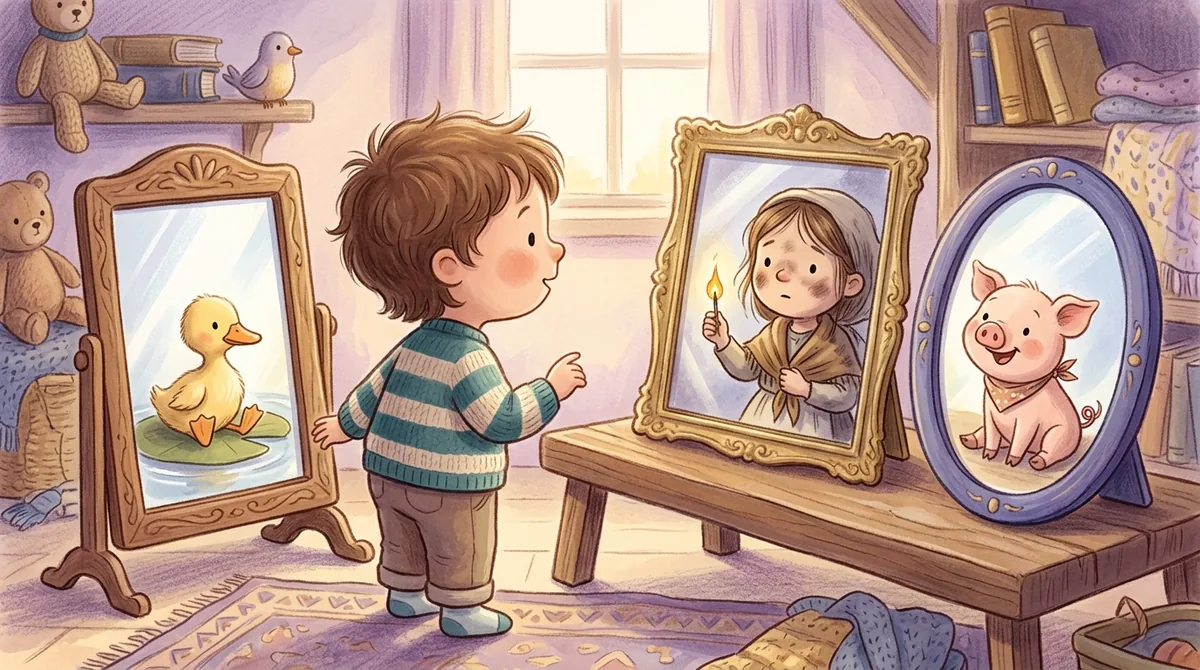
The Ugly Duckling is the purest empathy story in the library because the reader is never allowed out of the duckling's position. He is pecked by the ducks, chased by the hens, laughed at by the wild geese, nearly frozen in the reeds and, at the end, does not know what to do with himself when the swans glide towards him. Andersen, who was writing about his own childhood in Odense, makes the child feel each rejection from the inside and then makes them feel the relief of being seen. A child who has been through that ten minutes has a template for what a new child at nursery is going through, and the template comes with its own resolution: the swans were there the whole time.
The sentence to say afterwards is not "so we must be kind to people who are different". It is a question: "Which bit did the duckling hate most?" Children answer that easily and then, without prompting, usually tell you about someone at nursery. The story has done the introduction. The stories about belonging all work this way, and Thumbelina is a gentler alternative for a child who finds the duckling's winter too sad.
Worked example two: The Selfish Giant and a character who changes
Fixed heroes and villains teach children to sort people. Characters who change teach them to understand people, which is harder and more useful. Oscar Wilde's The Selfish Giant begins with a giant who builds a wall around his garden ("My own garden is my own garden") and ends with the same giant lifting a small boy into a tree with tears in his eyes. In between, the child watches the giant notice that winter has stayed in his garden, work out why, and feel sorry. The story does not tell you he is sorry; it shows him creeping downstairs to open the door, and a five-year-old reads the creeping correctly.
The empathy exercise here is tracking a change of mind. Ask: "When did the giant stop being selfish? What did he see?" A child who can answer has done the harder kind of perspective-taking, holding two versions of the same person and understanding what moved him from one to the other. It is the same skill they will need when a friend is unkind on Monday and sorry on Tuesday. The kindness stories include several characters like this; The Happy Prince, also Wilde, works the change from the other direction, with a swallow who keeps deciding to stay one more night.
Worked example three: The Lion and the Mouse and the view from below
Very young children can manage a simpler version of the exercise: imagining being much smaller, or much bigger, than they are. The Lion and the Mouse asks a three-year-old to be a mouse under a lion's paw and then to be a lion in a net, and the switch between the two is the entire plot. Aesop's closing line in the Jacobs translation, "little friends may prove great friends", gives the older child a moral, but the younger child has already done the work by squeaking for the mouse and roaring for the lion. Reading it with two voices is not a performance; it is a perspective-taking aid.
The same size-swap runs through the whole friendship theme, and it is the reason animal stories are such a good starting point. A child will happily imagine being a mouse who will not yet imagine being their little brother.
What the research says, honestly
The claim that reading fiction makes people more empathic is popular and partly supported. The best-known study, by David Kidd and Emanuele Castano in Science in 2013, found that adults who read a few pages of literary fiction did slightly better on a test of reading emotions from faces than adults who read popular fiction or nothing. A larger replication attempt in 2016 did not find the effect, and the field is still arguing about it. Earlier work by Raymond Mar and Keith Oatley found that lifelong fiction readers score higher on empathy measures, but that is a correlation, and empathic people may simply read more.
The research on children is more secure but narrower. It shows that when parents talk about mental states during picture-book reading, using words like think, want, pretend, sad and surprised, their children develop an understanding of other minds earlier and have a larger vocabulary for feelings. That vocabulary is not a side effect; a child who has the word jealous can notice jealousy in a sibling in a way a child without the word cannot. So the honest summary is: the story alone may or may not build empathy, but the story plus a parent naming feelings certainly builds the tools empathy runs on.
How to read for empathy: four sentences
You do not need a programme. You need four kinds of sentence, used sparingly, at natural pauses.
- Name the feeling. "The duckling is ashamed." Just the word, in passing, so the child hears it attached to the situation.
- Ask for the feeling. "How does the giant feel when the children run away?" Accept any answer; the point is the asking.
- Ask for the reason. "Why did the mouse come back?" This is the perspective-taking question and it is the most important of the four.
- Connect, once, lightly. "That's a bit like when Rosie wouldn't let you on the trampoline." Then stop. If you push the connection the child will feel lectured and close up.
The "Talk about it" section on every story page has questions of the second and third kind ready-written, and the guide to questions to ask during a bedtime story explains how to time them so the story survives.
Stories to avoid, and stories to save for later
Not every story helps. Stories where the villain is simply punished and nobody's inside is shown teach sorting, not empathy; some Aesop is like this, and it is fine, it is just doing a different job. Stories where the sad part has no relief can overwhelm a young child rather than exercise them: The Little Match Girl is one of the greatest empathy stories ever written, and it is a story for eight and up, read on a night when there is time to talk. The stories about big feelings collection is sorted with this in mind, from the gently sad to the properly so.
One more caution. Empathy for the villain is a real and valuable stage, and it usually arrives around six or seven, when a child suddenly wants to know whether the wolf was hungry. Do not shut it down. "Do you think the wolf had a family?" is a better conversation than most adults manage.
Tonight
Read The Lion and the Mouse to a child under five, or The Selfish Giant to a child over five, and ask one question of the third kind: why did the character do that. Then let them go to sleep on the answer. Empathy is not built in one night; it is built by the same question asked about a hundred different characters over several years, which is the argument of our wider guide to the benefits of bedtime stories.