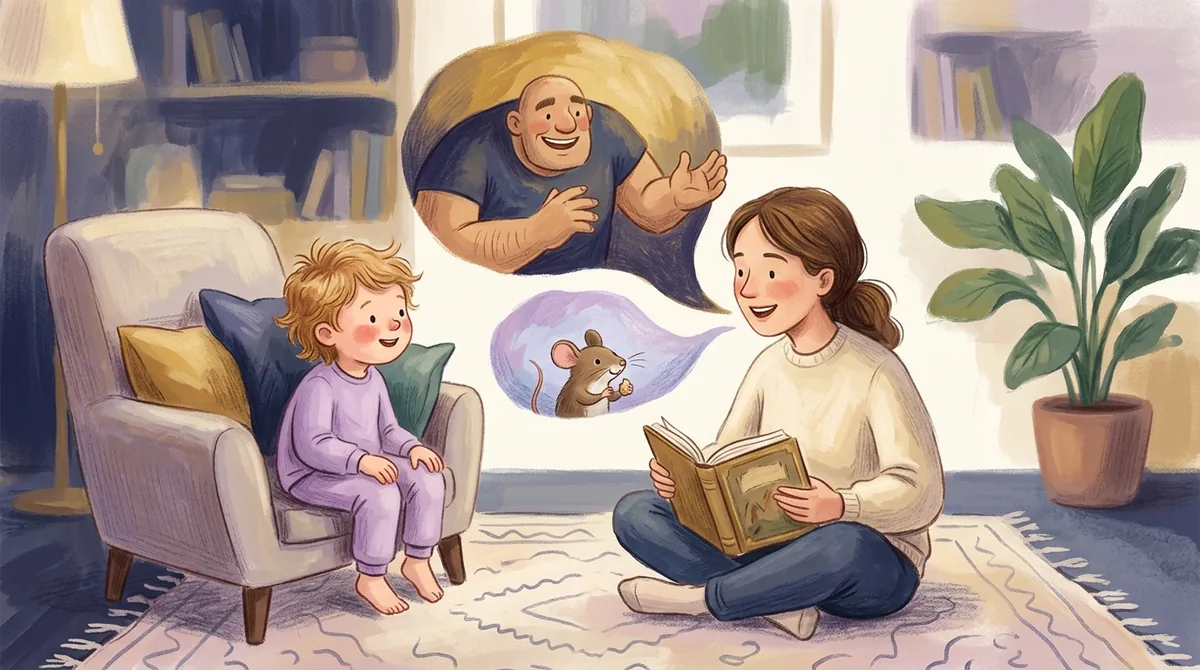
You need two voices, and you already have them. One is lower and slower than your normal speaking voice; the other is higher and quicker. Every character in every bedtime story can be played by one of those two, or by your own voice for the narrator. Nobody needs an accent, a growl, or the ability to do a convincing Scottish fox. This guide gives you the method, then walks through the cast of the site's most-read stories so you can practise on a troll, a wolf, a mouse and a flattering fox before tonight.
Two dials, not a hundred voices
Think of your voice as having two dials. The first is pitch: how high or low. The second is speed: how quick or slow. Turn both down and you have the big creature, the troll, the giant, the ox, the lion. Turn both up and you have the small creature, the mouse, the smallest goat, the child. Leave both in the middle and you have yourself, the storyteller. That is three settings, and it covers most stories in the library.
Why pitch and speed rather than accents? Three reasons. Accents are hard to keep consistent from night to night, and children notice when the wolf sounds different from last time. Accents tend to be funny, and funny is a wakeful feeling at nine o'clock. And accents attach to real people, which is a conversation you do not want with a five-year-old at bedtime. Pitch and speed attach to size and temperament, which is what a story character actually has.
There is a third dial for when you are ready: breath. A voice with a lot of air in it sounds tired, old or sly; a voice with none sounds young and bright. The old lion in The Old Lion and the Fox is low, slow and breathy. The fox visiting him is middle-pitch, quick and clean. You do not need this dial for a while. The first two are plenty.
The narrator is you
The most important voice in any bedtime story is the one that is not a character voice at all. The narrator, the voice reading "once upon a time" and "and so they went home", must be your ordinary voice, only slower and softer. It is the voice the child associates with you, with safety, and with falling asleep. Every character voice you do is a short excursion away from it, and you always come back. If the child is drowsy and the wolf's line comes, say the line in the wolf's voice and return instantly to your own for "said the wolf". The narrator voice is home.
This also solves the problem of "I ran out of voices". If a story has six characters, give voices to the two that matter most (usually the biggest and the smallest) and read everyone else as the narrator. Nobody has ever complained that the third woodcutter sounded like Dad.
A cast list: the troll and the three goats
Start with The Three Billy Goats Gruff, because it is the perfect training story: two settings of the dials, one line for each, a refrain, five minutes. Here is the cast.
- The troll: both dials down. Low, slow, and, if you like, a little breathy. "Who's that trip-trapping over my bridge?" should take about twice as long to say as it takes to read. Do not shout. A troll who mutters is more troll than one who roars.
- The smallest goat: both dials up. High, quick, a bit anxious. "Oh, it is only I, the tiniest billy goat Gruff." Rush the middle of the sentence and let it trail off at the end, as if he is hoping the troll has lost interest.
- The middle goat: narrator voice, or halfway between the two. This is where you learn that a character can be played by simply not doing a voice.
- The biggest goat: down in pitch like the troll, but not slow: firm and clipped. "It is I, the big billy goat Gruff." The contrast with the troll's drawl is what makes the child feel the biggest goat is going to win.
Read it once with this cast and the child will ask for it again. The whole giants, trolls and ogres collection works on the same two settings: something big and slow, someone small and quick, and the small one wins. The giant in Jack and the Beanstalk is the troll with the volume turned up one notch, no more.
The wolf: smooth, not loud
Parents often get the wolf wrong by making him growl. The wolves in the fairy tales are dangerous because they are charming. In Little Red Riding Hood, the wolf's lines are polite: "Good morning, Little Red Riding Hood. Where are you off to so early?" Play him low and slow, but warm, almost kind. Let the child hear the friendliness and feel the wrongness underneath. Then, at the bed, keep the same voice for "All the better to see you with, my dear" and only on the last line, "All the better to eat you with", let it go faster and a fraction louder. That is your one moment of drama, and it is enough.
In The Wolf and the Seven Little Kids the joke is that the wolf keeps trying to sound like the mother goat. Read his first attempt in his own low voice, "Open the door, my dear children, your mother is here," and let the kids reject it: "Our mother has a soft, sweet voice." When the wolf tries again after the chalk, do his line in a poor imitation of your high mother-goat voice, still with a bit of wolf underneath. Children find this funnier than any face you could pull, and it teaches them what the story is about: listening carefully to who is really speaking.
The Aesop wolves are different again. In The Wolf in Sheep's Clothing the wolf barely speaks; do the sheep as a gentle, high, slightly silly chorus and let the wolf be a silence. The wolf stories collection has all of them, and the same rule applies throughout: at bedtime, the wolf is quiet.
The mice: quick, light, and two of them
The mouse is the easiest voice in the library: high and quick, with a little squeak on the vowels. In The Lion and the Mouse that is all you need, against a low, slow lion. "Please let me go, and one day I will help you" in the mouse voice, then a long lion pause, and the lion's amused, rumbling "You? Help me?" Children love the contrast, and it carries the moral without your having to say it.
The Town Mouse and the Country Mouse is the harder case, and a useful lesson: two characters of the same size. You cannot use pitch to separate them, so use speed and breath. The town mouse is quick and clipped, a mouse in a hurry, slightly bored: "Is this all you have to eat?" The country mouse is slower, softer, with more air: "It is plain, but it is enough." By the end, when the country mouse decides to go home, that slow soft voice is the voice of contentment, which is exactly what you want in the room at bedtime. The mice stories are mostly two-minute fables, so they are a good place to practise the two-same-size problem without much at stake.
Fables: the flatterer and the fool
Aesop's characters are types rather than people, which makes them easy to voice. The fox is nearly always the flatterer: middle pitch, smooth, unhurried, a little too pleased with himself. In The Fox and the Crow, "What a beautiful bird you are! If only your voice were as lovely as your feathers" should sound like someone selling something. The crow says nothing until the caw, so make the caw a proper, ugly, high caw and let the cheese fall in the silence after it.
The proud characters, the hare in The Hare and the Tortoise, the frog in The Frog and the Ox, are quick and bright and slightly too loud; the steady characters, the tortoise, the ant, are slow and even, almost the narrator. The pattern across the Aesop's fables is that the winner sounds calm and the loser sounds excited, which is a nice thing for a child to absorb at bedtime without anyone spelling it out.
What not to do
- Do not shout. No voice at bedtime should be louder than your narrator. If a character needs to be loud, make them slower and lower instead; it reads as big without waking anyone.
- Do not do a voice you cannot repeat. Before you commit to a voice for the wolf, ask yourself whether you can do it again tomorrow. If not, pick a simpler one.
- Do not voice the child's own fear. If your child is frightened of witches this month, read the witch in Hansel and Gretel in your narrator voice, or skip the story. The voice is a tool for settling, and it is allowed to stay in the drawer.
- Do not make the funny voice the last voice. If the story ends on a character's line and that character is the comic one, read the last line as the narrator. The final voice in the room should be yours.
Keeping voices consistent (because they will check)
Children remember voices better than you do. If the troll was breathy on Monday and clipped on Wednesday, you will be told. The cure is to keep the cast small and the settings simple: low-slow and high-quick are easy to reproduce; a specific comedy voice is not. It also helps to decide the voice before the story starts. Look at the page, see who is in it, and set the two dials in your head. If you are reading from the hub guide's advice and glancing ahead before you start, this takes no extra time.
If you have two adults reading on alternate nights, agree the voices, or accept that "Mum's troll" and "Dad's troll" are different creatures. Children cope with that perfectly well as long as each adult is consistent with themselves.
A five-minute practice
- Say "Who's that trip-trapping over my bridge?" in your normal voice.
- Say it again with your chin down, slowly. That is the troll.
- Say "It is only I, the tiniest billy goat" with your eyebrows up, quickly. That is the small goat.
- Say "and the goat went over the bridge" in your own voice, slower and softer than you would talk. That is the narrator, and the most important of the three.
- Read the story once, alone, before bedtime, doing all three. It will take five minutes, and tonight will go better for it.
Tonight
Choose a two-voice story: The Three Billy Goats Gruff for a younger child, The Lion and the Mouse for a quicker one, or The Fox and the Crow if the child is old enough to enjoy a flatterer. Set the two dials before you begin, keep the narrator as yourself, and read the last line in your own voice. If it goes well, the wolf stories are the next step up.