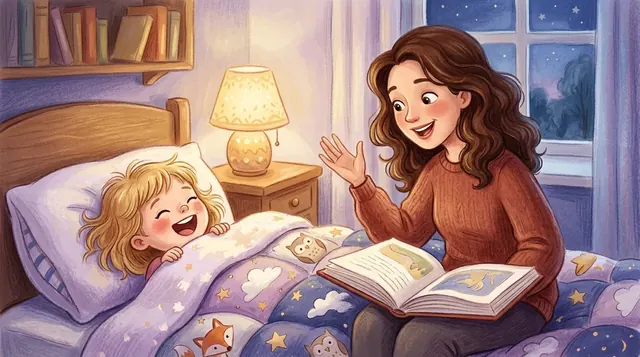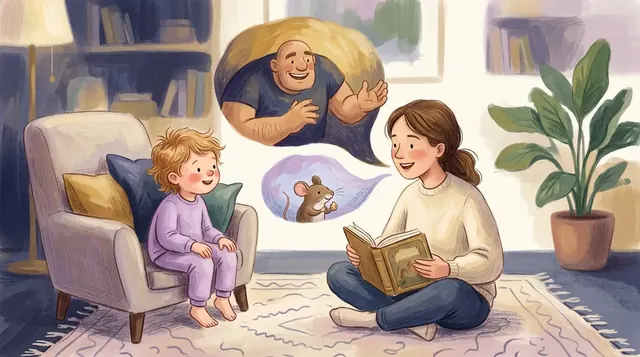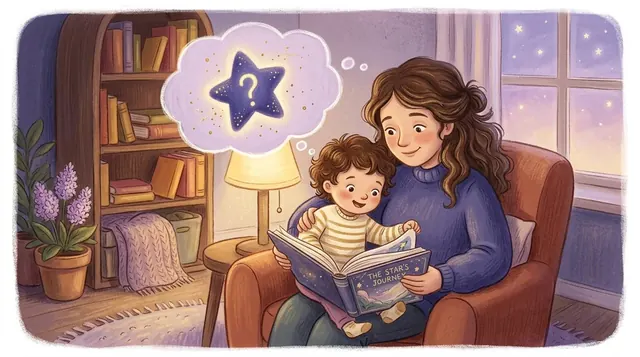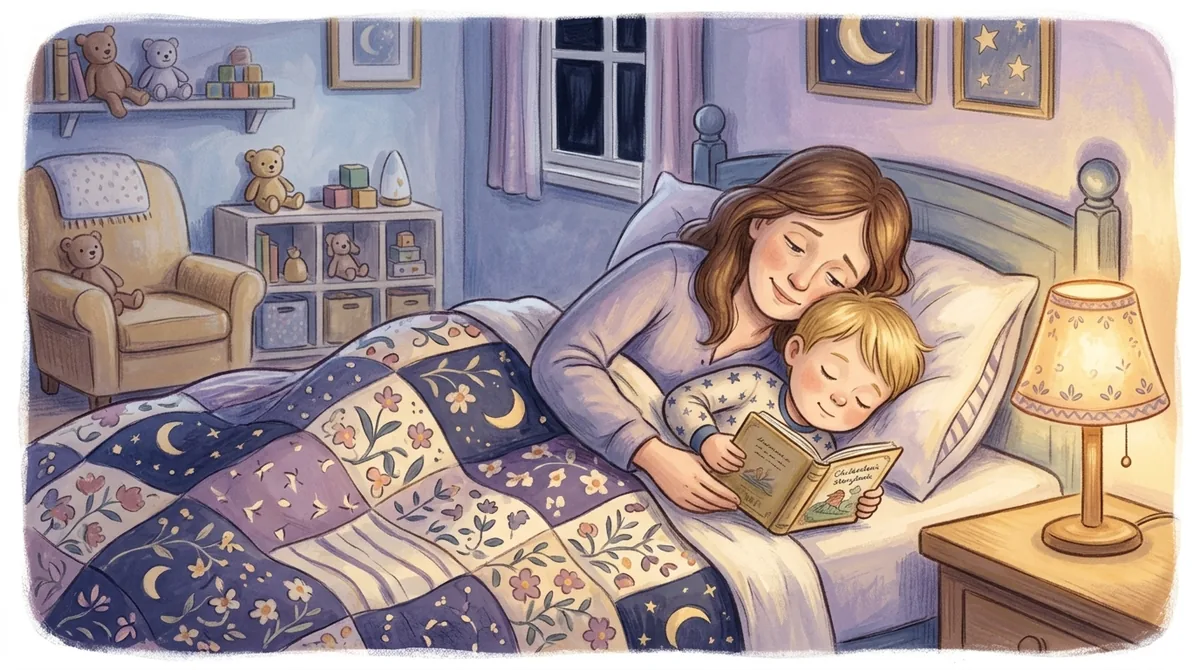
You do not have to read tonight. You have to keep the ritual, and those are different things. On the nights you cannot face a book, a rhyme said in the dark, a story told from memory with your eyes closed, or the site's read-aloud voice playing while you lie beside the child all count. What does not count is skipping it, and what actively harms is doing it crossly. This guide is a ladder of options, from the easiest to the nearly-full version, with the exact words for the worst nights and a small bank of stories you can tell without light.
The two-minute floor
Set a floor, and make it low enough that you can always reach it. Ours is two minutes: one rhyme, or the last page of a known story, in a low voice, with the lights already off. That is the ritual in its smallest form. A child does not need ten minutes every night to get the benefit of a bedtime story; they need the story to be there every night, as a fixed point, so that its presence tells them the day is over and they are safe. The bedtime routine guide puts it in terms of the sequence: bath, teeth, story, lights. On a bad night the story step can be tiny. It cannot be missing.
Decide the floor in advance, on a good night, and tell the child what it is: "On a very tired night we do a short one." Then it is a known thing, not a disappointment.
The ladder: five ways to do it that are easier than reading
From easiest upward. Pick the rung you can manage tonight.
1. A rhyme from memory, lights off
You already know a dozen. "Twinkle, Twinkle", "Hush-a-bye", "Wee Willie Winkie". Lie down or sit on the edge of the bed, switch the light off first, and say the rhyme slowly, twice if the child wants. The nursery rhymes section will refresh your memory of the words tomorrow if it is a rhyme you half know. For a toddler this is not the emergency version; it is the version. For an older child it is a comfortable regression, and they will not mind.
2. One fable
Aesop's fables take two minutes and have one turn each, which makes them the perfect tired-night story. Open the story page, dim it, and read The Lion and the Mouse or The Hare and the Tortoise straight through, no voices, no questions. Read the moral, then add "and the tortoise went home to bed" so it ends softly. Done. The five-minute stories page has the fables and the shortest tales together.
3. A story told from memory, eyes shut
Lie down beside the child, close your eyes, and tell a story you know by heart. This is the oldest form of the bedtime story and it has advantages the book does not: no light, no screen, no page, and your voice at pillow height. It also has the advantage of being possible at ninety per cent asleep. The bank of stories below is for this. If you cannot remember the middle, the child usually can. "What happens after the second goat?" is a perfectly good line, and being asked to help is a treat for them.
4. The read-aloud voice, with you beside them
Every story page has a Listen button that reads the story in your device's voice and highlights each paragraph as it goes. On a night your voice has gone, or you are fighting sleep yourself, put the phone face down or dimmed with night-light mode, press Listen, and lie beside the child. The rule, and it is the only rule, is that you stay in the room. The voice is doing the words; you are doing the rest, which is the closeness. Join in for the refrains if you can. The guide to audio stories and read-aloud voices explains how to set it up so it helps rather than hinders sleep.
5. The child reads to you
From about six, if the child can read, this is the treat version of a tired night rather than the fallback. "Tonight you read to me. I am going to lie here and listen." Pick something short and well below their reading level so it is fluent and calm, not effortful. Say thank you at the end, and mean it. Children who read to a tired parent at bedtime remember it fondly, and it is a rung of the ladder that quietly turns into the next stage of reading.
Three stories to learn by heart
Learn three short tales well enough to tell in the dark. It takes about a week of reading them at bedtime anyway. Choose ones with a fixed shape and a refrain, because the shape carries you when you are tired.
- The Three Billy Goats Gruff. Three goats, a bridge, a troll, the same scene three times. The refrain does most of the work and the child will supply the troll.
- The Lion and the Mouse. Two characters, two scenes, one promise kept. Ninety seconds, and it ends on kindness.
- The Enormous Turnip. A list that grows. You cannot get lost, because each scene is the last scene plus one, and if you forget who comes after the dog, the child knows it is the cat.
If you want a fourth, Goldilocks and The Three Bears has the three-times shape too (porridge, chairs, beds) and ends with someone in a bed, which is convenient. For the nights you want to make one up rather than remember one, the guide to improvising a story gives a formula that works even when you are half asleep: a hero the child likes, one wish, three obstacles, and the child solves the last one.
Lying down is a technique
Parents feel guilty about lying down next to the child during the story, as if it were cheating. It is not; it is one of the best ways to read at bedtime, and on a tired night it is the way. Your voice is at pillow height and quieter, which is what the ending of a story needs anyway. Your breathing slows, and children match the breathing of the adult beside them. The light can be off. The only risk is that you fall asleep first, and if you do, the child has been read to and is lying beside a sleeping parent, which is not a disaster. Set an alarm on your phone for fifteen minutes if you have things to do afterwards.
The bad-night script
For the nights you are so tired that even choosing feels hard, have a script. Say it the same way each time, so the child knows what it means.
- "I am very tired tonight, so we are doing a short story. Lights off first." (Turn the light off. Do not negotiate this step.)
- Lie down or sit on the edge of the bed. "Which one: the goats, or the lion and the mouse?" (Two choices, both short, both known. Never "what would you like?")
- Tell it. Slowly, quietly, with the refrain handed to the child. Let them fill gaps.
- Your usual closing words. Ours are "and that is the end of the story". Yours are yours. They matter more tonight than on a good night, because they are the sign that the ritual happened.
- "Big one tomorrow." Then go. Do not stay to be persuaded into the big one tonight.
If the child protests, the answer is warm and short: "I know. Short one tonight, big one tomorrow." Then the closing words again. Children accept a short story far more readily than a cross parent or no story, and the protest usually stops within a few nights of the rule being consistent.
The one real mistake
The only thing that damages the bedtime story is doing it in a way that makes the child dread it. Reading in a tight, hurried voice, sighing at the page turns, snapping at an interruption, or saying "fine, no story then" and leaving: each of these teaches the child that the story depends on your mood, and a ritual that depends on mood is not a ritual. If you are so tired that you cannot read without being short with them, go straight to the bottom rung, one rhyme in the dark, and say it kindly. Two kind minutes are worth more than ten resentful ones. Skipping it altogether is the other mistake, and it is a smaller one than reading it angrily, but it still costs you: the next night is harder, because the fixed point moved.
There is also a mistake on the other side: the parent who, out of guilt, reads the full ten minutes every night regardless and ends up dreading bedtime. That is how bedtime stories stop at four. Use the ladder. Use the read-aloud voice sometimes. A tired parent lying beside a child listening to a story together is not a lesser thing.
Tonight
If you are reading this at nine o'clock with the child waiting, here is the plan. Lights off. Sit on the bed. "Short one tonight." Tell the goats from memory or, if you cannot, open tonight's story, dim the screen, press Listen, and lie down beside them. Say the refrains together. Closing words. "Big one tomorrow." And tomorrow, when you have a little more in the tank, learn the lion and the mouse.