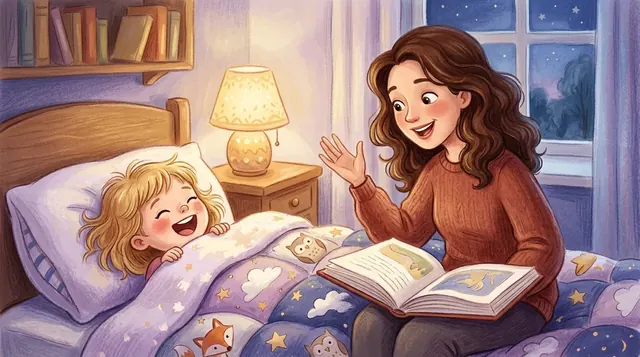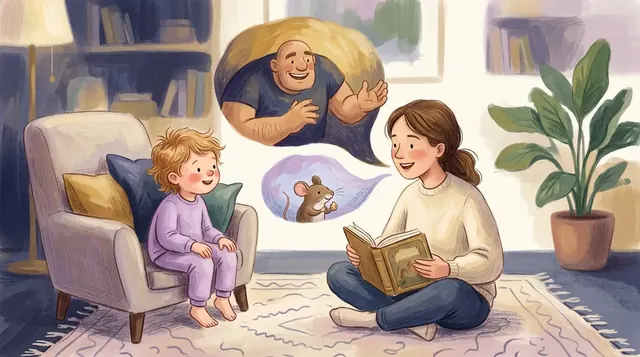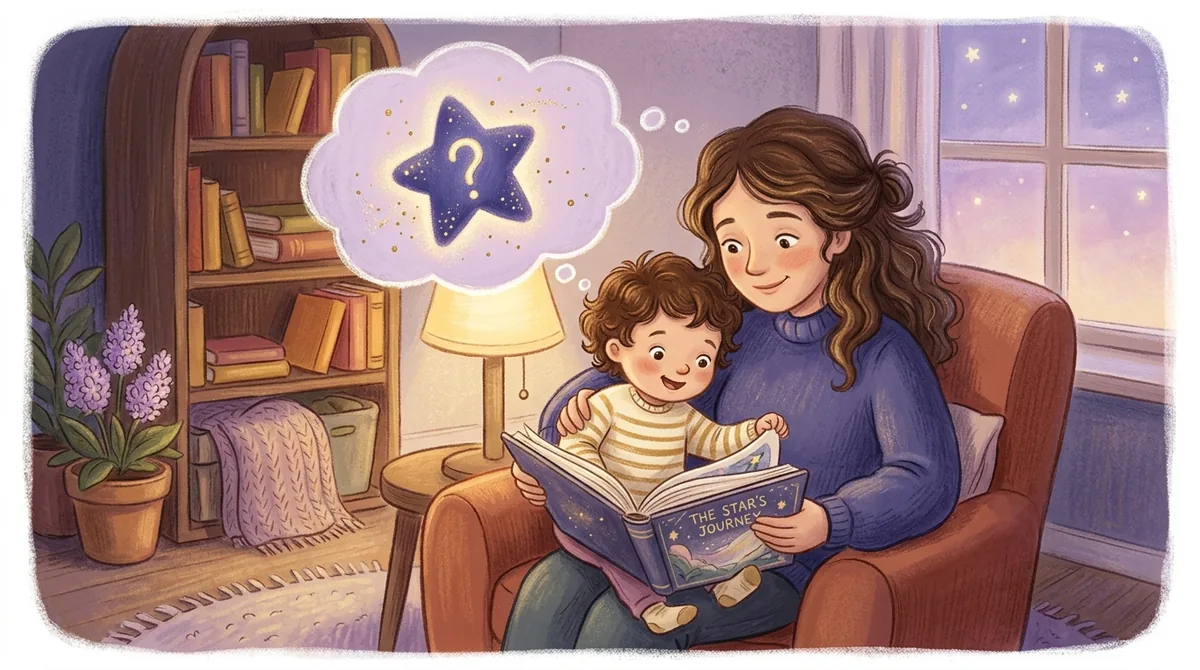
Ask two or three open questions, at pauses the story already has, and then go back to reading. That is the whole discipline, and it is harder than it sounds, because once you know that talking about a story doubles what a child takes from it, the temptation is to talk about every page. Do not. A bedtime story that is interrupted by a question on each page is not a story; it is a comprehension test, and children can feel the difference. This guide is about the where, the how and the wording, with examples from the fables and classic tales on the site.
Why questions help, and why most of them do not
Being read to is good for a child's language because story sentences are longer and stranger than the ones we use at the dinner table. But a child who only listens is receiving; a child who answers a question has to reach for words and put them in order. That reaching is where vocabulary and grammar get fixed in place. Research on what is usually called dialogic or interactive reading finds that the talking matters, not just the listening, and that the effect is strongest for children under about six. The language development guide goes through the mechanism.
But the research is about a particular kind of question: open, genuine, and answered by the child in their own words. It is not about "What colour is the hood?" (closed, and the child knows you know). It is not about "And what is the moral?" (a test). And it is not about anything asked in the middle of a sentence. A good question at the wrong moment is a bad question.
Where the pauses are
A story has natural places to stop, and those are the only places to ask. There are three.
- The page turn. In story-book mode, the moment before you swipe. The scene has ended, the child is waiting, and a question fills the gap the story has already made.
- The decision. Just before a character chooses. Before the hare lies down for a nap; before the boy cries "Wolf!" for the third time; before the mouse asks the lion to let her go. Stopping here lets the child predict, which is the most engaging thing a listener can do.
- The end. After the last line and before your closing words. This is the place for the feeling question and the connecting question, and it is where the "Talk about it" section on each story page is meant to be used.
That is it. Not mid-paragraph. Not in the middle of a character's speech. Not during the scary bit. Not in the last two paragraphs, which belong to sleep; if you want an end question, ask it after the final line, then read the final line again to land.
Four kinds of question, with the words to use
Predict: "What do you think happens next?"
The workhorse. It works on the first reading because the child does not know, and on the twentieth because they do and love being right. In The Hare and the Tortoise, stop as the hare lies down under the tree: "What do you think the tortoise is going to do?" In The Boy Who Cried Wolf, stop when the real wolf appears: "Do you think the villagers will come this time?" Whatever the child says, the answer is "Let's find out," and you read on. Do not tell them whether they were right; the story will.
Feel: "How do you think she felt when...?"
This is the empathy question, and it belongs at the end or at a scene end. In The Ugly Duckling: "How do you think the duckling felt when the other ducks laughed at him?" Then, at the end: "And how do you think he felt when he saw the swans?" Accept any answer, including "sad" and including "I don't know". If the child says "I don't know", offer two: "Do you think he felt scared, or excited, or a bit of both?" and let them pick.
Connect: "Has that ever happened to you?"
The question that links the story to the child's life, and the one to use sparingly, because it can open a conversation that is not for bedtime. Choose safe ones. After The Lion and the Mouse: "Have you ever helped someone bigger than you?" After a kindness story such as The Elves and the Shoemaker: "Who did something kind for you today?" Avoid "Have you ever been scared like that?" at bedtime. Save it for the school run.
Wonder: "I wonder why the fox..."
Not a question at all, technically, which is why it works with children who clam up when asked something directly. You wonder aloud and leave a gap. "I wonder why the crow believed the fox." Then silence. The child fills it or does not. Either is fine. In the fables this is the way to get at the moral without asking for the moral. After The Fox and the Grapes: "I wonder if the grapes really were sour." A five-year-old will tell you, indignantly, that they were not.
Worked examples: an Aesop fable and a classic tale
Here is The Ant and the Grasshopper, three questions, all at real pauses.
- After the grasshopper laughs at the ant for working (scene end): "Why do you think the ant keeps working when it is so sunny?"
- When the snow comes and the grasshopper is hungry (decision): "What do you think the grasshopper should do now?"
- After the last line: "I wonder what the grasshopper will do next summer."
Notice there is no "What is the lesson of this story?" The child has just answered it three times without being asked. The Aesop's fables are ideal for practising because they are two minutes long and have one turn each; you can try one question per fable and see how it goes.
Now The Elves and the Shoemaker, a longer tale with a gentle plot.
- After the first pair of shoes appears (page turn): "Who do you think made them?"
- When the shoemaker and his wife decide to hide and watch (decision): "What do you think they will see?"
- At the end, when the elves put on their new clothes and dance away: "How do you think the shoemaker felt, watching them go?"
Three questions, ten minutes, and the child has predicted, imagined and felt. That is a good night.
What to do with the answer
Follow it once, then go back. If the child says the tortoise is going to "get a rocket", say "A rocket! That would be quick. Let's see what he does," and read. You have honoured the answer without derailing the story. If the child gives an answer you think is wrong, do not correct it. "Hmm, maybe" is the whole response. The story will show them, and a child who was "corrected" during a story learns to give the safe answer next time, which is the opposite of what you want.
If the child asks a question back, answer it briefly and honestly. "Why did the fox want the cheese?" "Because he was hungry, and because foxes in stories are a bit greedy." Then read. Children's questions during a story are the surest sign it is working; there is a separate guide on what to do when the questions become interruptions.
Questions that spoil a story
- Quiz questions. "How many goats were there?" The child knows you know. It turns the story into school.
- The moral question. "So what does that teach us?" It announces that the story was medicine. Use "I wonder" instead.
- The question during the scary bit. A frightened child needs the ending, not a discussion.
- The question during the landing. The last two paragraphs are for sleep. Nothing goes there.
- Too many. If you have asked four, stop. The fifth is for tomorrow.
Questions by age
Toddlers (one to three) want pointing questions, which are the one exception to the rule about closed questions: "Where is the mouse?" is a fine question for a two-year-old, because for them finding the mouse is the game. Preschoolers (three to five) are the sweet spot for predicting and feeling. Early readers (five to eight) enjoy "wonder" questions and will start to argue with the story, which is wonderful; let them. Older children (eight to twelve) often do not want questions at bedtime at all, and if they want to talk about the story they will start. With a tween, the best question is silence and a raised eyebrow after a line that deserves one.
On the nights to ask nothing
A child who is drowsy, ill, upset, or already half asleep should be read to and not asked anything. The point of questions is engagement, and an engaged child is more awake; on a night when the child is already on the edge of sleep, the kindest thing is a straight read at half speed. The reading-aloud hub covers the landing technique; the questions guide is for the nights there is room for them. Most weeks there will be three or four such nights, and that is plenty.
Where to start
Pick a fable from the Aesop collection, read the "Talk about it" questions on its page before you begin, and choose one. Ask it at the decision point, follow the answer once, and read on. Tomorrow, try a classic tale from the library with two questions. By the end of the week you will know where the pauses are without looking for them, and the child will have started asking questions back, which is the point.