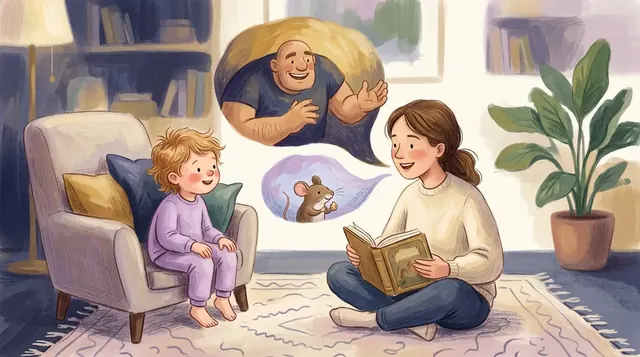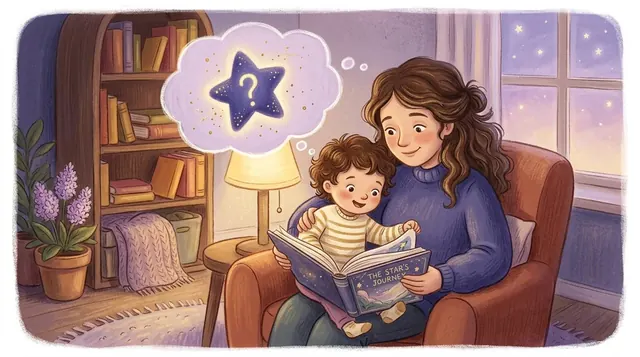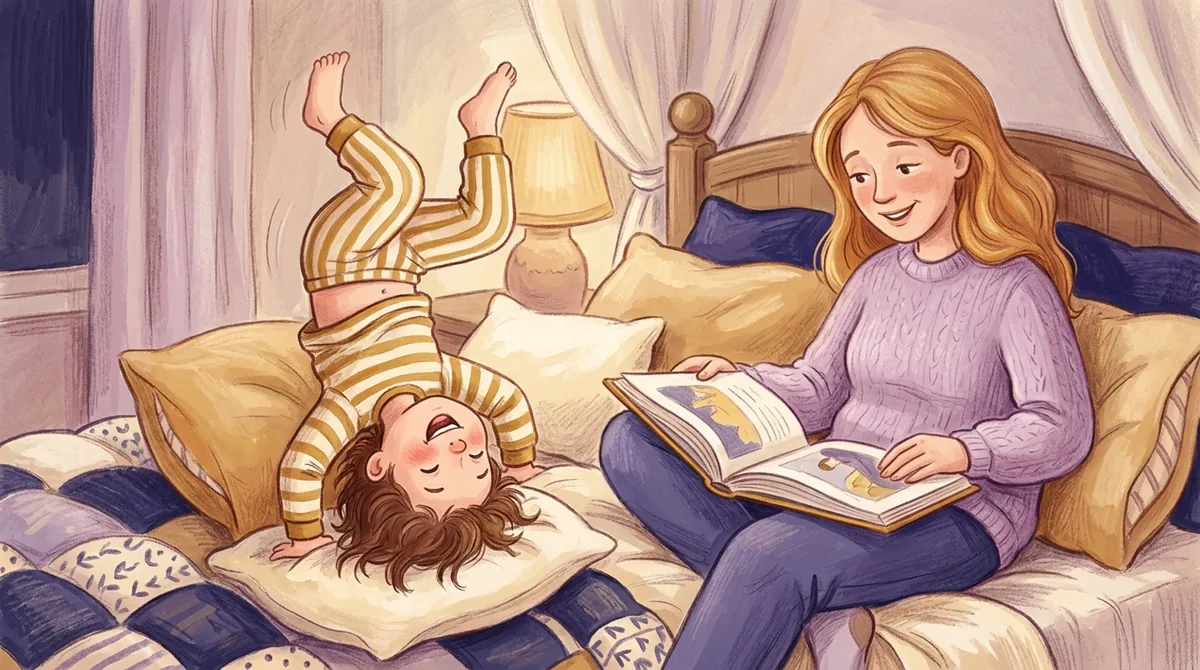
A child who talks over the story, rolls off the bed, or gets up to fetch a toy halfway through the troll's speech is not being rude, and almost certainly not bored. Young children listen with their whole body and comment on what they hear as they hear it; that is what engagement looks like at three. The trick is not to suppress it but to give it somewhere to go, and to notice when what looks like restlessness is really a signal that the story is too long, too late, or too much. This guide sorts interruptions into four kinds and gives a fix for each, then covers the two universal remedies: shorter stories and stories that invite the child in.
First, work out which kind of interruption it is
Not all interruptions are the same, and treating them the same is where reading aloud goes wrong. Watch for a night or two and see which of these you have.
The questioner
"Why is the wolf in the bed? Where is grandmother? Is that the woodcutter? Why has he got an axe?" This child is following closely and wants everything explained as it comes. The fix is short answers and a return phrase. Answer in five words, then say the last line again and go on: "He is hiding. So: the wolf pulled the covers up to his chin..." Do not say "wait and see" to a questioner more than once a story; they cannot wait, and it makes them ask louder. Save one longer answer for the end.
The wriggler
The child is listening but cannot be still: kicking the duvet, turning over, sitting up, lying down, hanging off the bed. This is not inattention; many children under six take in more when they are moving. The fix is to stop treating stillness as a condition of the story. Let them lie however they like, upside down if they must, and give the hands a job (below). The only rule is that they stay on the bed.
The wanderer
The child gets up and leaves. Sometimes to fetch a toy, sometimes with no reason at all. Usually this means the story is too long or started too late, and the child's attention has genuinely run out. The fix is a shorter story tomorrow and, tonight, a calm "I will keep reading; come back when you are ready," in your normal voice, without pausing. Nine times out of ten they are back within a minute, because a story being read to no one is unbearable.
The topic-changer
"Did you know Jasper has a dog? It is a brown one. Jasper's dog is called Biscuit." Nothing to do with the story. This child either needs to tell you something before they can settle, or is using talk to push bedtime later. Listen to the first one, properly: "A brown dog called Biscuit. Lovely. Tell me more about Biscuit tomorrow." Then read. For the second and third, the phrase is "That is a story for the morning. Right now we are with the goats." Say it the same way every time, and it becomes a rule they know.
A job for the hands
Restless children are calmer with something to do, and a story gives you an easy job to hand over: turning the page. On the site, story-book mode turns each story into swipeable pages with big text, and a three-year-old can swipe. Say "You are in charge of the pages. When I stop, you swipe." Now the wriggle has a purpose, the child is watching for the end of each page (which means listening), and the pause at the page turn, which is the most useful pause in reading aloud, happens by itself.
Other jobs: pressing the night-light dim button at the start; holding a soft toy who is "listening too" and needs to be shown the pictures; doing the actions for a rhyme (the huffing and puffing, the trip-trap on the duvet). For a child who cannot stop touching things, a toy in each hand is a perfectly good solution. The hands are busy; the ears are free.
Stories that turn talking into joining in
The best cure for a child who wants to talk during the story is a story that wants them to. Three kinds do this well.
Rhymes. A rhyme has a beat, and a child who is talking over a beat soon finds themselves talking with it. The rhyming stories and poems on the site are the place to start; the rhythm carries the child along and the rhyme tells them what the next word is going to be, so they can say it with you. Leave the last word of each couplet for them: "Twinkle, twinkle, little...?" The talking becomes the story.
Refrains. Any story with a line that comes round again gives the child a line of their own. The Gingerbread Man has "Run, run, as fast as you can"; The Three Billy Goats Gruff has "Who's that trip-trapping over my bridge?"; the three little pigs have the huffing and puffing. Tell the child at the start "You are the troll tonight," and the interruptions are now the troll's lines.
Cumulative tales. Henny Penny and Chicken Licken add one animal per scene and repeat the whole list each time. By the third repetition the child is reciting "Henny Penny, Cocky Locky, Ducky Daddles" with you, and there is no room in that breath for a question about Jasper's dog. The Enormous Turnip does the same with pulling: the child can pull.
The questions guide has the other half of this: asking a question yourself at the page turn means the child's talking is now the answer to something, and a child who has just been asked what happens next is a child who wants to hear whether they were right.
Shorter, earlier, and with the end in sight
A child who interrupts all the way through a ten-minute story is usually a child who needed a five-minute one. Every story on the site shows its read-aloud minutes at the top, and the five-minute stories are complete tales, with a beginning, a middle and a proper ending, not extracts. For a restless three- or four-year-old, one five-minute story read well, with the child on the pages and the refrains handed over, is worth three ten-minute stories read over the top of a wriggle. The preschooler stories are chosen with this in mind.
Timing matters as much as length. Interruptions climb steeply when a child is overtired; the wanderer, in particular, is often a child who should already have been asleep. If the story is consistently a fight, try starting the routine fifteen minutes earlier for a week and see if the fight goes. Often it does, and nothing about the reading needed to change.
Finally, tell the child how long the story is. "This one is short, three pages, and then lights out." Children interrupt less when they can see the end coming. On the site's story-book mode they can see it: the pages are countable.
What not to do
- Do not stop reading to insist on silence. A story that keeps stopping teaches the child that interrupting stops the story, which is the opposite of what you want. Keep reading through the small stuff, in the same calm voice.
- Do not demand eye contact or stillness. Many children listen best while lying face-down or fiddling with a label. Their ears are not in their eyes.
- Do not threaten to end the story. "If you keep talking there will be no story" makes the story a punishment tool, and the routine stops being safe. If a night is genuinely unworkable, say "We are too tired for the story tonight; we will have it tomorrow," in a kind voice, and do the rest of the routine as usual.
- Do not answer everything. The questioner will ask forty questions if you answer forty. Five words, and back to the page.
A script for a restless night
- "Tonight's story is short. You are in charge of the pages."
- Read the first page at two-thirds of your talking speed, in your ordinary voice, as the reading-aloud hub describes.
- First interruption: five-word answer, repeat the last line, carry on.
- First refrain: stop and look at the child. Let them say it. If they do not, say it and move on; they will next time.
- Second interruption, off topic: "That is a story for the morning. Right now we are with the goats."
- Page turn: "What do you think happens next?" Then: "Let's see." Swipe.
- Last page: halve your speed, drop your voice, land it. Closing words. Lights.
Tonight
Choose a five-minute story with a refrain: The Three Billy Goats Gruff or The Gingerbread Man for a preschooler, or a rhyme from the rhyming stories for a toddler. Open story-book mode, hand over the pages, and give the child the troll's line. Answer questions in five words. If they wander, keep reading. And if it still does not go, start fifteen minutes earlier tomorrow; the problem is more often the clock than the child.