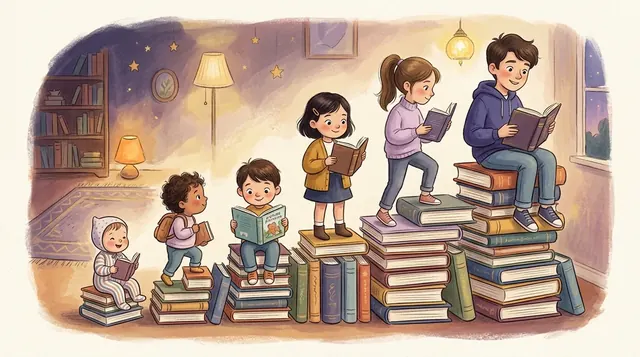
At five a child can follow a story from one end to the other. By eight they can follow one that doubles back, hold a villain and a hero in their heads at the same time, notice when a character is lying, and argue with the ending. That is a bigger change than any other in the years of being read to, and the stories should change with it: fuller fairy tales rather than kind retellings, quests rather than farmyards, and fables whose moral is worth a disagreement. This guide says what changed, which stories on this site use the change well, and how to run a week of bedtime reading for a child who is also, in the daytime, learning to read for themselves.
What changed at five
Three things. First, memory across a story: a six-year-old can remember at the end that the miller lied at the beginning, which makes Rumpelstiltskin work as a plot rather than a series of events. Second, other minds: they know the wolf is pretending, and they enjoy knowing it while the character does not, which is the whole pleasure of a villain. Third, tolerance for delay: a seven-year-old will wait through a middle in which things get worse, because they trust the ending is coming. None of this means the child wants a lecture, and none of it means a preschool story is now wrong. It means the early readers hub is where the new material is, and the fuller versions of tales met at four are ready to be read.
The fuller fairy tales
The Grimm tales in their fuller shape belong to this age. Hansel and Gretel has a witch who is genuinely dangerous and a sister who pushes her into the oven, and a six-year-old will take the whole of it because they can see Gretel's plan forming. Rapunzel has a tower, a witch and a prince who is blinded, and a child of seven wants the difficult middle, not a version with it removed. The Six Swans has a sister who must not speak for six years to save her brothers, which is a story about a promise that costs. The Goose Girl has a maid who steals a princess's place and a talking horse's head, and it is one of the strangest and best of the Grimm tales for an eight-year-old. From Andersen, The Tinderbox, with its three dogs with eyes as big as saucers, mill-wheels and towers, is the one to start with, and The Emperor's New Clothes is the story every seven-year-old understands instantly, because they have been the child who said the thing nobody else would.
The English tales are the same. Jack and the Beanstalk now gets its giant, its "fee-fi-fo-fum" and its harp; Tom Tit Tot is the English Rumpelstiltskin with a better rhyme. Puss in Boots is a con trick from beginning to end, which a six-year-old finds delicious once they have worked out that the cat is lying to everyone. All of these are in the ten-minute stories section, which is the natural length for the age.
Quests and clever heroes
The other new appetite is for a journey. Five-to-eight-year-olds want a hero who leaves home, meets three problems, and comes back cleverer, and the folk tales of Norway and beyond supply it. The Lad Who Went to the North Wind is a boy who goes to complain to the wind itself about his flour and comes back with a cloth, a ram and a stick. Long, Broad and Sharpsight gives a prince three companions with three impossible gifts, and a child of seven will spend the middle of the story working out which gift solves which problem. Seven At One Blow is a tailor who kills seven flies and lets everyone think it was seven giants, and it is the funniest of the Grimm quests. The Wise Girl and The Master Maid both have a girl doing the clever part, which matters for sons as much as daughters. The bravery section and the problem-solving section are the two theme pages to browse for this age, because a five-to-eight-year-old wants a hero who is brave and a hero who is clever, and the best ones are both.
Morals worth arguing about
A fable to a four-year-old is a rule. To a seven-year-old it is an argument, and the good ones are the ones they disagree with. The Boy Who Cried Wolf is the standard: the moral is that liars are not believed, and a six-year-old will point out that the sheep were still eaten, so the villagers should have come anyway, and that is a better conversation than the moral. The Fisherman and His Wife is about a wife who asks for more and more until she loses everything, and a seven-year-old wants to know whether it was fair that the fisherman lost too. The Golden Touch of King Midas asks what you would wish for instead. The Ant and the Grasshopper divides every household: should the ant have shared? Read the moral line on the story page, then ask the child whether it is right. The "Talk about it" questions on each page are written to start that argument, and a bedtime that ends in an argument about whether the ant was mean is a bedtime that has worked.
Letting them read the first page
Many children in this band are learning to read, and there is a temptation to make bedtime the practice slot. Resist it. Decoding is hard work, and hard work at nine o'clock wakes a child up. The guide to reading aloud and school readiness makes the fuller case, but the rule is simple: bedtime is for being read to, so that the child hears language a level or two above what they can read, and the daytime is for reading themselves. What works is a small ceremony: the child reads the first paragraph, or the first page in story-book mode with the text turned up large, and then hands over. They get the pride, you get the pace, and the story gets to its ending calm. If they want more, let them read the chorus lines or the villain's speeches, which are short and repeated and easy to get right.
A week of stories for a six-year-old
- Monday: Rumpelstiltskin. A plot with a middle. Ask afterwards how the queen might have found the name if the messenger had not.
- Tuesday: The Lion and the Mouse, read by them, then The Boy Who Cried Wolf, read by you. Argue about the villagers.
- Wednesday: The Lad Who Went to the North Wind. A journey and three gifts.
- Thursday: The Emperor's New Clothes. Short, and they will want to talk about the child at the end.
- Friday: Jack and the Beanstalk, with a giant's voice. Friday is the night for the loud one.
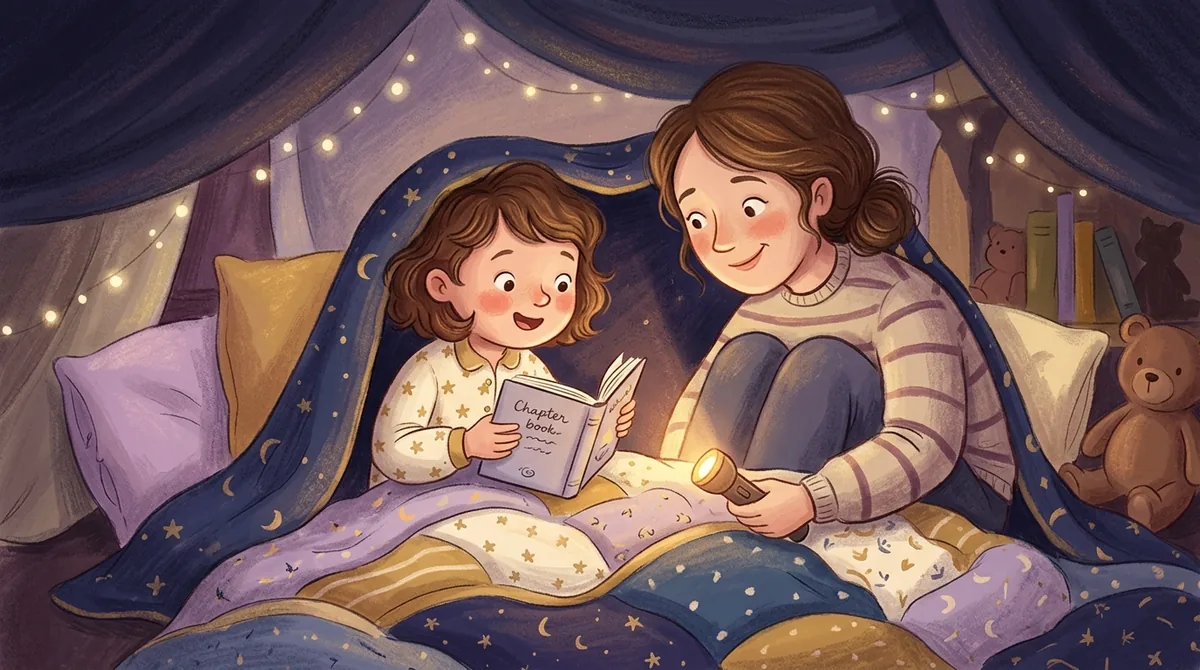
- Saturday: first half of The Snow Queen, in story-book mode, stopped at a chapter break. The first long story, split over two nights.
- Sunday: the second half, then something short and slow to land on.
Swap freely, but keep the shape: a plot, a fable, a quest, a short one, a loud one, and one story that is too big for a single night, because learning to wait for tomorrow's chapter is one of the things this age is for. If a night runs late, drop the story rather than rushing it; a six-year-old would rather have no story than a story read at speed, and the week's shape survives a missing Wednesday.
Where to start tonight
If the child is five and has come from the preschool hub, begin with The Tinderbox or The Elves and the Shoemaker in its fuller telling. If they are seven and bored of everything, Puss in Boots or Seven At One Blow, both of which reward a child who has noticed that the hero is cheating. If you have ten minutes and no plan, the ten-minute stories page is sorted for exactly this age.