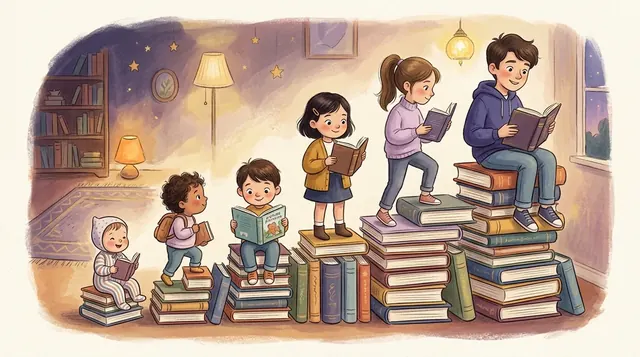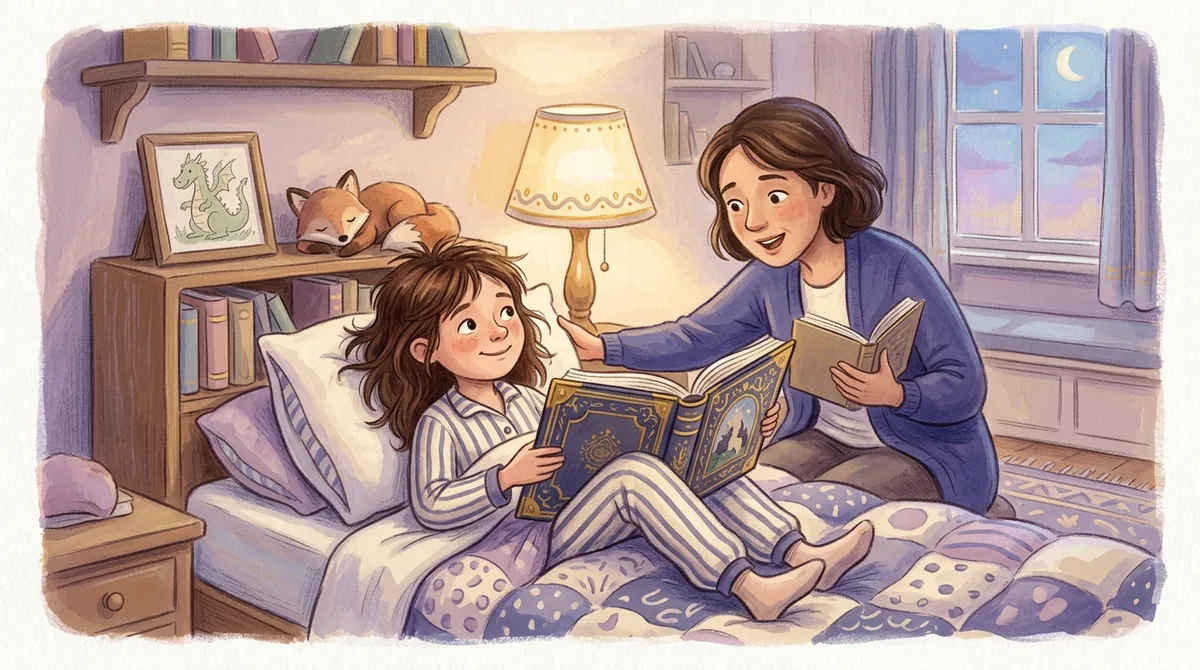
Yes, keep reading to them. An eight-to-twelve-year-old who can read a novel alone has not outgrown being read to; they have outgrown the stories they were read at five. Read them something with real language and an ending that is not tidy, and most of them will lie still for it, ask a question at the end that they would never ask at the dinner table, and come back the next night. This guide answers the objections, names the tales on this site that suit the age, and says how to run a long story across several nights without losing the thread.
"But they can read for themselves now"
They can, and they should, and it is not the same thing. When a child reads alone they read at the level they can decode, in their own head, with nobody to ask. When they are read to they hear language a level or two above what they could manage alone, in a voice that gives it shape, with someone beside them who can be asked what "gilded" means. The National Literacy Trust's work on reading for pleasure finds that being read to at home is one of the strongest things a family can do for a child's reading, and there is no age at which it stops being true. What stops is the child's tolerance for material beneath them. The fix is not to stop; it is to move to the big kids hub and the long stories section, where the tales are longer, the words are richer and the endings are not always happy.
"But they say they're too old"
A nine-year-old who says "I'm too old for bedtime stories" is almost always saying "I'm too old for that story", and it is worth taking them at their word. Offer something that does not look like a bedtime story: a quest that takes three nights, a tale with a death in it, a piece of Shakespeare. Say "this one's a bit older" and mean it. If the child still refuses, the guide to when children stop wanting bedtime stories covers the three switches that usually bring them back, but the first thing to try is simply a story that respects them.
What a tween is listening for
Three things that the fairy tales of early childhood do not supply. Language that is doing something: a sentence that is beautiful, a phrase they want to repeat, a word they have not met. Characters who are not simply good or bad: a prince who is kind but was selfish, a mermaid who chooses wrongly for a good reason, a girl who saves a boy who was not kind to her. Endings that cost: the swallow dies, the mermaid does not get the prince, the giant grows old. A tween is starting to notice that the world does not put itself right entirely, and a story that admits it is a story they trust. The identity section gathers the tales about becoming someone, which is the tween preoccupation, and it is a good place to browse.
The tales to read
These are the long literary tales on this site that suit the age best, with the reason for each.
- The Snow Queen is Andersen's longest and best: a splinter of a cruel mirror gets into Kay's eye, the Snow Queen takes him, and Gerda walks the length of the world to get him back. It is a quest in seven parts with a robber girl, a talking reindeer and a girl as the hero, and it runs over three nights in story-book mode.
- The Happy Prince by Oscar Wilde is a statue who gives away his gold leaf by leaf through a swallow who stays too long into the winter. The swallow dies. Ten-year-olds cry at it and ask for it again, and the line "Swallow, Swallow, little Swallow" is one they will keep.
- A Midsummer Night's Dream, retold for bedtime, is the first Shakespeare most children meet, and it should be, because it is a comedy about people falling in love with the wrong people in a wood full of fairies. "Lord, what fools these mortals be" is a tween's sentence.
- Beauty and the Beast is a story about looking past what someone seems to be, and at this age a child can see that Beauty's choice to return to the Beast is the hard part, not the transformation.
- The Little Mermaid, in Andersen's version, ends with the mermaid choosing not to kill the prince and becoming foam. A child who knows only the film is not ready for it at six and is exactly ready at ten.
- The Selfish Giant, also Wilde, is short enough for one night and about a wall coming down. It is the gentlest introduction to an ending with a death in it.
- The Light Princess by George MacDonald is a princess with no gravity, in both senses, and a prince who is willing to drown to give it back to her. It is funny for the first half and serious for the second, which is how tweens like things.
- East of the Sun and West of the Moon is the Norwegian tale of a girl who marries a white bear, breaks the one rule, and walks to a castle that cannot be found to put it right. It is a quest with a heroine who makes a mistake and fixes it herself.
- The Fir Tree is Andersen's story about a tree that wants to be somewhere else at every stage of its life and only sees what it had when it is too late. For a child who cannot wait to be older, it lands.
- The Nightingale is about a real bird and a mechanical one, and an emperor who learns the difference. Its argument about what is real is one a tween can have.
The Hans Christian Andersen collection holds the fuller versions of his tales, several of which are retold gently elsewhere on the site for younger children; the ones on that collection page are the ones for this age.
Reading a long story across several nights
A tween's bedtime story is a chapter, not a story. The story-book mode on every story page splits a long tale into chapters, each a few swipeable pages of large text, so that you can stop at a natural break tonight and pick up tomorrow. A few things make this work.
- Stop at the chapter break, not at the tired point. Ending on "and the robber girl looked at Gerda and laughed" is better than ending mid-scene.
- Start the next night with the child telling you where you got to. This is the single most useful comprehension exercise there is, and it feels like a conversation rather than a test.
- Keep the pace slower than feels natural. Literary prose is denser than fairy-tale prose, and a ten-year-old needs the sentences given room.
- Do not explain the hard words unless asked. The "Words to know" list on each page is there if they ask; the meaning is usually in the sentence, and a child who works out "gilded" from context has learned it better than one who was told.
- Use the Listen button for the nights you are away, with the child listening in the dark; the guide to audio stories says how to keep it from becoming a screen.
The conversation at the end
The reason to keep reading to a tween is not sleep, though it still helps with that. It is that a story gives a child a way of talking about something without talking about themselves. A ten-year-old will not tell you they feel left out; they will tell you that the ugly duckling should have gone back and shown the ducks, and that is the same conversation. The "Talk about it" questions on each page are written for this and get harder with the age band. Ask one, in the dark, and wait. The silence a tween leaves before answering is the best part of the evening.
Where to start
For a child of eight or nine who has just left the fuller fairy tales, The Selfish Giant tonight and The Snow Queen from tomorrow, in chapters. For an eleven-year-old who has announced they are too old, A Midsummer Night's Dream, introduced as "this is Shakespeare, it's about people making fools of themselves in a wood", followed by The Happy Prince when they are ready for a sad one. The long stories page lists everything of chapter length.