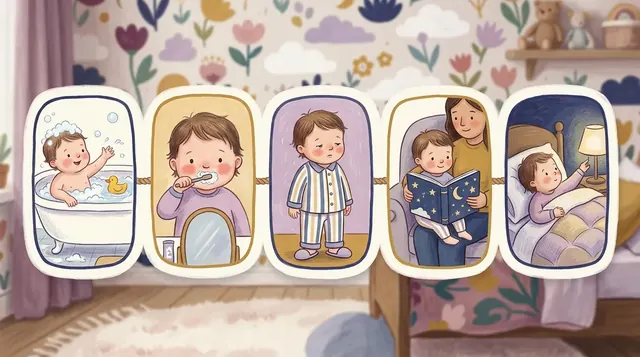
Five minutes for a toddler, ten for a preschooler or early reader, a chapter of a longer story for a child over eight. Those are the lengths that fit inside a half-hour routine and end before the child is overtired, and every story in this library is labelled with its read-aloud minutes so you can pick by the clock. But the number on the label is a ceiling, not a promise. The right length tonight is whatever ends before the yawns win, and the skill is learning to see that point coming.
The overtired cliff
A tired child gets sleepier and then, without warning, gets wired. Eyes go glassy, then suddenly bright; a child who was leaning on you sits up, giggles, kicks, wants to talk about diggers. This is the overtired cliff, and once a child has gone over it, sleep is twenty to forty minutes further away than it was five minutes before. A story that runs past the cliff does harm, however lovely it is.
The signs that the cliff is near are small and worth learning: a long yawn followed by a sudden burst of chatter, rubbing eyes and then rubbing them harder, a request for a drink or the toilet that comes out of nowhere. When you see them, finish the paragraph, close the book at the next natural pause, and say the goodnight words. You do not have to finish the story. Tell the child you will finish it tomorrow, and then do.
Length by age
These are working ranges, not rules. Every child is different, and the same child differs on a Monday and a Saturday. The age pages group the library's stories by these stages, with read-aloud minutes on each story card.
- Babies (0–12 months): two or three minutes. A rhyme or two, or the first page of anything, in a soft voice. They are listening to you, not the plot.
- Toddlers (1–3): three to five minutes. One short story or two or three rhymes, the same ones every night. Anything longer loses them, and a story they cannot follow does not calm them.
- Preschoolers (3–5): five to ten minutes. One real story with a beginning, a problem and an ending, or two short ones if the first was very short. This is the age where "one more" starts, so agree the number before you open the book.
- Early readers (5–8): ten minutes, occasionally fifteen. A full fairy tale or a fable with a conversation after. Children this age can follow a ten-minute story with a twist in the middle and still land calmly.
- Big kids (8–12): ten to fifteen minutes, as one chapter of a longer story. The story can be as long as you like; the nightly slice should not be.
How many words is that?
Reading aloud to a child, with pauses and voices, runs at about 130 to 160 words a minute, which is slower than adults read to each other and much slower than we read silently. So a 500-word story is a three-to-four-minute story, 1,200 words is about eight minutes, and 2,500 words is a quarter of an hour. The site's read-aloud minutes are calculated on this basis. If you are a naturally fast reader, and most parents are, the labels will run slightly short of your reading and you should slow down rather than pick a longer story.
The Boy Who Cried Wolf is a good calibration test: a complete story with a set-up, a repeat, and an ending, that reads in about four minutes at a proper bedtime pace. If you get through it in two, you are reading too fast for bedtime.
Five-minute stories are not a compromise
Parents sometimes treat a short story as a consolation prize on a rushed night. It is not, for two reasons. The first is that a child's sense of a satisfying story comes from its shape, not its length: a beginning, a problem, three tries, an ending. A four-minute fable with that shape feels complete; a ten-minute story cut off at page six does not. The second is that many of the world's oldest children's stories are short by design. Aesop's fables are two minutes long because they were built to be remembered and retold. The Hare and the Tortoise is not a short version of a longer story; it is the whole story, and it has been the whole story for two and a half thousand years.
The five-minute stories collection is made of complete tales, chosen because they end properly. Use it on the nights the routine has already run late, for toddlers, and for the second bedtime after a bad dream.
Ten minutes: the natural bedtime length
If there is a standard bedtime story, it is ten minutes long. That is enough for a real adventure with a twist in the middle and a calm landing, and short enough that the landing arrives before the cliff. Most of the classic fairy tales, in their bedtime versions, fall here: the shoemaker and the elves, the three bears, the princess and the pea. The ten-minute stories collection is the largest of the three, and it is where most families should be on an ordinary night with a child between four and eight.
The one caution with ten-minute stories is where the excitement sits. A story whose loudest moment is in the last paragraph, with no calm after it, leaves a child buzzing. Look for stories whose peril is in the middle and whose ending is a journey home, a feast, or a sleep. Most old tales are built that way, which is one reason they last.
Long stories: read the chapter, not the book
The long stories run from fifteen minutes to half an hour aloud, and they are the ones older children ask for. The rule is to read them a chapter at a time. The story-book mode on each page splits the tale into pages and chapters, so there is always a natural place to stop. Ending on a small cliffhanger is fine for a nine-year-old and a poor idea for a five-year-old; for the younger child, stop at a calm moment and recap in a sentence tomorrow.
Never start a long story on a night that has already gone late, and never read a full one to the end because the child begged. The story will be there tomorrow. A child who is asleep by eight will not be.
When the story ends too soon
The opposite problem is rarer but real: the story finishes, the child is nowhere near sleepy, and the room is silent with twenty minutes of wakefulness still to fill. This usually means the story was pitched too young, the bedtime is too early for this child, or the afternoon nap ran late. The wrong response is to reach for a second story, which teaches that the first one was not the end. The better response is to lengthen the calm without adding a plot: talk through one of the Talk about it questions from the story page, slowly; or sit with the lamp off and describe, in a quiet voice, what the characters are doing now that the story is over ("the tortoise is asleep under his leaf"). If it happens three nights running, move bedtime fifteen minutes later or shorten the nap. Length was not the problem; timing was.
When to stop early and how to do it
- Watch for the cliff signs from about the halfway point.
- Finish the sentence, then the paragraph if it is short.
- Say what happens next in one line. "The goats get across and the troll never bothers anyone again." Children need the ending, not the pages.
- Close the book and say the goodnight words exactly as usual.
- Tomorrow, start where you stopped, or start again if it was a short story; a toddler will not mind, and an older child will enjoy the recap.
Stopping early is not a failure of the routine. It is the routine working: the point of the story was to get the child to the edge of sleep, and it did. The broader shape of the evening around the story is covered in the bedtime routine guide.
Tonight
Check the read-aloud minutes at the top of the story page before you begin, and pick one that fits the time you actually have, not the time you wish you had. If it is already late, choose from the five-minute stories and read it slowly. If the evening is on schedule, The Boy Who Cried Wolf for a preschooler or a ten-minute fairy tale for an older child. Either way, stop at the first yawn that turns into a giggle.