Reading to two children of different ages works if you stop trying to find a story that suits both and instead pick one for the older child, then build the younger one a part in it. A six-year-old will not sit through a toddler's rhyme, but a two-year-old will happily sit through a six-year-old's fairy tale if they have something to do in it. Add a fair way of choosing, a fixed way of ending, and a short rhyme in reserve for the little one's last minute, and one story a night for both is not only possible but easier than two separate bedtimes.
Pitch it at the older child
Children stretch up to stories more readily than they stoop down to them. A younger sibling has spent their whole life watching an older one do more interesting things, and being allowed into the big story is a treat, even when half of it goes over their head; a story pitched too young, on the other hand, loses the older child by the second paragraph, and a bored older sibling is a disruptive one. So choose for the elder, within limits: nothing genuinely frightening if the younger is under four, and a length the younger can sit through, which usually means the ten-minute stories rather than a full chapter of a long one.
The library's age pages show suggested ages on every story card. For a pair three years apart, pick from the older child's page and check the younger's age against the range. Snow White and Rose Red is a good example for a six-year-old and a three-year-old: two sisters, a friendly bear, a bad-tempered dwarf who is funny rather than frightening, and a calm ending. The older child follows the plot; the younger one follows the bear.
Give the younger child a job
A toddler or preschooler who has a task in the story is a participant, not an audience, and participants do not wander off. The job depends on the age.
- Under two: pointing. "Where's the bear?" on each page. In story-book mode the big pictures and text make this easy.
- Two to three: the noises and the refrain. The troll's roar, the goats' trip-trap, "run, run, as fast as you can". Cumulative tales are full of these, while the nursery rhymes provide even shorter repeated lines.
- Three to four: the page turn, or the swipe in story-book mode, on a signal from you. This gives the youngest control of the pace, and the pause at each turn is where the older child's question fits.
- Four to five: a character's line. "You say what the mouse says." The younger child now has a voice in the story, and the older one, who has heard the tale before, gets to be the expert who prompts them.
Who chooses
Alternate strictly, night by night, and let everyone know whose turn it is before the routine starts. The chooser picks between two stories you have already approved for both ages, not from the whole library; a free choice produces a fight and a story the other child hates. The non-chooser gets the first job or the first cuddle. Over a week this comes out even, and children will police it for you: "It's my turn tomorrow" is the sound of a system working.
For the nights the chooser wants something the sibling cannot cope with, the rule is that the frightening story moves to a different time, not that it is refused. Read it to the older child on Saturday afternoon. Bedtime is for the story both can hear.
Where to sit and where to read
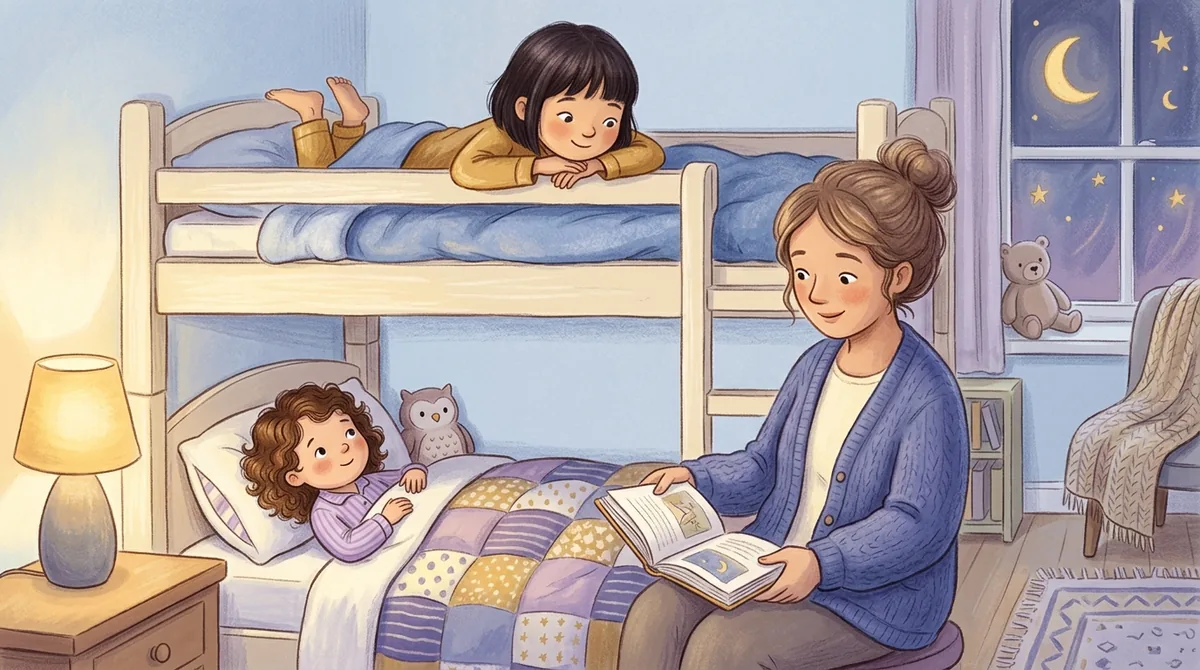
If the children share a room, read in it, with both in their beds and you between them, and the lamp on your side. If they have separate rooms, read in the younger child's, because the younger child is the one who needs to be in bed when the story ends, and the older one can walk to their own room. In story-book mode the text is large enough to be read from between two beds, and the night-light mode keeps the room dim enough that the younger child's slide towards sleep is not undone by the light.
Splitting the ending
The one place a shared story falls down is the end, because a three-year-old needs to be asleep twenty minutes before a seven-year-old does. Split it.
- The shared story ends at a calm point; for a long story, at the chapter break.
- The younger child's ending first. A short rhyme or two, the same every night, the goodnight sentence, the lamp on their side off. This is the reserve rhyme, and it is what makes the whole thing work: it gives the little one a ritual of their own inside the shared one.
- The older child's ending second, in a quieter voice. The last page of the story, or a page of a long one, then the goodnight sentence and the lamp off. If the rooms are separate, this happens in the older child's room; if shared, it happens in a whisper and the older child usually enjoys the privilege more than the page.
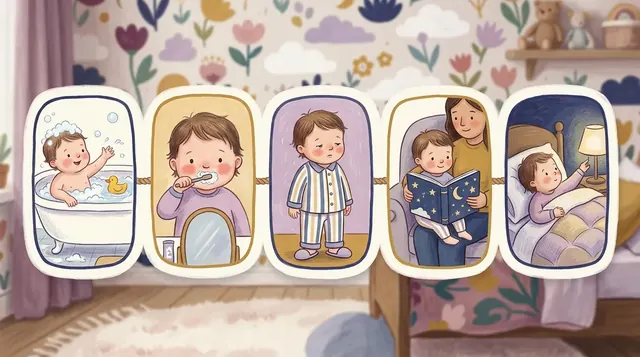
The full shape of a routine, and how the ending holds it together, is in the bedtime routine guide; with two children, the ending is the part to get right first.
Stories that are about being two
Siblings in fairy tales rescue each other from towers, witches and swans' feathers, which is a useful thing to hear the night after a fight over the last biscuit. The brothers and sisters stories collection gathers them, and the wider family stories theme has the tales of mums, dads and grandparents around them. For two who have been squabbling, The Bundle of Sticks is a three-minute fable in which a father shows his quarrelling sons that sticks tied together cannot be broken; the older child gets the lesson, the younger one gets to try to snap the sticks. Hansel and Gretel suits an older pair, six and up, who will notice that it is the sister who does the rescuing.
Gaps of five years and more
A ten-year-old and a four-year-old cannot share a story every night, and should not have to. Share two or three nights a week, with the older child sometimes reading to the younger; a ten-year-old reading a rhyme to a preschooler gets a great deal out of it, and so does the preschooler. On the other nights, run the younger child's bedtime first and give the older one a chapter of a long story afterwards, alone. The older child is being read to at the age when most children are not, and that half hour is worth protecting more than the shared one.
When one is ill, or away, or a baby
A new baby in the house is the commonest reason a shared bedtime breaks. The baby cannot join the story, and the older child, who has lost a good deal of attention that week, needs it more than ever. Feed the baby in the room during the story if you can; the older child gets the story, and the baby gets the voice. If one child is ill, read the shared story to both in the sick child's room and keep the ending the same. If one is away, read the same story anyway and tell the other about it tomorrow; the routine survives the absence better than the child would survive a gap.
Tonight
Decide whose turn it is to choose, and offer two stories. For a pair between three and seven, offer Snow White and Rose Red and The Bundle of Sticks. Give the younger one the bear's noises or the sticks to snap. End with a rhyme and the goodnight words for the little one first, and the last page for the older one in a whisper.