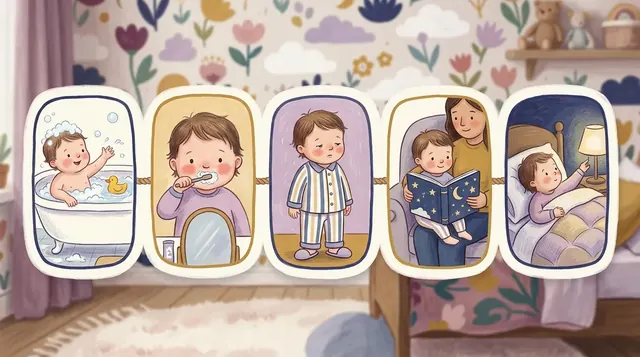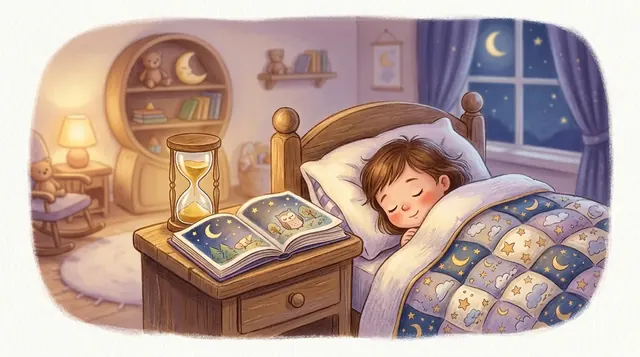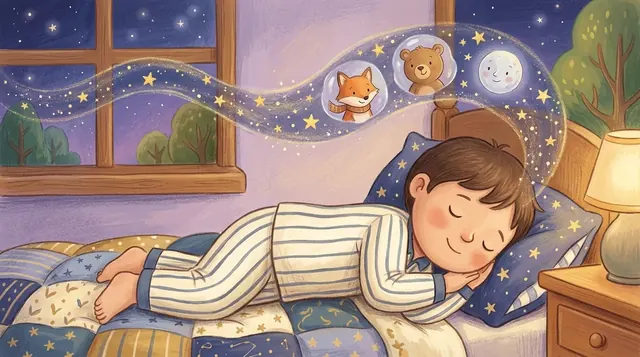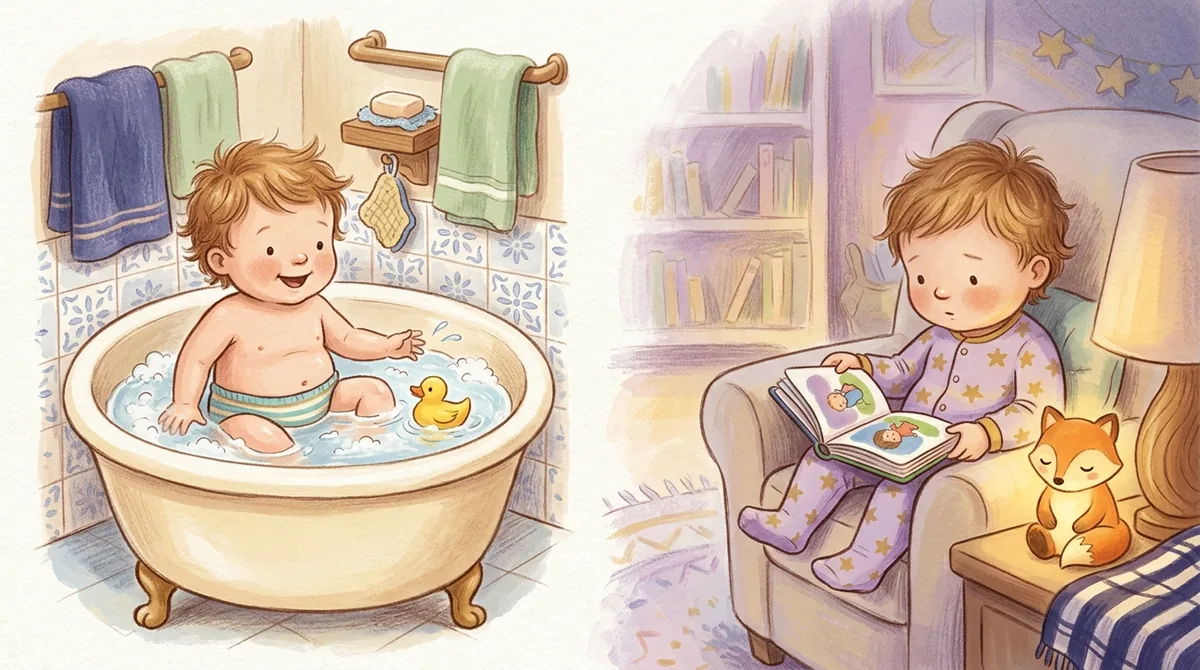
A toddler's bedtime routine is a shorter, simpler, more stubbornly repetitive version of the family routine: bath or wash, teeth, nappy or toilet, into the sleeping bag, two or three very short stories or rhymes, one song, one goodnight sentence, lights out. Twenty minutes from the bath to the dark, at the same time every night, with the same words, until the child could run it themselves. Toddlers cannot yet be reasoned with about bedtime, so the routine has to do the persuading, and it does that by being utterly predictable.
Why toddlers need something different
Three things about a one-to-three-year-old shape the routine. They have almost no sense of time, so a warning like "bedtime in ten minutes" means nothing unless it is attached to an event: "after this song, bath". They learn by repetition and are comforted by it, which is why they demand the same story every night and correct you when you skip a line. And they are testing the world for its edges, which is why a toddler who has been quietly cuddled through a story will suddenly stand up in the cot and shout. None of this is defiance. It is how a toddler finds out that the rules are real, and the routine's job is to answer the question the same way every night.
Toddlers also tip into overtiredness faster and harder than older children, and once they are over the edge they are almost impossible to settle. A toddler routine has to be short because the window is short.
The routine, step by step
- The signal (about 6.30). Not a time, an event. Curtains closed in the living room, the same phrase every night: "Bath time." Carry them if they resist; do not negotiate.
- Bath or wash (five to eight minutes). Warm, quick, calm. A single bath toy is fine. Talk in a low voice about what you are doing. If bath is a battle, a warm flannel and a fresh nappy is a perfectly good step.
- Teeth and nappy (three minutes). Teeth with a song, always the same song; toddlers tolerate a toothbrush better when it has a soundtrack. Nappy, pyjamas, sleeping bag.
- Into the cot or bed, lamp on, big light off. The story happens in the sleeping place, not on the sofa, so there is no move to make after it.
- Two or three short stories or rhymes (four to five minutes). The same ones. Rhymes are ideal because they are short, rhythmic and memorable; the nursery rhymes in the library are the right length and the right shape. Hey Diddle Diddle takes less than a minute and gives a toddler six silly lines to learn. If your toddler prefers a story, pick one from the five-minute stories and keep to it for a month.
- One song, lights out (two minutes). The same lullaby, sung while the lamp goes off. This is the true end of the routine and the child will learn it as such.
- The goodnight sentence. "Night night, love you, see you in the morning." Then leave, or sit quietly by the cot if that is your way, but do not restart anything.
The whole sequence is about twenty minutes. It can be shorter. It should not be longer.
The same story every night
You will be asked for the same story, and then the same story again, and then, when you try a new one, the same story. Read it. A toddler hearing a story for the twentieth time is not bored; they are learning it, and a story they know by heart calms them in a way a new one cannot, because there are no surprises. By the second week they will finish your sentences, and by the third they will tell you off for changing a word. Count that as success. The reasons this works, and how to keep your own sanity while it does, are in why children want the same story every night.
When you do want to introduce a new story, add it as the first of the two or three, and keep the favourite as the last. The last story is the one that sends them off, and it should be the one they know.
Choosing the two or three
Toddler stories need a strong rhythm, familiar animals, one gentle surprise and no real peril. Rhymes qualify by definition. Cumulative tales, where a line of characters joins in one by one, are perfect because each repeat is a chance for the child to join in. The Gingerbread Man works at two and three for the refrain alone, though pick the version whose fox is more mischievous than frightening. The library's stories for toddlers are filtered for exactly these qualities, and the fuller guide to what works at this age is bedtime stories for toddlers.
Naps set the bedtime
A toddler's bedtime is decided in the afternoon. A nap that ends after three o'clock will push sleep back, and a nap skipped entirely will produce an overtired child by half past five who is impossible by seven. Most toddlers need one nap of one to two hours in the early afternoon, and most give it up somewhere between two and a half and three and a half. In the weeks a nap is being dropped, bring bedtime forward by half an hour and expect the routine to be rockier than usual.
Rough total sleep for this age is eleven to fourteen hours in a day, naps included. If a toddler is waking at half past five, look first at whether the nap is too long or bedtime too early, and adjust by fifteen minutes at a time.
Standing up, shouting and getting out
At some point after the lamp goes off, the toddler will stand up and shout, or, once in a bed, get out and appear in the doorway. This is the test. The answer is the same every time: return them, without conversation, without eye contact if you can manage it, without cross words and without cuddles, and leave again. You may do this eleven times on the first night. It is usually three by the third night and none by the end of the week, provided the answer never changes. A single night of "all right, one more story" resets the count to eleven.
Distress is different from testing. A toddler who is crying hard, coughing, hot, or frightened needs you, and you go. The difference is usually obvious; a testing toddler stops the moment you appear, and a distressed one does not.
Teething, colds and the week it all goes wrong
Every toddler routine breaks about once a month, for a reason that has nothing to do with the routine: a tooth, a cold, a new nursery room, a trip to the grandparents. During the bad week, keep the shape and loosen the rules. Do the stories and the song at the usual time even if the bath is skipped and even if you end up sitting by the cot for half an hour. Comfort a poorly child as much as they need. What matters is that the stories and the song and the sentence still happen, in that order, so that when the tooth is through you have something to go back to. The first night after, run the routine exactly as before and expect one bad night of protest while the toddler checks whether the old rules have returned. They have. By the third night the routine usually is too.
Cot to bed
Most toddlers move from cot to bed between two and three, and the move often unsettles a routine that was working. Keep everything else the same: same time, same stories, same song, same sentence. Change only the sleeping place, and make the new bed boring, with nothing in the room worth getting up for. If the child is climbing out of the cot, move sooner; if they are not, there is no hurry, and a routine that works in a cot at two and a half is not broken.
Tonight
Choose the two rhymes or the one short story you will read every night for the next fortnight. Hey Diddle Diddle, Little Red Hen is a fine first choice, or any rhyme from the nursery rhymes page. Pick the song. Write the goodnight sentence down so that everyone who does bedtime says the same one. Start at the same time tomorrow, and the day after, and by the weekend the child will be reciting the routine back to you.