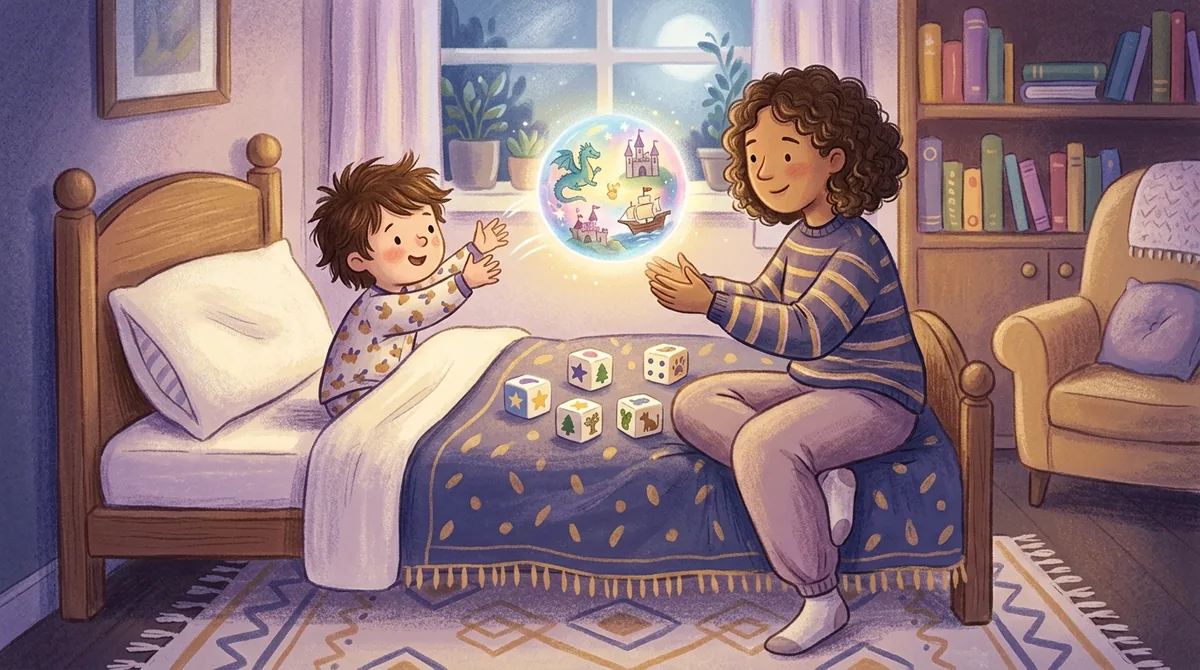
A storytelling game is a story with the child on the inside of it, and it solves two bedtime problems at once: the child who cannot stop talking and the parent who cannot think of anything to say. Below are ten games grouped by who they suit, each with the exact words to start it, an example of how it goes, and a way to end it, because ending is the hard part.
Three rules that make any game work at bedtime
First, agree the end before you begin. "We will do five 'and thens' and then it is goodnight." A game with no stated end will be negotiated for twenty minutes. Second, the parent keeps the ending. The child can invent the middle, the villain and the flying bathtub, but the last paragraph is yours, and it is always calm. Third, use the same closing line every night regardless of the game: "And that was the end of that, and everyone went to sleep." After a fortnight that sentence alone will make eyelids heavy. A child who wriggles and interrupts is not being difficult; they are asking to take part, and reading aloud to a child who interrupts explains why a game is often the better answer than a firmer "shush".
Games for the youngest (1 to 3)
1. What does it say?
The simplest game there is, and the one toddlers ask for most. You tell a tiny story in which every character is an animal, and you stop before each noise. "The cow walked into the barn and said..." The child supplies the moo. Build the story from the farmyard in Hey Diddle Diddle, Little Red Hen or from the animals on the child's pyjamas. Ending: the last animal is always the one that says "shhh".
2. The story of your teddy
Say: "Once upon a time there was a bear called Bear, and he lived in a bed just like this one." Tell the teddy's day, which is the child's day: breakfast, the park, the bath. Ask the child at each step, "And was Bear brave?" or "And was Bear sleepy?" The answer is always yes. Ending: Bear gets into bed with the child, and you tuck them both in with the same words.
3. Goodnight everything
Not quite a story, but the best wind-down game for this age. Point at things in the room in turn and say goodnight to them, and the child repeats. "Goodnight lamp. Goodnight curtains. Goodnight left foot." Get quieter as you go, and finish with the child's own name. Toddlers love it because there is nothing to get wrong.
Games for talkative children (3 to 8)
4. And then
The round-robin. You say one sentence, the child says the next, back and forth, each beginning "And then". Start it: "Once there was a rabbit who wanted to see the sea. And then..." Let the child go wherever they like for four or five turns. When it is your go and you want to land, say "And then the rabbit got so sleepy she lay down in the sand," and take the last two turns yourself. A five-year-old's version might run: "And then a shark came!" "And then the shark said sorry, it was only looking for its hat." "And then the hat was on the rabbit!" "And then the rabbit gave it back and they both had a lie down." Fine. Nobody said it had to make sense.
5. Three words
The child gives you three words and you must make a story that uses all of them. Say: "Give me a person, a place and a thing." You will get "a dinosaur, the supermarket, a sausage." Then tell it with three tries: the dinosaur wants a sausage, cannot reach the shelf, cannot fit through the door, and finally asks. Older children can be given the three words themselves and made to tell it. The constraint is the whole point; a child with a blank page freezes, a child with three words is already halfway there.
6. Fortunately, unfortunately
You alternate sentences, yours beginning "Fortunately" and the child's "Unfortunately". "Fortunately, the pig had built a very strong house. Unfortunately, the wolf had a hammer. Fortunately, the hammer was made of cheese." It is the three-little-pigs engine from Huffy Puffy Wolf turned into a game, and the pattern teaches, without saying so, that every problem in a story has an answer. You end it by taking two "fortunatelys" in a row.
7. The rule
Before the story starts, the child makes a rule the hero must not break: "Never go into the shed." You then tell a story in which the hero is drawn, step by step, towards the shed, and the child gets to shout "Don't!" at every step. Of course the hero goes in. What is inside is always something kind. This is the engine of Little Red Riding Hood and The Wolf and the Seven Little Kids, and children find it thrilling even when they made the rule themselves. Keep the thing in the shed harmless: a nest of kittens, a birthday cake, a grandmother with cocoa.
Games for tired parents (any age from 3)
8. The wrong story
Tell a story the child knows well and get it wrong on purpose. "Once upon a time there were three billy goats called Fluffy, Bob and... Sandwich." The child corrects you. Continue with the next mistake. The troll under the bridge is a duck; the third goat is the smallest; the bridge is over a bathtub. You do almost no inventing, because the child is doing the storytelling for you by supplying the right version. The Three Billy Goats Gruff and Goldilocks and the Three Bears are the best ones to get wrong, because their details are so fixed that every mistake is obvious. Let the last third be told correctly, at speed, and end on the real ending.
9. The interview
You are the reporter; the child is the hero of a story that happened to them today, or to their toy. "I am here with the famous explorer Maya, who this afternoon discovered a new kind of snail. Maya, tell us: where were you when you found it?" Ask only open questions and repeat their answers back as narration: "So the snail was under the slide. And what did you do?" When you have five or six answers, retell the whole thing as a story in one go, slowly, and add "and then Maya went to bed" at the end. This is the lazy parent's version of turning your child's day into a story, and it needs no invention at all.
10. Ending first
Tell the child the last line and ask them to work out how the story got there. "The last line is: and the elephant never wore a hat again. What happened?" The child tells the story backwards, or forwards, or in circles; it does not matter. When they run out, you say the last line, and that is the end. Eight-year-olds especially love this because it is a puzzle, and the problem-solving stories in the library make good source material: give them the last line of The Crow and the Pitcher, "and the crow drank," and see how many ways they can get water up a jug.
A game the classics have been playing for centuries
The cumulative tale is a storytelling game that got written down. The Enormous Turnip adds a puller every verse and repeats the whole chain each time; Henny Penny adds a bird every stop. Children can play this without knowing they are playing: you start the chain, they repeat it back and add one. "The farmer pulled the turnip. The wife pulled the farmer, and the farmer pulled the turnip. The..." By the time the mouse joins, every child in the room is chanting the list, and chanting a list is a very good way to get sleepy. Read the real one first, then play it with the child's own names.
How to end a game that will not end
Every one of these will overrun if you let it, so here is the exit. Warn once: "Two more turns." Take the last turn yourself, whoever's it was, and make it a sleepy one: the hero lies down, the sun goes down, the shed door closes. Then say your closing line, the same one every night, and stop talking. If the child keeps going, do not join in; say "That is a good idea for tomorrow" and turn out the light. The story will still be there in the morning, and so will the game.
Tonight
Start with game 8, the wrong story, because it needs nothing from you but a tale you both know. Read The Three Billy Goats Gruff tonight, straight, and tomorrow tell it wrong. If you would rather invent, the fifty story prompts supply the three words for game 5, and how to write a bedtime story shows the three-tries shape that every game above is quietly built on.