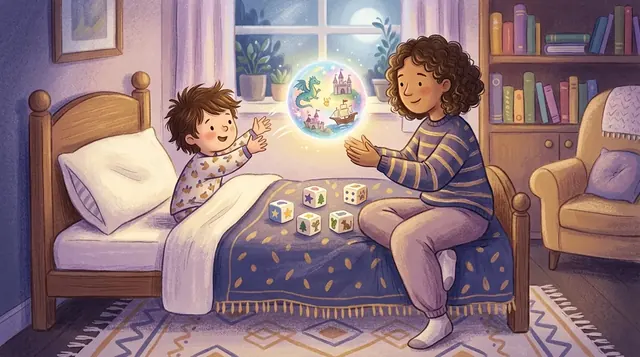
Retelling your child's day as a bedtime story, with them as the hero and the day's small troubles as the plot, does something "how was school?" never manages: it lets the child hear their own day from the outside, in the third person, with the problem solved and the ending calm. It needs no invention, because the material walked in through the door at half past three. What it needs is a shape, and a few rules about what to leave out.
Why "how was school?" fails and a story works
Ask a six-year-old how their day was and you get "fine", because the question is too big to answer and because answering it means reliving it. A story reverses both problems. It is small: one thing that happened, not the whole day. And it is not about them; it is about "a girl called Ada, who is a bit like you," which is far enough away that the hard part can be looked at. That distance is the trick every fable in the library uses. Nobody in The Boy Who Cried Wolf is the listening child, which is precisely why the listening child can take the lesson. Children will discuss a hedgehog's worry about the first day of school with a frankness they would never bring to their own.
There is a second reason it works. A day, as lived, has no ending; it just runs out. A story has one. Giving the lost water bottle or the argument at lunch a proper ending, even a slightly better one than really happened, is how the child files it away and stops turning it over at lights-out.
Three rules before you start
- Third person, close cousin. The hero is not "you". It is "a boy called Theo who lived on a street a lot like this one", or the child's own name with one small change (a tail, a hat that talks, a very large dog). The one-step distance is what makes it safe.
- One problem only. The day had twenty things in it. Pick the one that was still on the child's face at teatime, and leave the rest out, or use them as scenery.
- A real ending, or a better one. If the day's problem was solved, tell how. If it was not, solve it in the story the way it could have been solved, and say so lightly: "and that is what Ada did the next day."
Gathering the material without an interrogation
You cannot build the story at bedtime from nothing, so the collecting happens earlier, in the car, at the table, in the bath, with questions that are small enough to answer. Not "how was your day?" but:
- "Who did you sit next to at lunch?"
- "What was the thing that made everyone laugh?"
- "Was there a moment today when you thought, oh no?"
- "What did you do at the exact middle of the day?"
- "Did anybody get in trouble, and was it fair?"
Listen for the one answer that comes with a change of voice. That is your problem. Do not react to it; say "hm" and move on. It will be in the story in four hours, and by then it will have a solution.
The shape: four parts, with blanks
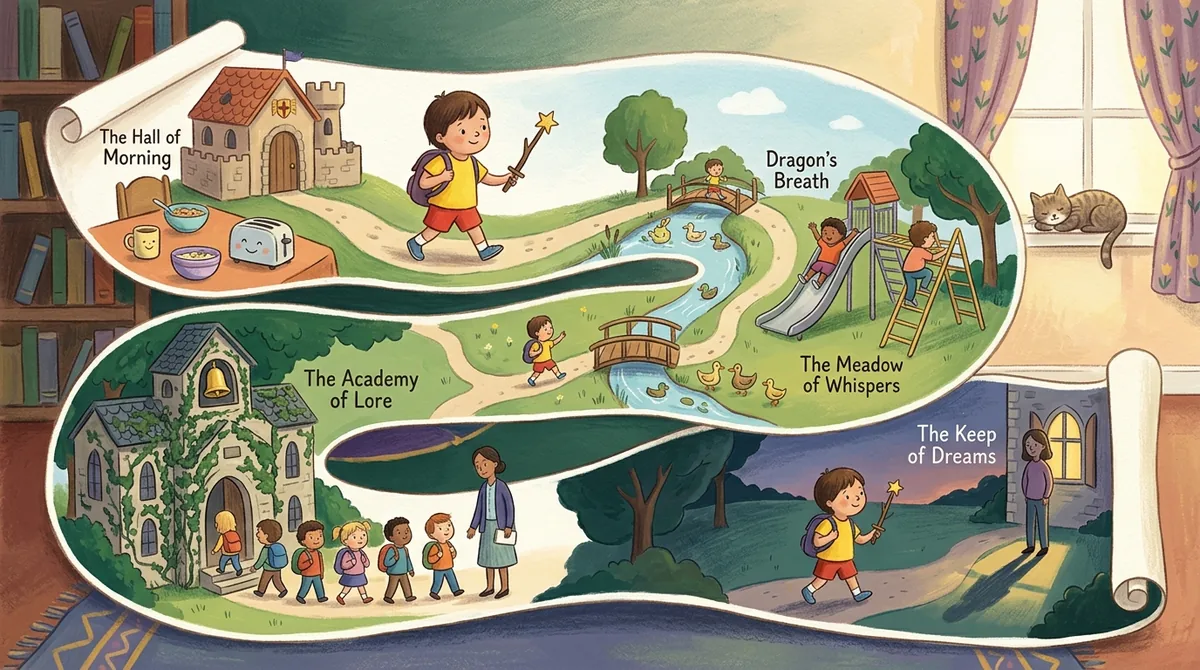
Fill this in silently while you brush their teeth. Each part is two or three sentences, and the whole thing is under five minutes.
- The morning: "One ______ morning, ______ woke up, and the first thing they did was ______." Use a true, trivial detail (the wrong sock, the toast) so the child recognises the day.
- The wobble: "But at ______, something went wrong. ______." State it plainly and briefly. Do not dramatise it; the child was there.
- The three tries: "First, ______ tried ______. Then ______. And in the end, ______." One of the tries can be what really happened. The one that works should be something the hero did, not something an adult fixed.
- The evening: "And then it was teatime, and ______ had ______, and had a bath, and got into bed, and the day was over, and it had been a good day, mostly." Finish with the real bedtime you are both in.
The four-part shape is the ordinary hero-problem-tries-landing shape from how to write a bedtime story, with the day supplying every blank. If you want the same thing without any true material at all, making up a story on the spot is the fully invented version.
A worked example: the lost water bottle
A five-year-old came home cross because his water bottle went missing and he had to drink from the tap "like a baby". That is the whole of the material. Told back that night it came out like this, about a hundred words:
One rainy Tuesday, a boy called Theo, who had a very good jumper with a fox on it, got to school and hung up his bag. But at playtime, when he went for a drink, his water bottle was gone. First he looked in his bag. Not there. Then he looked in his tray. Not there either. So Theo did a brave thing: he went up to Mrs Ellis and said, "I have lost my bottle, please may I use the tap?" And she said, "Of course, and I will look for it." And she found it in the wrong tray, and put it in his bag, and on Wednesday it was there.
Two things were changed. In real life he had not asked; he had drunk from the tap and stewed. In the story he asks, and it works, and he gets to hear himself doing it. Nobody said "next time, ask." The story said it for us, and he asked on Wednesday.
What to do with a hard day
A day with a fight, a telling-off or a friend who said "you're not my friend any more" needs more care, not less story.
A falling-out
Put both children in as animals. Two otters who both wanted the same rock. Tell it so that each otter has a reason, then let the hero-otter do the small thing that ends it: hand over the rock, or ask to share it, or just sit down next to the other one and say nothing. Keep it short. Then, and this is important, end with the two otters doing something ordinary together, because what the child needs to hear is that the friendship survived the afternoon. The stories about big feelings collection is full of this move: the feeling gets a creature, the creature gets through it.
A telling-off
Do not retell it. The story is not the place to make the point again, and a child who hears their misdeed narrated back at bedtime learns only that the story is a trap. Instead, tell a day in which the hero made a mistake in the morning and did something kind in the afternoon, and give the afternoon twice the words. The child needs to go to sleep as someone who is liked.
A worry about tomorrow
If the trouble is ahead, the trip or the test or the dentist, tell tomorrow as if it were already yesterday. "One Thursday, Ada went to the dentist, and the chair went up and down, which was the best bit, and the dentist counted her teeth and got to twenty, and then it was over and there was a sticker." Told in the past tense, tomorrow is survivable. This is the same thing The Anxious Leaf does with the arrival of autumn: the feared thing comes, and it turns out to be the flight the leaf was made for.
Big days: first day of school, a new baby, moving house
For the very large days, borrow a classic and put the child in it, rather than starting from scratch. The week before a first day of school, read something from the school and first-day stories, then tell the same story with the child's name and the actual school's name. A new baby is the moment for The Ugly Duckling told the other way round: the story of the older duckling, who was there first, and who is still the one the mother duck counts first every night. Moving house is a journey-and-return with no return, so give the hero something from the old house that comes too, and end the story with that thing in its new place on the new windowsill. These do not need to be original; they need to be true in the one way that matters, which is that the hero comes through.
What to leave out
- Teasing. The story must never get a laugh at the hero's expense. If the day was funny, the hero can be in on the joke, but not the butt of it.
- Anyone else's real name doing something bad. Friends and teachers get animal stand-ins if they were the problem. The child will still know who is meant, and so will the friend's parent, eventually.
- The moral. Theo asked for the tap on Wednesday without anyone saying "and so Theo learned to ask". Trust the story.
- Everything after the ending. When the hero is in bed, stop. Do not add "and tomorrow we have swimming". Tomorrow can wait.
Tonight
At teatime, ask one small question from the list and listen for the change of voice. At bedtime, read something short first if the day was ordinary, or go straight to the story if it was not. If you want a model of a day told back with the small problem in the middle and the calm at the end, Together We Are Good is a good one to read aloud first, and The Crow and the Pitcher is what a single small problem, solved by the hero's own effort, looks like in two minutes. Then say: "This is a story about a girl called Ada, who is a bit like you," and tell them their day.